How Associations and Nonprofits Are Using AI

Your team has a grant due Friday, a newsletter to send, and survey responses nobody has had time to read. That’s where associations and nonprofits are starting with AI
Organizations that benefit most from AI aren’t always those with the largest budgets or tech teams. Many start by improving one repetitive task, seeing what works, and expanding from there.
This guide covers how associations and nonprofits use AI today and some best practices for using AI at your organization.
How nonprofits and associations are using AI today
Most nonprofits and associations already use AI in some way. Research shows that 91% of executives use AI officially, and 88% of leaders think organizations that don’t adapt within two years will struggle to compete for donors. These numbers help explain why many organizations are already moving ahead with AI.
But how deeply organizations use AI varies. Only 29% of organizations use AI extensively. The most common uses are for communications, like writing emails, newsletters, and social media posts. Of those using AI, 36% use it to collect and analyze donor data, and 20% use it to predict donor behavior.
The report also found a leadership-driven gap. When boards strongly support AI, 59% of organizations use it frequently. When boards are more cautious, only 14% use AI. Researchers say board support is the main factor in separating organizations that benefit from AI from those that don’t. This leadership gap helps explain these examples, where support is already paying off.
Here are four places where nonprofits and associations are putting AI to work:
- Fundraising and donor engagement: Reaching donors most likely to give, with a message that fits them.
- Grant writing: Moving from a blank page to a solid first draft.
- Communications: Producing stories, emails, and updates at the pace donors expect.
- Operations and program delivery: Matching, triaging, and scheduling work that overwhelms small teams.
Real-world examples of nonprofits and associations using AI
The fastest way to understand what AI can do for a nonprofit or association is to look at the groups already using it.
| Use case | Example organization | AI application | Reported outcome |
| Operations | The Society for Imaging Informatics in Medicine (SIIM) | AI to automate key processes and streamline continuing education program | More than 15,500 training and professional development learners supported |
| Member engagement | American Hotel & Lodging Association (AHLA) | AI-supported tracking and engagement analysis | Advanced reporting, member engagement, and communications |
| Member services | American Society for Surgery of the Hand (ASSH) | AI-powered information access | AI and automated processes to provide 22,000+ members hundreds of resources for patients and practitioners |
These examples show that AI can help without replacing an organization’s current systems or staff.
AI for association and nonprofit fundraising and donor engagement
Fundraising is a strong area for nonprofit AI because organizations already have plenty of data about donors, campaigns, communications, and giving habits.
AI can help answer questions like:
- Which donors are most likely to respond to a particular appeal?
- Which one-time donors might be ready to become recurring donors?
- Which supporters appear to be disengaging?
- What message or story is most relevant to a particular audience?
- Which fundraising activities are using resources without producing comparable returns?
For nonprofits and associations, better targeting helps use limited resources more efficiently and avoids sending messages to donors who are unlikely to respond.
AI for grant writing
AI can help with grant writing, especially in small associations or nonprofits where one person might do everything from researching funders to writing applications, tracking deadlines, and managing reports.
AI can assist with:
- Researching potential funders
- Summarizing funding guidelines
- Comparing eligibility requirements
- Creating first drafts
- Reusing approved organizational language
- Identifying missing information
- Checking applications against requirements
- Organizing grant calendars
- Summarizing previous proposals and reports
AI handles the repetitive parts of grant writing. Your grant writer can have more time to add the context, evidence, relationships, and judgment that make a winning application strong.
AI for communications and marketing
You write newsletters, create social posts, update websites, craft donor appeals, promote events, develop reports, and respond quickly to new issues.
AI can save time in the marketing and communications process, making it easier to move from one task to another and to draft and adapt content more quickly. Common uses include:
- Turning long reports into executive summaries
- Creating first drafts of emails and social posts
- Adapting one piece of content for multiple channels
- Translating communications
- Summarizing research
- Brainstorming campaign concepts
- Creating interview or survey summaries
- Identifying recurring themes in qualitative input
The American Hotel & Lodging Association (AHLA) uses AI to improve communications within its online community and connect with over 32,000 members. Staff automated messages and reduced repetitive work, giving them more time to build an engaged member community and support ongoing loyalty.
AI for operations and program delivery
Some of the most valuable uses of AI in nonprofits and associations happen in the backend. For example, the American Society for Surgery of the Hand (ASSH) used AI to automate key processes and provide over 22,000 members with hundreds of resources for patients and practitioners.
The Society for Imaging Informatics in Medicine (SIIM) used AI to automate important processes and streamline continuing education programs for more than 15,500 learners. These examples show how AI can work in the backend, and they lead into the operations and program delivery tasks it can support.
AI can help your staff:
- Summarize meetings and documents.
- Analyze survey responses
- Sort and categorize big datasets
- Identify trends in program information.
- Automate regular administrative workflows.
- Prepare reports
- Search internal knowledge
- Translate materials
- Support forecasting and decision making
Other organizations use AI to analyze member engagement, summarize community discussions, research member organizations, and handle routine administrative work. In each case, AI can help staff work more efficiently and improve the member, donor, or volunteer experience.
What small associations and nonprofits are doing with AI
If your organization only has a few employees, a small tech budget, or no IT department, the examples above might feel out of reach. However, small nonprofits and associations do not need to begin with complex AI projects. Starting small is often best, and the first step is to look at the repetitive work your team already does.
In a recent nonprofit study, 60% of nonprofit executives rely on a single full-time staff member for all financial management and accounting. And 48% name repetitive administrative work as a top technology frustration. Another 42% cite manual data entry across multiple platforms. In the case studies above, these are the tasks AI effectively took over first, so staff had more time during their workday.
To effectively adopt AI at your organization you can ask yourself, where does your team do the following:
- Copy information from one system to another?
- Read hundreds of pages to find a few important details?
- Rewrite essentially the same information for different audiences?
- Search through old documents for an answer?
- Manually categorize responses?
- Spend hours preparing routine reports?
- Build communications from scratch?
All these tasks are good opportunities to start using AI. Start with one that you think could save your team the most hours and build on what you learn.
Common challenges associations and nonprofits face adopting AI
Nonprofits and associations have real reasons to be cautious about using AI, even when the earlier examples seem promising.
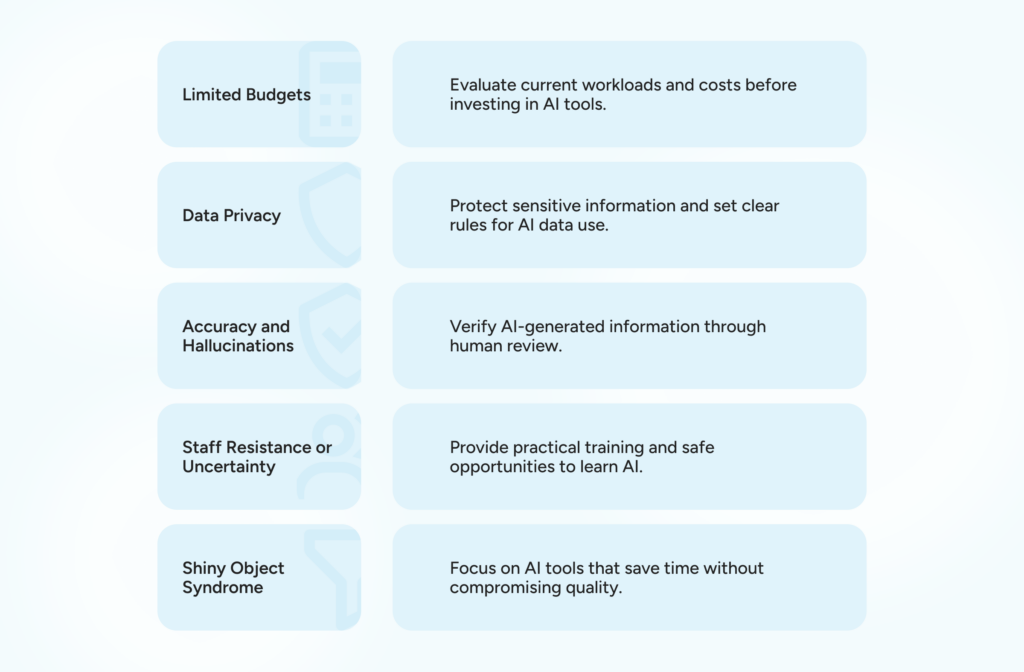
1. Limited budgets
AI tools range from free consumer apps to expensive enterprise platforms. Start with the problem.Thenpicka tool. Estimate how much staff time the current process takes, then decide whetheran AI solution could reduce that workload.
2. Data privacy
Nonprofits and associations often handle sensitive information about donors, members, clients, volunteers, children, patients, or communities. Do not put confidential or personally identifiable information into an AI tool unless you know how it will be handled. Set clear rules for what staff can and cannot enter into AI systems.
3. Accuracy and hallucinations
AI can sometimes produce incorrect information with confidence. For high-risk work, set up a human review process. The more important the decision, the more critical the review.
4. Staff resistance or uncertainty
People may worry that AI will replace their jobs or may not know how to use it. Training should focus on practical workflows, not just the technology. Give staff safe opportunities to try AI and share what they learn.
5. Shiny object syndrome
AI is changing quickly, but you don’t need every tool. The best question to ask is, “Where could AI give our team time back without lowering our standards?”
How to choose your first AI use case by organization size and capacity
The right place to start using AI depends on several factors, including your organization’s size, data readiness, risk tolerance, and staff capacity. Use those factors to guide your first choice.
Small or grassroots organization
Start with communications, research, administrative tasks, or grant-writing support. Look for a repetitive workflow that one or two people currently handle manually.
Goal: Save staff time without adding significant risk.
Mid-sized nonprofit or association
Start with fundraising insights, donor segmentation, reporting, workflow automation, or program-data analysis. At this stage, you may have enough historical data to move beyond simple generative AI and begin using predictive insights.
Goal: Make better decisions and work more efficiently.
Large nonprofit or association
Start with organization-wide data insights, member or donor engagement, predictive modeling, service delivery, or integrated workflow automation. Larger organizations can also invest in administrative frameworks, data infrastructure, training, and cross-functional AI teams.
Goal: Link AI to your organization’s goals and measurable results.
Any organization
Regardless of your size, ask five questions before implementing an AI use case:
- What problem are we trying to solve?
- How much time, money, or capacity does that problem currently consume?
- What data would AI need to solve it?
- What could go wrong, and who should review the results?
- How will we measure whether the experiment worked?
Definewhat success looks like before you start: hours saved, higher response rates, more completed applications, donors retained, or members engaged.
Is it safe and ethical for associations and nonprofits to use AI?
Nonprofits and associations can use AI responsibly, but it requires more than just choosing the right software. Responsible AI use starts with guidelines on:
- Data privacy and security
- Human monitoring
- Accuracy and fact-checking
- Bias and equity
- Intellectual property
- Transparency
- Appropriate use of AI-created content
- Accountability for AI-assisted decisions
That’s true whether you are a national association or a small community nonprofit. AI can help with the work, but people are still responsible for the results.
Putting AI to work with MomentiveIQ
You’ve seen how other nonprofits and associations use AI. Now it’s your turn to see what AI can do for your organization. MomentiveIQ is built specifically for nonprofits and associations. It helps organizations put AI to work across time-consuming workflows, surface predictive insights, and support more knowledgeable decision-making.
With more decades of experience working with nonprofits and associations, Momentive Software helps organizations move from testing AI to finding where it can make a real difference with MomentiveIQ.
FAQs
Nonprofits use AI for fundraising, donor engagement, grant research and writing, communications, data analysis, administrative automation, reporting, and program delivery. Associations also use AI to improve member engagement, personalize communications, analyze member data, and make information easier to access.
Nonprofits can use AI for fundraising to encompass the entire fundraising workflow. Your nonprofit or association team can use AI to identify at-risk donors, build an outreach sequence, and track results.
Yes. Small organizations can begin with relatively simple applications such as drafting communications, summarizing research, organizing information, researching grants, and automating administrative work. The key is to choose a clearly defined problem and measure whether the AI application actually saves time or improves an outcome.
Nonprofits and associations can use a range of generative AI tools and custom AI applications for grant research, eligibility screening, proposal drafting, compliance checks, and organizing institutional knowledge.
Yes, if organizations put appropriate safeguards in place. Nonprofits and associations should consider privacy, data security, accuracy, bias, intellectual property, transparency, and human review before using AI—especially when involving sensitive information or high-stakes decisions.
Start with a problem your organization is trying to solve. Next, look for a repetitive, measurable workflow where AI could save meaningful time, enhance decision-making, or increase capacity without creating unacceptable risk. Then define success metrics, establish human oversight guidelines, and test the use case on a manageable scale before expanding it.
Struggling to keep your volunteer program organized? Discover what volunteer management software can do for your organization.