


Grant writing has long required nonprofits to balance several demands, including finding the right opportunities, understanding complex requirements, telling a persuasive story, collecting accurate data, and submitting everything before the next deadline.
Artificial intelligence (AI) is handling the parts that don’t require human judgment — prospecting, drafting, and formatting — so grant writers can focus on the parts that require their expertise.
But if you’ve searched for AI grants for nonprofits or associations, you’ve probably noticed the term has two different meanings. Some organizations are looking for grants and funding programs specifically designed to support AI initiatives. Others want to know whether AI grant writing tools for nonprofits can help them find opportunities and write stronger proposals.
This guide briefly covers the funding-program side of the equation before focusing on the question most nonprofit grant writers are asking: How can AI help your nonprofit or association find more relevant grants and produce better applications without jeopardizing accuracy, authenticity, or human decision-making?
What “AI Grants for Nonprofits” Really Means
AI can take repetitive work off your plate. It can speed up grant prospect research, find potential funding matches, organize requirements, generate first drafts, and help refine repetitive sections. However, AI cannot replace the person who understands your organization’s community, relationships, programs, and impact.
When it comes to learning how AI can apply to grant writing, the phrase AI grants for nonprofits can refer to two very different things, including the following:
1. Funding programs that support AI and technology initiatives
Some technology companies, foundations, and philanthropic organizations offer funding programs designed to help mission-driven organizations explore or implement AI. Other technology companies and foundations periodically offer nonprofit technology grants, cloud credits, training, or funding opportunities related to digital transformation.
These programs can be valuable, but eligibility, application windows, and funding priorities change frequently. If your nonprofit is specifically seeking funding to adopt AI, build technical capacity, or develop an AI-enabled program, you can monitor opportunities directly from major technology funders and philanthropic organizations.
2. AI tools that help nonprofits find and write grants
The second meaning is becoming increasingly important for development teams. These are the tools that use artificial intelligence to support activities like the following:
- Grant prospect research
- Funder discovery
- AI grant matching
- Eligibility screening
- Proposal describing
- Narrative drafting
- Editing and rewriting
- Logic model development
- Deadline and application tracking
This is where AI grant writing for nonprofits and associations becomes less about chasing a futuristic technology trend and more about solving a practical problem: doing more high-quality grant work with limited time and staff capacity.
The Grant Writer’s Reality: Shrinking Budgets, More Competition, Too Many Deadlines
Teams spend hours evaluating funder priorities, eligibility requirements, geographic restrictions, award histories, deadlines, and alignment with organizational programs.
Then comes the application itself.
Grant writers may need to pull information from annual reports, program evaluations, budgets, strategic plans, previous proposals, CRM systems, and conversations with program staff. The same organization may be describing similar work repeatedly—but each funder asks different questions, uses different terminology, and prioritizes different outcomes.
Most of the work isn’t just writing. It’s finding, organizing, verifying, adapting, and managing information. That’s where AI can help.
The best AI tools for nonprofit grant writing reduce time spent on repetitive administrative and drafting tasks so grant professionals can focus on strategy, storytelling, and funder relationships.
Two Jobs AI Can Do: Finding Grants vs. Writing Them
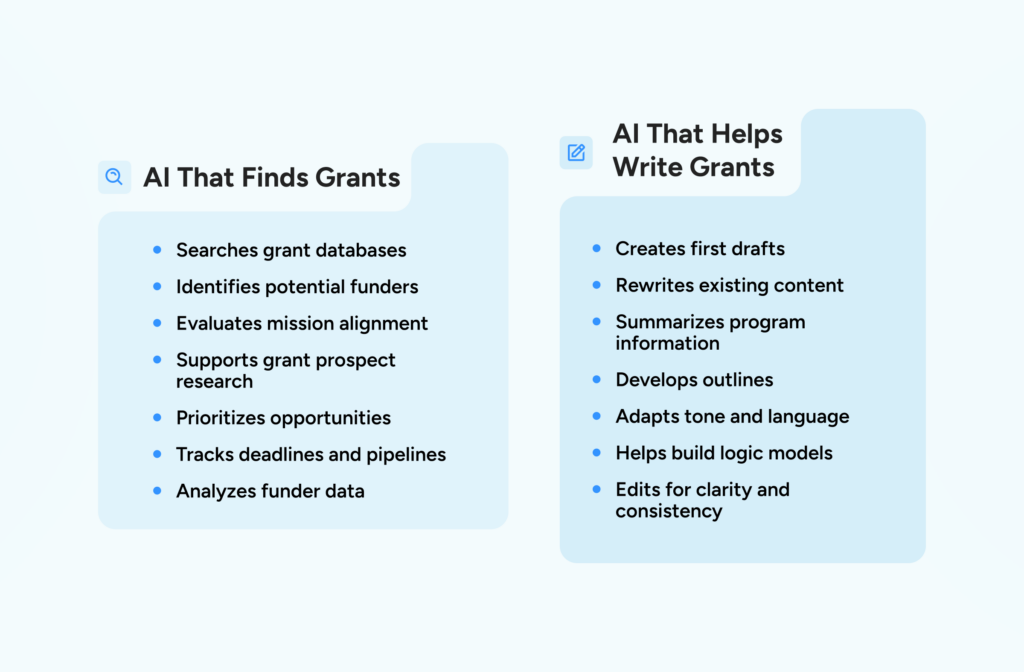
The tools fall into two categories:
| AI That Finds Grants | AI That Helps Write Grants |
| Searches grant databases | Creates first drafts |
| Identifies potential funders | Rewrites existing content |
| Evaluates mission alignment | Summarizes program information |
| Supports grant prospect research | Develops outlines |
| Prioritizes opportunities | Adapts tone and language |
| Tracks deadlines and pipelines | Helps build logic models |
| Analyzes funder data | Edits for clarity and consistency |
Some platforms focus primarily on one side of the workflow. Others are beginning to combine grant discovery, writing assistance, and application management.
Ask which is your bigger bottleneck — finding grants or writing them?
If your biggest challenge is, “We don’t know where to look for funding,” prioritize AI to find nonprofit grants. If your biggest challenge is, “We have opportunities but can’t keep up with applications,” an AI writing assistant may be more useful. If both problems are limiting your capacity, a more integrated AI-driven grant writing and management platform may make sense.
AI Tools That Find and Match Grants
More teams are already there. According to the latest Association Trends Report, 38% of professionals prioritize AI tools at their organizations. Over half (57%) of the surveyed professionals used AI tools to generate content at their associations.
AI-assisted grant discovery tools make grant prospect research faster and more targeted. Instead of manually reviewing hundreds of opportunities, these platforms can help organizations filter opportunities based on factors such as mission area, geography, organization type, program focus, and historical funder activity.
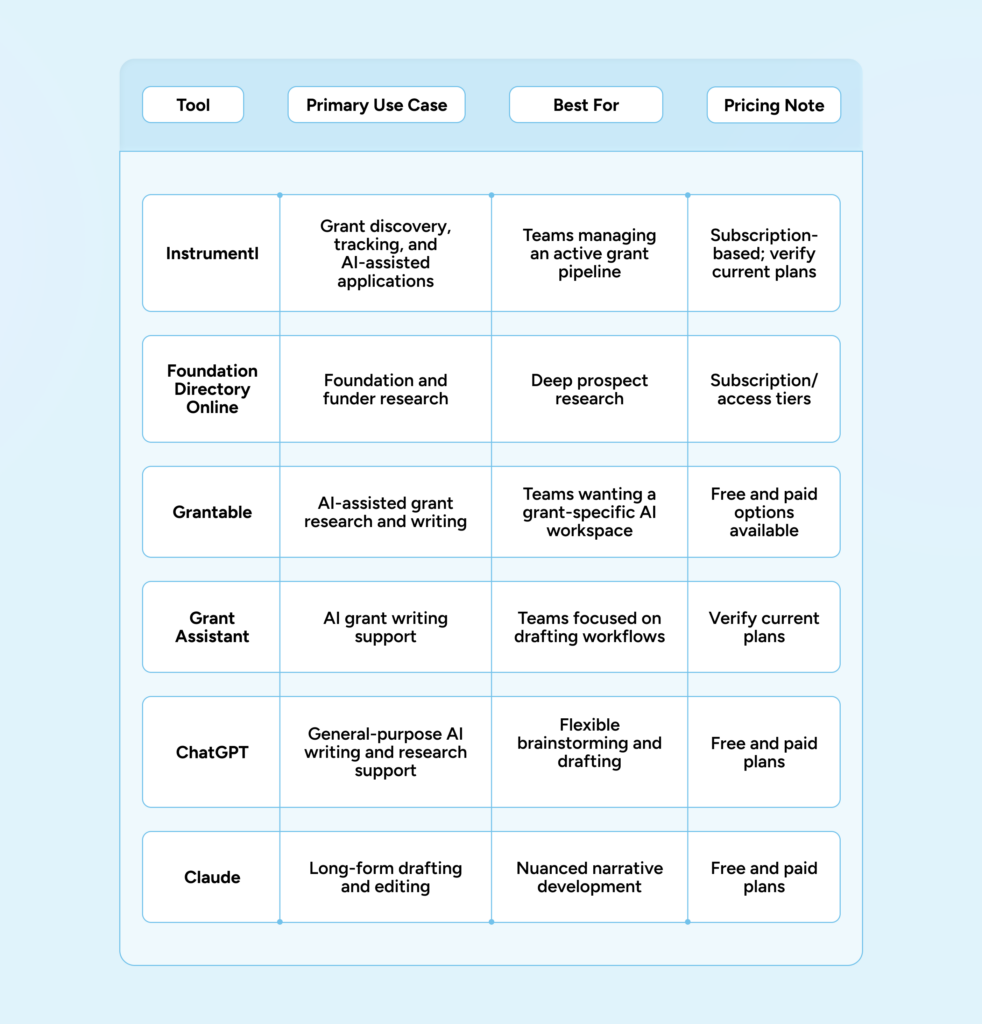
Here are the tools nonprofit teams commonly evaluate:
| Tool | Primary Use Case | Best For | Pricing Note |
| Instrumentl | Grant discovery, tracking, and AI-assisted applications | Teams managing an active grant pipeline | Subscription-based; verify current plans |
| Foundation Directory Online | Foundation and funder research | Deep prospect research | Subscription/access tiers |
| Grantable | AI-assisted grant research and writing | Teams wanting a grant-specific AI workspace | Free and paid options available |
| Grant Assistant | AI grant writing support | Teams focused on drafting workflows | Verify current plans |
| ChatGPT | General-purpose AI writing and research support | Flexible brainstorming and drafting | Free and paid plans |
| Claude | Long-form drafting and editing | Nuanced narrative development | Free and paid plans |
Features and pricing can change. Verify existing capabilities, security practices, and costs directly with any potentialproviders.
Instrumentl
Instrumentl has long focused on helping nonprofits discover and manage grant opportunities. Its platform combines funder research, opportunity tracking, deadline management, and AI-assisted application capabilities.
Its newer AI functionality helps teams generate and refine application responses using organizational documents and funder insights.
Best fit: Organizations with an established grant program that need stronger prospecting and pipeline management alongside writing assistance.
Keep in mind: Teams should evaluate pricing and feature availability against the volume of grants they pursue.
Foundation Directory Online
Foundation Directory Online from Candid is primarily a funder research resource, not an AI writing platform. It can be particularly useful for organizations performing detailed research into foundations, grantmaking history, and philanthropic priorities.
Best fit: Grant professionals who need deep prospect intelligence and are comfortable handling proposal development separately.
Keep in mind: A strong research database doesn’t automatically solve the writing or workflow management side of grant development.
Grantable
Grantable is designed specifically around the grant-seeking workflow, combining AI-assisted proposal development with funder discovery and organizational content management. Its approach stresses using an organization’s existing materials to support proposal drafting.
Best fit: Nonprofits looking for a purpose-built grant workspace rather than a general AI chatbot.
Keep in mind: Review how the platform handles source data, organizational knowledge, collaboration, and pricing before adopting it.
AI Writing Assistants for Narratives, Outcomes, and Logic Models
The second category of AI grant writing tools for nonprofits and associations focuses on generating and improving content.
General-purpose AI assistants such as ChatGPT and Claude can be useful throughout the writing process. They don’t inherently know your organization or your funder’s requirements, but they can help transform information you provide into usable drafts.
For example, AI can assist with:
- Creating a proposal outline from an RFP
- Turning program notes into a first narrative draft
- Summarizing research
- Rewriting technical language for a general audience
- Creating multiple versions of an executive summary
- Identifying repetitive language
- Drafting outcome statements
- Brainstorming logic model components
- Editing for precision and brevity
- Checking whether a response tackles every question
ChatGPT
ChatGPT can serve as a flexible writing assistant for brainstorming, outlining, rewriting, and editing.
Best fit: Teams that want an accessible, general-purpose AI tool and are willing to provide strong source material and detailed prompts.
Strength: Versatility. It can help across many stages of the grant-writing process.
Limitation: It is not a dedicated grant database or funder intelligence platform. Human review is vital to verify every verifiable statement, statistic, eligibility claim, and funder-specific detail.
Claude
Claude is particularly useful for working with longer documents and refining nuanced writing. For nonprofit teams, it can support grant narratives, case statements, impact stories, and other long-form communications. Momentive’s overview of nonprofit AI tools also identifies Claude as useful for nuanced content development and grant writing workflows.
Best fit: Teams working with substantial amounts of source material or developing complex, long-form narratives.
Limitation: Like other general AI tools, it needs accurate source information and clear human direction.
Grant-specific AI writing platforms
Purpose-built tools such as Grantable and Instrumentl aim to combine general AI capabilities with grant-specific workflows, including organizational data libraries, application requirements, funder information, and proposal management.
This category may be particularly useful for teams that write grants frequently and want to reduce the amount of manual context-setting required for every new application.
Where AI Shines vs. Where Human Expertise Is Still Essential
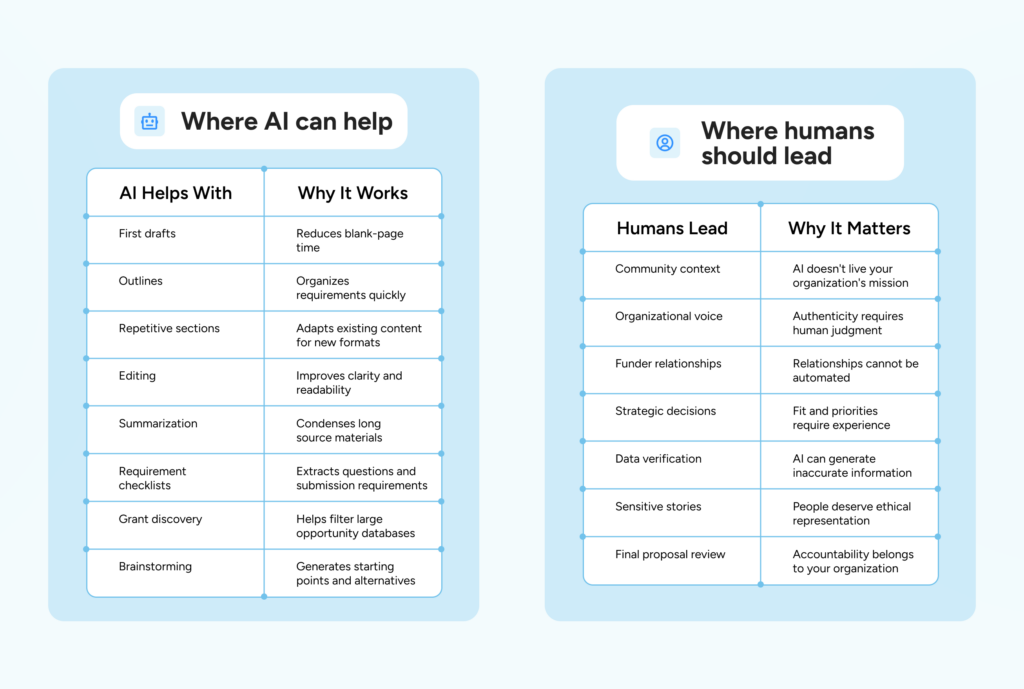
AI can improve the grant-writing process, but it is not equally good at every task. Here are some ways AI tools can help and some ways in which human experience is still essential:
Where AI can help
| AI Helps With | Why It Works |
| First drafts | Reduces blank-page time |
| Outlines | Organizes requirements quickly |
| Repetitive sections | Adapts existing content for new formats |
| Editing | Improves clarity and readability |
| Summarization | Condenses long source materials |
| Requirement checklists | Extracts questions and submission requirements |
| Grant discovery | Helps filter large opportunity databases |
| Brainstorming | Generates starting points and alternatives |
Where humans should lead
| Humans Lead | Why It Matters |
| Community context | AI doesn’t live your organization’s mission |
| Organizational voice | Authenticity requires human judgment |
| Funder relationships | Relationships cannot be automated |
| Strategic decisions | Fit and priorities require experience |
| Data verification | AI can generate inaccurate information |
| Sensitive stories | People deserve ethical representation |
| Final proposal review | Accountability belongs to your organization |
Treat AI as a junior research and writing assistant. It can help you prepare, but it should not have the authority to submit.
How to Prompt an AI Tool to Sound Like Your Organization, Not a Robot
Generic prompts produce generic output. Compare these two prompts:
Weak prompt:
Write a grant proposal explaining why our nonprofit needs funding.
Stronger prompt:
You are assisting a nonprofit grant writer. Using only the information below, draft a 400-word needs statement for a community health program. Maintain a warm, evidence-based tone. Do not invent statistics, outcomes, partnerships, or services. If information is missing, insert [VERIFY] rather than making assumptions. Our organizational voice is clear, human-centered, and specific.
For better results, give an AI tool the contextual, specific information it actually needs.
A practical prompt framework for nonprofit grant writing
Include these five elements in your prompt:
1. Your organization
Explain your mission, history, audience, geography, and programs.
2. The funder
Provide the grant guidelines, priorities, eligibility requirements, and evaluation criteria.
3. The assignment
Specify exactly what you need: an outline, 250-word response, logic model, executive summary, or editing pass.
4. The source material
Paste approved facts, statistics, outcomes, and previous messaging.
5. The guardrails
Tell the AI what it must not do. For example:
Do not invent facts. Do not claim outcomes we cannot verify—flag missing information. Preserve names and statistics exactly as provided. Use plain language. Avoid generic phrases such as “transformative impact” or “game-changing.”
The goal of AI grant writing for nonprofits shouldn’t be more words. It should be help your team create a stronger starting point for thoughtful human edits and additions.
Funder Policies on AI-Generated Content — and How to Disclose Your Use
One of the most common questions around AI nonprofit funding applications is whether funders allow AI-created content. There’s no universal rule; it depends on the funder.
Some funders may not address AI use at all. Others may require applicants to disclose generative AI assistance, prohibit certain uses, or establish rules around confidentiality and authorship.
Before using AI on an application:
- Read the funder’s current application guidelines.
- Search the funder’s website for AI or generative AI policies.
- Review the application terms and certifications.
- Ask the funder directly if the policy is unclear.
- Follow disclosure requirements exactly.
Even when disclosure isn’t required, your organization still is responsible for every statement submitted in the application.
A clear internal policy should distinguish between acceptable assistance—such as brainstorming, outlining, grammar editing, and summarization—and higher-risk uses involving confidential information, beneficiary data, financial records, or unchecked claims.
A simple disclosure approach
If disclosure is requested, be transparent and brief. For example:
Generative AI was used as a writing and editing assistant while preparing this application. Organizational staff reviewed, verified, and approved all content.
Don’t assume this wording satisfies every funder. Follow the language and requirements specified by the grant maker.
Is It Safe to Put Your Organization’s Data Into AI Grant Tools?
Make security part of your AI evaluation process from the beginning. Grant applications can contain sensitive information, including the following:
- Financial data
- Program budgets
- Personally identifiable information
- Beneficiary stories
- Internal strategy documents
- Partnership information
- Unpublished research
Before uploading organizational materials into an AI platform, review:
- Data retention policies
- If your content is used to train models
- Encryption and security practices
- User permissions
- Administrative controls
- Data deletion processes
- Third-party integrations
- Contract terms
Your team should also form clear rules about what information staff can and cannot enter into your AI tools.
The best AI tool for nonprofit grant writing is not necessarily the one that produces the fastest draft. It should also fit your organization’s security requirements and governance practices.
Getting Started With AI Grant Work Responsibly
Start with one repetitive, low-risk task. For example, follow these simple tasks:
Step 1: Choose a workflow bottleneck
Ask your team these questions:
- Are we spending too much time finding grants?
- Are we struggling with first drafts?
- Are deadlines falling through the cracks?
- Are we rewriting the same organizational information repeatedly?
Step 2: Test AI with approved content
Use information that has already been reviewed and approved, such as public website copy, annual reports, or successful past proposals where appropriate.
Step 3: Create a human review process
Review every AI-generated output for the following functionality:
- Accuracy
- Funder alignment
- Tone
- Completeness
- Confidentiality
- Unsupported claims
Step 4: Build reusable prompts
Save prompts that work well for recurring tasks such as:
- Needs statements
- Program descriptions
- Outcome summaries
- Proposal outlines
- Editing passes
Step 5: Measure whether the tool saves time
Don’t evaluate AI based on how impressive a first draft looks. Evaluate whether it helps your team:
- Research opportunities faster
- Reduce administrative work
- Improve consistency
- Meet more deadlines
- Spend more time on strategic grant development
AI should free up your staff — not add another tool to manage.
For more guidance on building a wider nonprofit AI strategy, explore our guide to AI tools for nonprofits.
Winning the grant is only the first step. Effective nonprofit grant management is just as important for tracking obligations, demonstrating stewardship, and supporting future funding opportunities.
Put AI to Work Across Your Whole Nonprofit
Grant-specific tools can help your team draft proposals and find funding opportunities. But grant writing is only one part of the work required to advance your mission.
MomentiveIQ puts AI to work across the systems that support the work behind every grant, helping organizations automate regular tasks, surface predictive insights, and keep AI-driven actions governed and auditable. Built for nonprofits and associations on more than 40 years of sector knowledge, MomentiveIQ helps teams spend less time navigating disconnected tools and more time acting on meaningful information.
Unlike the grant-specific tools reviewed above, MomentiveIQ serves as a broader AI layer across nonprofit and association operations—not another standalone grant-writing point solution. If you’re exploring how AI can support fundraising, engagement, operations, and decision-making throughout your organization, see MomentiveIQ in action.
FAQ
Can you use AI to write grant proposals?
Yes. AI can help write grant proposals by generating outlines, creating first drafts, rewriting existing content, summarizing source material, and editing for clarity.
However, don’t treat AI as an autonomous grant writer. Human experts should verify facts, provide organizational context, ensure funder alignment, and review every final submission. The strongest workflow uses AI to accelerate preparation while keeping strategy and accountability with your nonprofit and association team.
Do funders allow AI-written grant applications, and do you have to disclose it?
Policies vary by funder. Some grant makers may allow AI-assisted writing without specific restrictions, while others may require disclosure or prohibit certain uses.
Always review the funder’s current guidelines before using AI. If disclosure is required, follow the funder’s instructions. Even if AI assistance is permitted, your organization remains responsible for the accuracy and integrity of the final application.
What’s the best AI tool for nonprofit grant writing?
No single tool works best for every nonprofit. The right option depends on where your team needs the most support.
General-purpose AI tools can help with drafting and editing. Grant-specific platforms may combine AI writing with funder discovery, application requirements, and pipeline management. Research-focused databases can support deep grant prospect research.
Before choosing a tool, identify your biggest challenge, including finding grants, writing applications, managing deadlines, or maintaining organizational knowledge across the grant process.
Can AI help find grants my nonprofit actually qualifies for?
Yes. AI-enhanced grant discovery platforms can help filter and prioritize opportunities based on information such as your organization’s mission, location, programs, population served, and funding history.
However, treat AI grant matching as a starting point, not a final eligibility determination. A staff member should always review the complete funder guidelines before spending time on an application.
Is it safe to put my organization’s data into AI grant tools?
It depends on the platform and the type of information being shared. Before uploading organizational data, review the provider’s security practices, data retention policies, training policies, permissions, and contract terms.
Nonprofits and associations should also establish internal AI governance guidelines that define what information can be entered into approved tools. Avoid sharing confidential or sensitive information unless your organization has evaluated and approved the platform for that use.