AI Strategy for Nonprofits: Build a Roadmap That Ships

AI use jumped from 21% to 91% in a single year, but adoption and operationalization are different. Nonprofit leaders know AI matters, and the race to utilize it properly is underway.
Organizations need a plan to ensure they’re using the right AI tools. Eighty-eight percent of executives say orgs that don’t close that gap in two years will struggle to compete for donors.
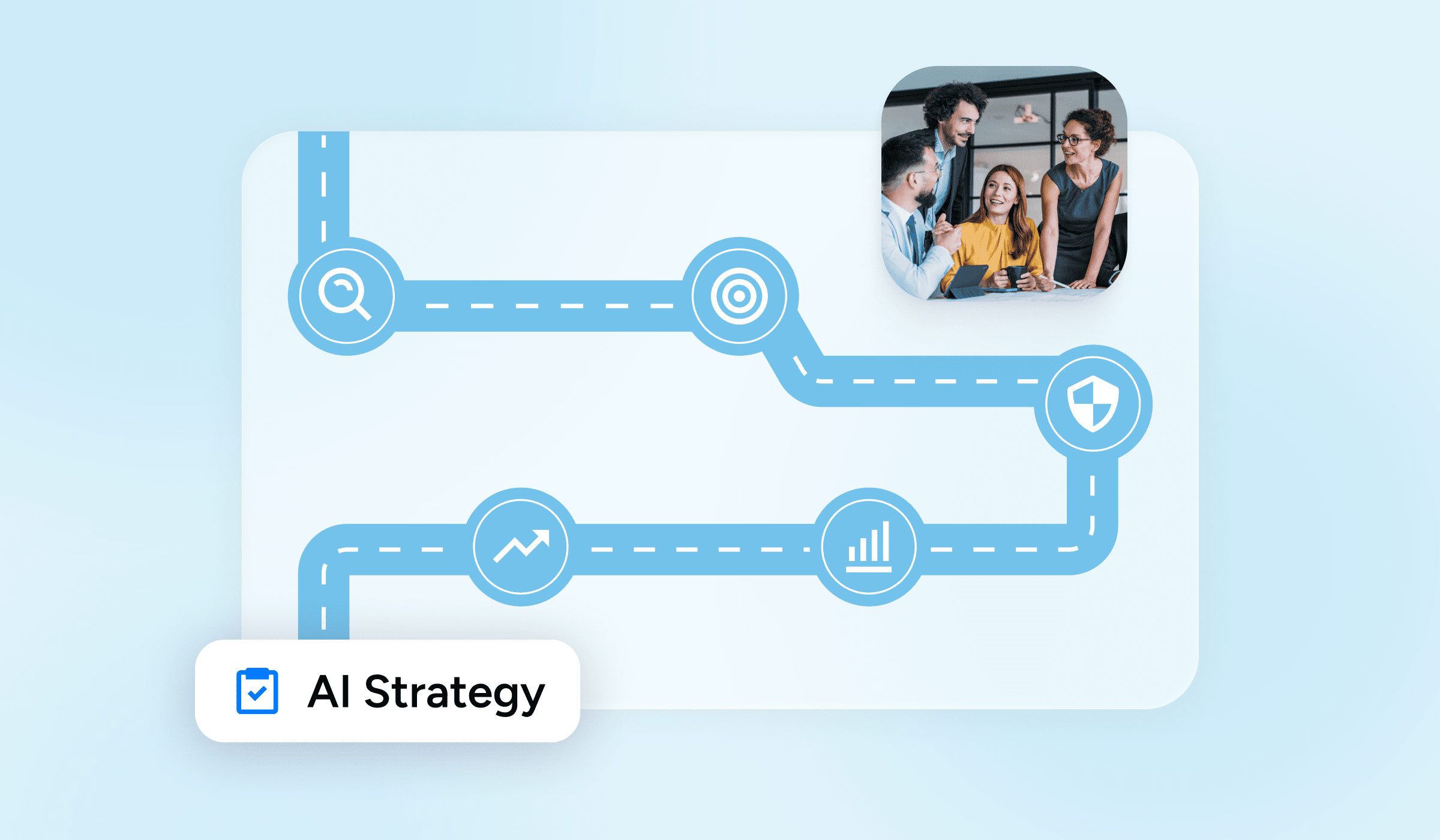
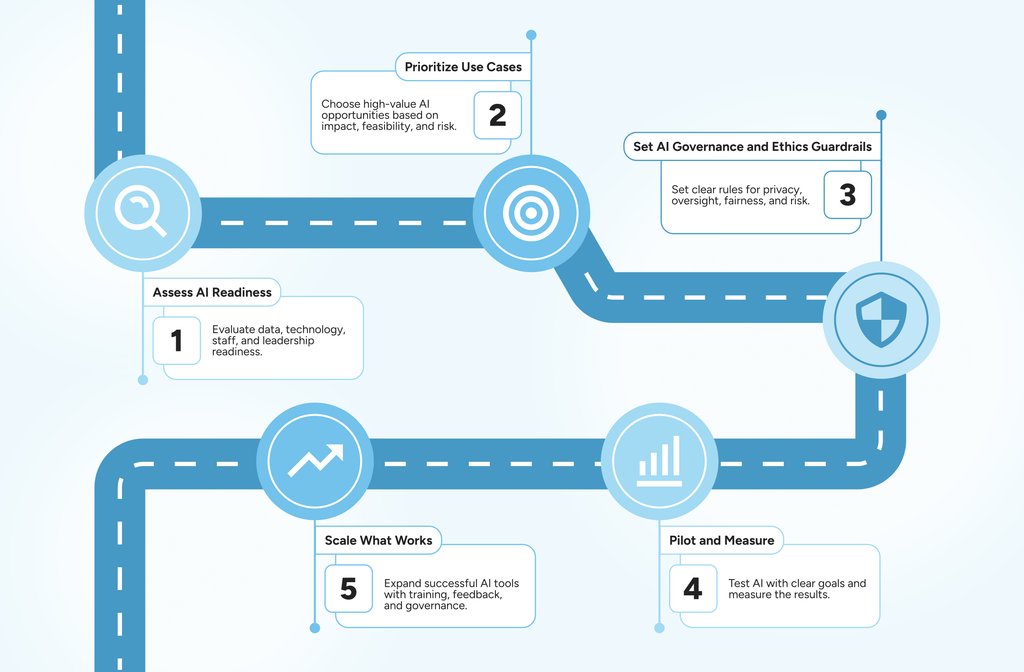
So what can you do to ensure you’re following an effective AI strategy for nonprofits? This guide discusses a five-phase AI roadmap built specifically for nonprofit organizations: how to assess your readiness, prioritize the right use cases, set governance before you build anything, run a measurable pilot, and scale what works.
If you’re an executive director, COO, or operations lead who needs a defensible plan, this is written for you.
What Is an AI Strategy for Nonprofits?
AI strategy for nonprofits is a documented plan that defines which problems AI will solve, how the organization will use it, what resources and timelines are required, and how success is measured.
It’s not about adopting every AI tool. It’s knowing which problems you hope to solve and having a plan in place if something goes wrong.
Nonprofit AI strategy is built on:
- Mission alignment: How the tools support your mission
- Governance: Who decides to get what tools, and how is accountability measured
- Sequencing: What do you get first and why
- Sustainability: How does this tool maintain or grow capacity
Nonprofits need AI tools that are purpose-built for them. Between stakeholder data, staff capacity, board accountability, and donor trust, the tools need to support your organization’s mission while considering the unique demands of operating as a nonprofit.
Why Most Nonprofit AI Efforts Stall
AI efforts stall without a framework. If one person in your organization adopts an AI tool, champions its use, and then leaves, the knowledge and experience around that tool leaves with them.
That’s the most common version of a scenario that nonprofits frequently see: teams adopt whatever the latest new thing is without data policies or oversight, and six months in there’s no consistent use and no way to scale; initiatives without a named owner rarely survive with competing priorities; organizations that build before they govern spend more time cleaning up problems than capturing value; and pilots that never define what working looks like can’t produce evidence that earns broader investment.
It’s why organizations need an AI framework in place. That framework starts with:
Phase 1: Assess Your AI Readiness
Before you start using a technology, conduct an AI readiness assessment. Look at these four areas:
- Data: Do you have clean, accessible data in the areas you want AI to help with? Messy data, siloed program records, and paper-based processes all limit what AI can do.
- Technology: What does your current stack look like? Are your core systems API-accessible? Do you have a cloud-based infrastructure, or are you running on-premises software that would require significant migration?
- Staff capacity: Who has bandwidth to own this work? What’s the team’s current comfort level with technology?
- Leadership alignment: Do you have executive sponsorship? Does the board understand enough to govern it? Have you had the mission-alignment conversation at the leadership level?
The assessment and the findings don’t need to be a grand undertaking. A structured conversation with the right people at the table, having an honest conversation about these four areas, will show you what needs to be addressed before you can adopt the proper tools.
Phase 2: Prioritize High-Value Use Cases
Once you’ve identified what needs to be addressed, you can make the case for how AI tools will do that.
Consider using a prioritization framework set against how the AI tool will help with:
- Impact: How does this move our organization towards a mission-critical outcome?
- Feasibility: Do we have the capacity to use this tool effectively?
- Risk: What happens if the tool underperforms or fails?
You’ll evaluate use cases against that framework. Some common examples include:
- Donor communications: Personalizing outreach based on giving history and engagement signals
- Grant research: Scanning and summarizing potential funders against your program profile
- Volunteer coordination: Matching availability and skills to program needs
- Program reporting: Drafting narrative reports from structured outcome data
- Board and leadership communications: Summarizing meeting materials, tracking action items
Address day-to-day scenarios before moving onto the most ambitious use cases. Assign an owner to each use case to have an actionable plan in place once you move to implementation.
Phase 3: Set AI Governance and Ethics Guardrails
Organizations that build first and operate without guardrails spend more time fixing probems when something goes wrong than making progress.
Your AI governance framework should cover:
- Data privacy: Which constituent data can be used with AI tools, under what conditions, and with which vendors? What data can never leave your systems?
- Bias and fairness: Who reviews AI outputs for bias before they’re used in decisions that affect constituents?
- Human oversight: Which decisions require a human in the loop, no matter how confident the AI output looks?
- Vendor accountability: What do you require from AI vendors regarding data handling, model transparency, and security?
- Incident response: What happens when something goes wrong?
At the staff level, it means clear guidelines on what tools can be used, for what purposes, with what data.
Once a tool launches, it’s critical to receive regular reporting on its use. Your written AI policy doesn’t need to be long; it just needs to answer the above questions, so your team knows how to use the tool, and your board can see the oversight and structure they’re responsible for.
Phase 4: Pilot and Measure
With the foundation and framework established, it’s time to pilot the tool; start small and grow.
When you launch a new tool, consider these conditions: start with a narrow operating scope, establish a timeline, and have specific, measurable goals.
Before you launch, define what success looks like. It could be time saved per week on a task, staff adoption rates, or a measurable improvement on a specific outcome. Be specific with what you’re measuring because if you cannot define what “working” looks like, you cannot make a case for continued investment.
When you launch, collect quantitative data and qualitative data. At the 60–90-day mark, run a structured review against your pre-defined metrics and make a clear decision regarding the tool: continue, adjust, or stop.
If you do stop using a tool, don’t consider it a failure because it’s the framework doing its job. If the tool was a success, move on to the final phase.
Phase 5: Scale What Works
Once you have a successful pilot, scaling isn’t just taking off the guardrails and unleashing the tool for everyone to use. Successfully scaling a tool requires change management, documentation, and a regular feedback cycle.
Start scaling what works by training staff who weren’t in the pilot, addressing concerns proactively, and identifying internal champions who can model adoption and answer peer questions.
Create clear process guides, decision trees for when to use the tools and when not to, and governance checkpoints built into workflows.
Regularly review your team’s outputs, and create a channel for staff to identify and raise concerns.
As you receive feedback, update your AI policy accordingly or when tools change, or capabilities evolve.
The five phases can be an undertaking, but they’re critical to set your organization up for success. You don’t have to work through them alone.
Build vs. Buy: When to Bring In Outside Help

At some point in this process, most nonprofit leaders eventually ask the same question: do we do this ourselves? To answer that question, consider these common adoption paths and who owns the rollout:
| Factor | In-House Team | AI Consultant | AI Platform |
| Upfront cost | Low | High | Included in subscription |
| Time to value | Slow | Medium | Fast |
| Sector expertise | Varies | Varies | Built in |
| Ongoing governance | Your responsibility | Project-based | Ongoing |
| Scalability | Limited by staff | Limited by contract | Built to scale |
Building in-house works when you have a capable staff member with dedicated bandwidth, clean data, and the organizational patience for a slower ramp. But if that person leaves, the capability often leaves with them.
Bringing in an AI consultant makes sense for one-time strategy work: a readiness assessment, a governance policy build, a vendor evaluation. The risk is the handoff. Consultants deliver a plan, and your team has to execute. If you don’t have the internal capacity to operationalize the work, the consultant presents a recommendation, not a capability.
A purpose-built platform closes those gaps. Rather than helping you design a strategy or leaving execution to your team, it handles the ongoing work by automating workflows, surfacing insights, and keeping governance baked in without requiring you to hire or retain an AI function internally. This remains true across organizations of all sizes.
Putting Your AI Strategy into Action
For most nonprofits, the build vs. buy analysis points to a similar conclusion: the organizations that make the most progress find a platform that already understands the sector, embeds into existing operations, and handles the execution work their team doesn’t have capacity to own.
That’s what MomentiveIQ is built for. It’s an AI platform built for nonprofits and associations, with 40 years of sector knowledge, rather than generic enterprise tools designed without your constraints in mind. MomentiveIQ automates the workflows that consume your team’s time, surfaces predictive insights about donors and constituents, and keeps every action governed and auditable so you’re not managing AI risk on top of everything else that demands your team’s time.
Plus, MomentiveIQ is included in existing Momentive subscriptions. Getting started doesn’t require a new budget line or a procurement process. It’s the operational layer that turns your roadmap from a planning document into measurable results. If you lead an association, the same framework applies. MomentiveIQ is built for you too.
Skip the build. Ship the roadmap with MomentiveIQ.
You’ve got the strategy: MomentiveIQ runs it. It automates workflows that consume your team’s time, surfaces predictive insights, and keeps every action governed and auditable. Built for nonprofits and associations on 40+ years of sector knowledge, so you don’t have to build an AI function from scratch. Get your MomentiveIQ demo.
Your Board-Ready AI Roadmap
You have the pieces of the AI strategy puzzle, but how do you bring it together and build board confidence in the plan? Your board and leadership team need to enter a plan with clarity so they can govern it without needing to understand every technical decision behind it.
The one-page roadmap template below is built for that conversation. It packages the five phases in this guide into a format for a board meeting or leadership retreat, covering each phase’s objective, key activities, named owners, timelines, success metrics, and governance commitments.
It’s designed to open the AI conversation with your board, align on direction and build confidence in execution.
Download Your Board-Ready AI Roadmap today.
Ready to Move from Roadmap to Results?
Most nonprofits get stuck between framework and execution. Building internal AI capability takes time, staff bandwidth, and ongoing governance work that most nonprofit teams aren’t resourced to absorb on top of existing priorities.
MomentiveIQ is built for that gap. It executes the strategy you’ve mapped by automating time-consuming workflows, surfacing predictive insights, and keeping every action governed and auditable, all built on 40 years of nonprofit and association sector knowledge. Get your MomentiveIQ demo today.
Frequently Asked Questions
An AI strategy for a nonprofit is a documented plan that defines which problems AI will solve, how the organization will govern its use, what resources and timelines are required, and how success will be measured — all aligned with the mission. It’s the difference between adopting tools reactively and building a sustainable, accountable AI capability that your board can oversee and your staff can execute.
Start with a readiness assessment across four areas: data quality, your current technology stack, staff capacity, and leadership alignment. That gap analysis shows where you’re starting and which use cases are actually feasible before you invest time or budget. From there, prioritize two to three high-impact, lower-risk use cases, assign owners, and set governance before you pilot anything.
At minimum, a nonprofit AI governance policy should cover data privacy rules (which constituent data can be used, with which vendors, under what conditions), bias and fairness review processes, human oversight requirements for decisions that affect constituents, vendor accountability standards, and an incident response plan for when something goes wrong. It doesn’t need to be long — two to three pages that answers those questions clearly is enough to give your team direction and your board the oversight structure they need.
It depends on what you need. Building in-house works when you have a technically capable staff member with dedicated bandwidth and clean data to work with, but it’s fragile — if that person leaves, the capability often goes with them. Hiring a consultant makes sense for one-time strategy work like a readiness assessment or governance policy., Still, the handoff is a real risk if your team lacks the capacity to execute afterward. A purpose-built platform is often the most durable option for ongoing execution, because it doesn’t depend on any one person staying.
Project-based AI strategy engagements typically range from $15,000 to $75,000 depending on scope, deliverables, and the firm. Ongoing advisory retainers run higher. For nonprofits looking to operationalize AI without a large consulting spend, a purpose-built platform included in an existing subscription — like MomentiveIQ — can deliver ongoing execution and governance at no additional license cost.
The highest-value starting points are use cases with clear data, defined outcomes, and lower risk if they underperform. Common options include donor communication personalization based on giving history and engagement signals, grant research summarization, volunteer matching, program outcome reporting, and board communication support. The right use cases for your organization depend on where your data is cleanest and where staff time is most constrained — that’s what a readiness assessment and use case prioritization exercise is designed to surface.