
10 Sage Intacct Alternatives for Nonprofits in 2026

Sage Intacct is a cloud financial management platform with a nonprofit edition built around funds, grants, and programs. If you are comparing Sage Intacct alternatives for nonprofits, you’re usually comparing cost, implementation, or partner dependency. A Sage Intacct alternative is any financial platform a nonprofit uses instead of Sage Intacct for built-in fund accounting, or a different mix of implementation and support.
This guide compares 10 alternatives to Sage Intacct, including MIP Accounting by Momentive, Blackbaud Financial Edge NXT, and Oracle NetSuite, by pricing model, fund accounting depth, implementation, and organization size. These Sage Intacct competitors range from small-nonprofit tools to full ERPs.
Key takeaways:
- Sage Intacct publishes no prices and sends both nonprofit plans to a “Request pricing” form. Sage Intacct partners Rand Group and Cargas report starting prices of about $9,000, and advanced modules can add $3,000 to $10,000+ to the yearly subscription.
- The 10 alternatives fall into four groups:
- Purpose-built fund accounting: MIP Accounting, Blackbaud Financial Edge NXT, AccuFund, Araize FastFund, Aplos
- General ERPs: NetSuite, Dynamics 365 Business Central, Acumatica
- Salesforce-native option: Accounting Seed
- General small-business accounting: QuickBooks Online
- Sage Intacct remains a strong fit for large or multi-entity nonprofits that need full ERP scope. Consider an alternative when your nonprofit doesn’t need a full ERP scope and the price that goes with it.
Why Do Nonprofits Look for Sage Intacct Alternatives?
Nonprofits look for Sage Intacct alternatives when cost, implementation effort, or scope no longer fits their need. Sage Intacct’s price depends on users, modules, and entities, and many organizations implement it with a partner. As a result, smaller teams may end up paying for features or seatsscope they don’t use.
Total cost and per-module pricing
Sage Intacct has no pricing models publicly published online. Each request is custom to the organization., instead it’s custom based on requesting a demo. Sage Intacct partners Rand Group and Cargas each say advanced modules can add anything from $3,000 to $10,000+ to the yearly subscription.
Implementation time and partner dependency
The project, not just the software, is part of the cost. Sage Intacct’s own nonprofit page says that many organizations work with Sage implementation specialists or certified partners to ensure a smooth setup. For a small finance team, a roughly 90-day project, a five- or six-figure fee, and an outside partner to rely on can be hard to absorb, so some nonprofits look for tools with a shorter, vendor-led setup.
Feature scope beyond what a mid-size nonprofit uses
There’s a difference between the full module list and what a smaller team actually runs. A mid-size nonprofit that needs dynamic allocations would be looking at a Sage Intacct plan positioned for larger organizations, even if the rest of those featuresat scope goes unused.
Grant and fund tracking that depends on configuration
Funds, grants, and programs are modeled through Sage Intacct’s dimensional structure, it’s unclear how much is preconfigured for nonprofits and how much your implementation partner builds. A nonprofit that wants funds and grants built into its chart of accounts, rather than modeled during setup, will likely prefer purpose-built fund accounting software.
If one or more of these four pressures sounds familiar, the next step is to define what a better fit looks like for your organization.
What Should Nonprofits Look For in a Sage Intacct Alternative?
The best Sage Intacct alternative is the one that matches how your nonprofit tracks restricted money, reports to funders, and staff implementation, not the one with the longest feature list. Check eight features: fund and grant accounting, FASB- and GASB- reporting, allocations, multi-entity consolidation, payroll and HR, implementation model, three-year cost, and scalability.
1. Fund and grant accounting out of the box
Check whether restricted funds, grants, and programs are built into the chart of accounts or depend on configuration. Purpose-built nonprofit accounting software tracks funds natively, while general ERPs often rely on dimensions or partner add-ons.
2. FASB- and GASB- reporting
Confirm the system produces the statements your auditors expect. Under FASB’s ASU 2016-14, nonprofits report net assets with and without donor restrictions and provide an analysis of expenses by natural and functional classification (Journal of Accountancy). GASB sets the standards for U.S. state and local governments, so ask which standard the statements follow if that applies to your team. Reporting and audit management tools matter here.
3. Allocations
Shared costs such as rent and salaries need to be split across programs, funds, and grants. Ask whether allocations run automatically, whether you can preview them before posting, and whether they come with the plan you are quoted.
Sage Intacct lists dynamic allocations in its pPremium nonprofit plan. Momentive’s MIP Accounting lists allocations among its automated workflows, and its workflow automation page describes allocations when consolidating across multiple entities.
4. Multi-entity consolidation
If you run affiliates, chapters, or a foundation alongside the main organization, check how consolidation and intercompany entries work, and whether additional entities carry an extra fee. Cargas notes that additional Sage Intacct entities do.
5. Payroll and HR
Payroll that allocates labor costs by fund, grant, or program keeps those costs tied to the right funding source. Check whether payroll and HR are native modules, such as MIP Accounting’s nonprofit payroll and HR management, or separate products you must integrate.
6. Implementation model
Ask who implements the system, how long it takes, and what is included. Sage Intacct is typically implemented by a partner and billed separately, while some vendors, including Momentive, list a dedicated implementation team.
7. Three-year total cost
Add subscription, modules, additional entities, implementation, training, and support across three years. Partner guides show implementation alone can equal or exceed the first-year subscription.
8. Scalability
Check whether you can add funds, users, and entities without a re-implementation, and what each addition costs.
How Much Does Sage Intacct Cost for Nonprofits?
Sage Intacct nonprofit pricing is quoted per organization, and Sage Intacct partners say it depends on users, modules, and entities. In this section, compare the estimated costs associated with Sage Intacct, reported by Sage’s partners. These are costs from Sage’s partners only, so confirm nonprofit pricing with your Sage Intacct contact, since none are published.
| Cost component | Estimated Costs | Partner Source |
| Entry subscription (one business user, core financials) | $9,000 a year for a basic package | Rand Group, updated 2026 |
| Entry subscription | $13,200 a year | Cargas, updated 2026 |
| Typical annual spend | About $20,000 for smaller organizations; above $75,000 for larger or more complex ones | Rand Group |
| Typical annual spend | $30,000 to $35,000 on average among Cargas customers | Cargas |
| Advanced modules | $3,000 to $10,000 or more added to the yearly subscription | Rand Group, Cargas |
| Additional entities | Extra fee per entity; amount not published | Cargas, Rand Group |
| Implementation (one time) | $25,000 to $150,000 | Rand Group |
| Implementation (one time) | $1.00 to $1.50 per $1.00 of annual subscription; about 90 days on average | Cargas |
Sage Intacct Alternatives Compared
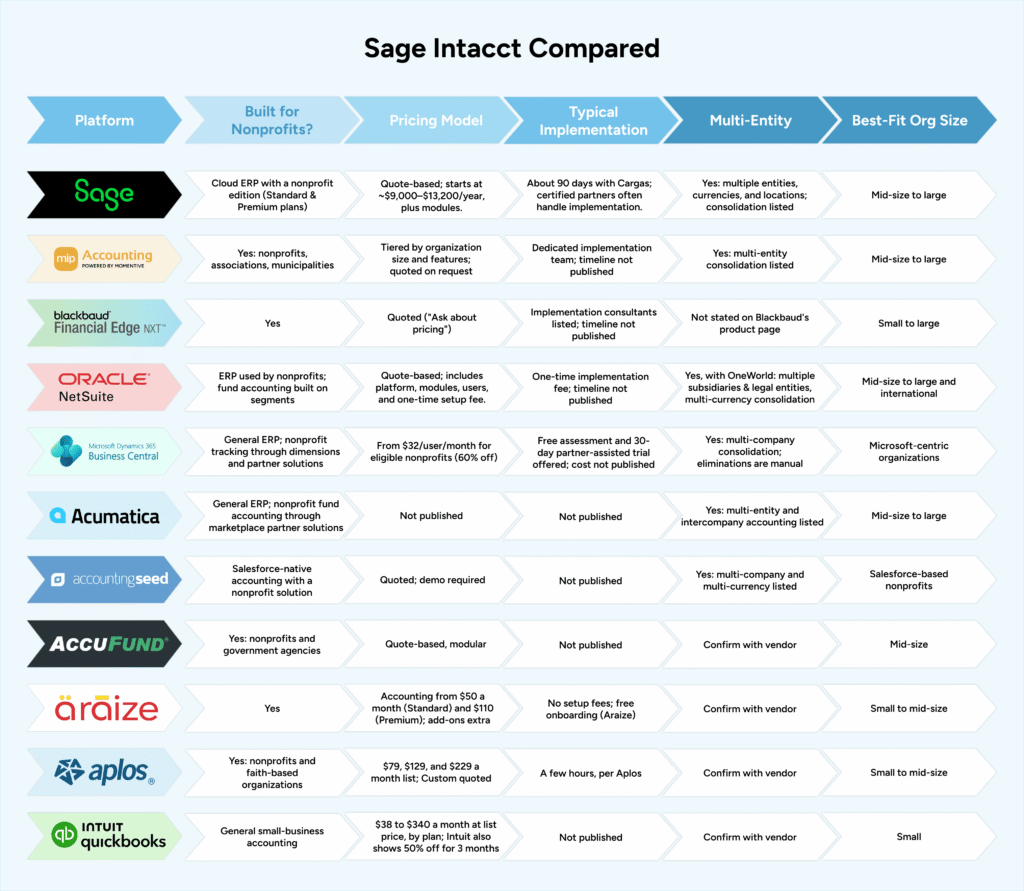
This table compares Sage Intacct and 10 alternatives by nonprofit focus, pricing model, implementation, multi-entity support, and best-fit organization size.
| Platform | Built for Nonprofits? | Pricing Model | Typical Implementation | Multi-Entity | Best-Fit Org Size |
| Sage Intacct | Cloud ERP with a nonprofit edition (Standard and Premium plans) | Quote-only (“Request pricing”); Sage Intacct partners report general starting prices of about $9,000 to $13,200 a year, plus modules | About 90 days when Cargas leads; Sage Intacct says many organizations use implementation specialists or certified partners | Yes: multiple entities, currencies, and locations; consolidation listed | Mid-size to large |
| MIP Accounting by Momentive | Yes: nonprofits, associations, municipalities | Tiered by organization size and features; quoted on request | Dedicated implementation team; timeline not published | Yes: multi-entity consolidation listed | Mid-size to large |
| Blackbaud Financial Edge NXT | Yes | Quoted (“Ask about pricing”) | Implementation consultants listed; timeline not published | Not stated on Blackbaud’s product page | Small to large |
| Oracle NetSuite | ERP used by nonprofits; fund accounting built on segments | Quote-only: license combines a core platform, optional modules, and users, plus a one-time implementation fee | One-time implementation fee; timeline not published | Yes, with OneWorld: multiple subsidiaries and legal entities, multi-currency consolidation | Mid-size to large and international |
| Microsoft Dynamics 365 Business Central | General ERP; nonprofit tracking through dimensions and partner solutions | From $32 per user per month for eligible nonprofits (60% off commercial pricing), per Microsoft | Free assessment and 30-day partner-assisted trial offered; cost not published | Yes: multi-company consolidation; eliminations are manual | Microsoft-centric organizations |
| Acumatica | General ERP; nonprofit fund accounting through marketplace partner solutions | Not published | Not published | Yes: multi-entity and intercompany accounting listed | Mid-size to large |
| Accounting Seed | Salesforce-native accounting with a nonprofit solution | Quoted; demo required | Not published | Yes: multi-company and multi-currency listed | Salesforce-based nonprofits |
| AccuFund | Yes: nonprofits and government agencies | Quote-based, modular | Not published | Confirm with vendor | Mid-size |
| Araize FastFund | Yes | Accounting from $50 a month (Standard) and $110 (Premium); add-ons extra | No setup fees; free onboarding (Araize) | Confirm with vendor | Small to mid-size |
| Aplos | Yes: nonprofits and faith-based organizations | $79, $129, and $229 a month list; Custom quoted | A few hours, per Aplos | Confirm with vendor | Small to mid-size |
| QuickBooks Online | General small-business accounting | $38 to $340 a month at list price, by plan; Intuit also shows 50% off for three months | Not published | Confirm with vendor | Small |
Size positioning for MIP Accounting and AccuFund follows the brief, and Sage Intacct’s follows Momentive’s guide and partner descriptions; the vendor pages do not publish size bands.
10 Sage Intacct Alternatives for Nonprofits
These 10 Sage Intacct competitors range from purpose-built fund accounting to full ERPs and small-nonprofit tools. Each entry covers pricing and fees, features, and who the tool is built for, and how it differs from Sage Intacct, so you can compare them on the same terms.
1. MIP Accounting by Momentive
MIP Accounting by Momentive is fund accounting software for nonprofits, associations, and municipalities. It tracks money by fund, grant, program, or project, and Momentive’s nonprofit accounting page lists multi-entity consolidation, FASB- and GASB-compliant financial statements, and a 990 worksheet.
Unlike Sage Intacct, it is purpose-built fund accounting rather than a general ERP with a nonprofit edition. One customer, Jacob O., CFO of the Ponca Tribe of Nebraska, says: “MIP’s ability to track expenses, budgets and taxes has allowed growth to skyrocket over the last four years.”
Pricing and fees: MIP Accounting uses tiered pricing based on organization size and feature needs. Request a demo for a quote.
Features:
- Fund and grant accounting: An unlimited chart of accounts built for nonprofits, to track unlimited funds, grants, programs, departments, and cost centers, with automatic inter-fund entries and unlimited customized budgets, even for cross-year grant projects.
- Reporting: Statements of functional expenses, budget-versus-actual by fund, grant-specific reports, and more than 150 built-in reports.
- Workflow and audit trails: Approvals, allocations, and recurring entries with built-in audit trails.
- Payroll and HR: Nonprofit payroll and HR management built into MIP Accounting, which generates general ledger entries automatically and accounts for fund accounting and grant allocation needs.
- Integrations: GiveSmart, Nimble AMS, YourMembership AMS, and NetForum AMS.
Best for: Nonprofits, associations, and municipalities that want fund and grant accounting, audit-ready reporting, and payroll and HR without enterprise ERP scope.
2. Blackbaud Financial Edge NXT
Blackbaud Financial Edge NXT is Blackbaud’s cloud fund accounting software for nonprofits. Blackbaud is built for nonprofits, with subfund tracking for grants, projects, and endowments and automated workflows for restricted funds. Unlike Sage Intacct, it is nonprofit-specific and connects to Raiser’s Edge NXT, Blackbaud’s fundraising CRM.
Pricing and fees: Blackbaud lists no prices and directs buyers to an “Ask About Pricing” form.
Features: Subfund tracking for grants, projects, and endowments; role-based access and document attachments for audit trails; built-in nonprofit report templates and customizable dashboards; invoice capture and bank and credit card reconciliation; and an integration with Raiser’s Edge NXT.
Best for: Blackbaud pairs Financial Edge NXT with Raiser’s Edge NXT, so it suits nonprofits that already use Blackbaud’s fundraising CRM.
3. Oracle NetSuite
Oracle NetSuite is a cloud ERP that nonprofits use for fund accounting, grants, and operations. ERP Research describes its fund accounting as built on segments, with OneWorld consolidation, grant budget-to-actual tracking, and statements aligned to ASB ASU 2016-14. NetSuite is a broader ERP, compared to Sage Intacct, for organizations whose needs extend to procurement and expense management.
Pricing and fees: NetSuite is quote-only. ERP Research’s 2026 buyer-reported bands are about $999 a month to start for one legal entity, about $2,000 to $5,000 a month more for OneWorld multi-entity and multi-currency, and $99 to $129 per full user per month, with implementation typically 1.5 to 3 times the first-year license cost.
Features: GAAP- and FASB-compliant fund accounting for donor and grant restrictions. OneWorld multi-subsidiary, multi-currency consolidation. NFP Financials grant management, where you can record a grant at the proposal stage and turn it into a billing transaction when the award is won, for contribution grants and cost-reimbursable grants. NetSuite also lists nonprofit reports including Grant Statement of Activity, Upcoming Grant Milestones, Overdue Grant Payments, and Unbilled Grants
Best for: Large or international nonprofits that want ERP capabilities beyond accounting; NetSuite’s nonprofit page also covers procurement and international grants..
4. Microsoft Dynamics 365 Business Central
Microsoft Dynamics 365 Business Central is Microsoft’s cloud ERP. Microsoft describes dimensions as values that “categorize entries so you can track and analyze them,” for example by project or department. Its nonprofit page lists visibility into contributions and funding and program budgets but does not describe a dedicated fund accounting module, so ask partners how funds and grants are set up. Unlike Sage Intacct, it is a general business ERP that sits inside the Microsoft ecosystem.
Pricing and fees: Microsoft says eligible nonprofits can get Business Central starting at $32.00 per user per month, 60% off commercial pricing, and offers a free assessment with an initial cost estimate and a 30-day partner-assisted trial. Implementation costs are not published.
Features: Dimensions for categorizing entries by project, department, or other values, and consolidation of several companies into one, with elimination entries posted manually.
Best for: Nonprofits that want a general business ERP with Microsoft’s nonprofit discount, Microsoft offers a partner-assisted trial.
5. Acumatica
Acumatica is a cloud ERP with unlimited users and a pricing model based primarily on the applications you implement, not user seats. Its nonprofit page lists consolidated reporting across multiple entities, funds, grants, and locations and its marketplace lists NonProfitPlus from Accounting System Integrators. NonProfitPlus adds fund accounting for: Unrestricted, restricted, endowment, and board funds, grants with automated drawdowns and revenue recognition, and budgets and encumbrances by fund, grant, or program. Unlike Sage Intacct, its license is not tied to user count.
Pricing and fees: Acumatica quotes pricing and publishes no dollar figures. It says cost depends on the applications you implement, business usage and resources, and the deployment license. The NonProfitPlus listing gives no pricing and routes to a partner contact.
Features: Unlimited companies in one environment, automatic due-to and due-from intercompany entries, and consolidated financial statements; and the NonProfitPlus functions above.
Best for: Nonprofits that want an ERP with unlimited users and multi-entity consolidation and are open to a partner-built nonprofit solution such as NonProfitPlus.
6. Accounting Seed
Accounting Seed is cloud-based accounting software built on Salesforce, with a nonprofit solution listed on its site. It can track donations as restricted or unrestricted and synchronize financial data with the Salesforce Nonprofit Success Pack. Donations entered in NPSP instantly flow into the general ledger with no manual entry necessary. Unlike Sage Intacct, the accounting lives inside your Salesforce CRM.
Pricing and fees: Accounting Seed lists no prices. Pricing adapts to the size of your organization and depends on factors such as users, ledgers, and extensions, and its site offers a demo request.
Features: Salesforce NPSP synchronization, donation-to-ledger posting, restricted and unrestricted donation tracking, grant tracking with allocations and funder reports, and multi-company and multi-currency options listed in its product navigation.
Best for: Nonprofits that run Salesforce as their CRM and want accounting in the same platform.
7. AccuFund
AccuFund Accounting Suite is modular fund accounting software for nonprofits and government agencies. AccuFund describes AccuFund Anywhere as a browser-based nonprofit system that incorporates fund accounting. i3 Verticals says it acquired AccuFund, Inc. effective January 1, 2023. Unlike Sage Intacct, you can start with a core system and add modules over time.
Pricing and fees: AccuFund publishes no prices and describes its pricing as “competitive” and scalable for any sized nonprofit.
Features: Includes grants management, payroll and HR, and endowment modules, with cash receipts, bank reconciliation, and program tracking.
Best for: Nonprofits and government agencies that want modular fund accounting and may add modules over time.
8. Araize FastFund
FastFund by Araize is cloud-based nonprofit software that combines fund accounting, payroll, and fundraising, and customers license only the modules they need. Araize’s site describes restricted-fund and grant tracking, FASB-compliant reporting, and payroll with labor allocations by fund, grant, or program. Unlike Sage Intacct, it advertises no setup fees and free onboarding.
Pricing and fees: Araize lists no setup fees, a free trial, free support and onboarding, and you can cancel anytime.
- Accounting at $50 a month (Standard)
- $110 a month (Premium)
- Payroll from $55 a month
- Fundraising from $50 a month
- A $300-a-year bundle combines accounting and fundraising for up to 250 active donors and 250 active accounts
- Add-ons:
- Accounts payable and accounts receivable ($22 a month each)
- Direct cost allocations ($22)
- Indirect cost allocations ($40)
- Extra users ($22 for two, $40 for five)
Features: Standard lists cash-based accounting, fund accounting, a six-segment account number, budgeting, project tracking, FASB-compliant financial statements, bank integration, recurring transactions, expense and revenue allocations, and 990 reporting. Premium adds accrual-based accounting, accounts payable, accounts receivable, and direct cost allocations. Payroll includes salary and payroll tax allocations, direct deposit, and tax filing; fundraising includes a donor CRM, online giving, pledge tracking, and event management.
Best for: Small to mid-size nonprofits that want modular fund accounting, payroll, and fundraising from one vendor, according to Araize’s published plans.
9. Aplos
Aplos is fund accounting software for small and mid-size nonprofits and faith-based organizations. Aplos says it can typically be set up in just a few hours. Unlike Sage Intacct, Aplos publishes its prices and offers a 15-day free trial with no credit card.
Pricing and fees: Lite $79, Core $129, and Advanced from $229 a month, with 2, 2, and 3 users, and Custom quoted (Aplos pricing).
Features: Fund-based balance sheet and income statement, bank reconciliation, custom reports, a board portal, and 1099 management. Core adds budgeting, accounts payable and receivable, recurring transactions, and period close. Advanced adds budgeting by fund or grant and dimensional reporting.
Best for: Small to mid-size nonprofits and faith-based organizations that want published pricing and quick setup. Aplos positions Advanced for organizations with $250,000 or more in annual revenue and Custom for $1 million or more.
10. QuickBooks Online
QuickBooks Online is Intuit’s general-purpose small-business accounting software. Unlike Sage Intacct, it is not an ERP, so test how it handles restricted funds, grant reporting, and the statement of functional expenses before you migrate.
Pricing and fees: Intuit lists Simple Start at $38 a month, Essentials at $85, Plus at $140, and Advanced at $340 at list price, with 1, 3, 5, and 25 users included, and shows 50% off for three months; the page does not state when that promotion ends.
Features: Plans scale by user count. Intuit’s nonprofit page describes fund accounting as tracking expenses by fund or program, lets you tag donations to a program or fund, lists class and location tracking on Plus, and includes donor and grant management in budget tracking on Plus and Advanced. It also says QuickBooks offers discounted products for nonprofits through TechSoup.
Best for: Very small nonprofits with simple accounting needs.
Which Alternative Fits Your Nonprofit’s Size and Complexity?
The right Sage Intacct alternative depends on size and complexity. Small nonprofits usually need simple fund tracking, mid-size organizations with grants and audits need purpose-built fund accounting, and large or multi-entity organizations need consolidation depth. Enterprise ERP needs beyond accounting point to NetSuite, Dynamics 365, or Acumatica.
- Small nonprofits: Aplos and QuickBooks Online.
- Mid-size nonprofits with grants, audits, and multiple funds: MIP Accounting, AccuFund, and Araize FastFund.
- Large or multi-entity organizations: MIP Accounting and Blackbaud Financial Edge NXT. Confirm how each handles consolidation across entities.
- Enterprise ERP needs beyond accounting: Oracle NetSuite, Microsoft Dynamics 365 Business Central, and Acumatica.
- Salesforce-centered organizations: Accounting Seed.
When does staying on Sage Intacct make sense?
Sage Intacct fits large or multi-entity nonprofits that need consolidation, dynamic allocations, and full ERP scope, and organizations that have finished implementation and use the modules they pay for. Sage Intacct positions its Standard plan for “established small and mid-size nonprofit organizations” and its Premium plan, which adds advanced reporting and dynamic allocations, for “larger, more complex nonprofit organizations.”
For a broader ranking, see our guide to the best nonprofit accounting software.
How Do You Switch From Sage Intacct?
Switching from Sage Intacct starts with your subscription renewal date. Check the term, map your dimensions to funds, grants, and programs, export trial balances and history, rebuild reports, and run both systems through one close. Time the cutover to your renewal and fiscal year so nothing is paid twice or lost.
- Check the subscription renewal date: Confirm your term with your Sage Intacct partner and plan the move around the renewal.
- Map dimensions to funds, grants, and programs: Decide how each Sage Intacct dimension becomes a fund, grant, program, or department in the new chart of accounts.
- Export trial balances and history: Pull trial balances, grant balances, and transaction history, and confirm your plan lets you export what you need.
- Rebuild reports: Recreate board, grant, and audit reports, including the statement of functional expenses, and check them against the old system.
- Run both systems through one close: Keep Sage Intacct available until a full month-end close matches in the new system.
Switching is easier with a team behind you. So ask vendors what onboarding and data conversion includes. Momentive offers a dedicated implementation team for data migration, system configuration, testing, and training, so you can focus on your mission.
Frequently Asked Questions About Sage Intacct Alternatives for Nonprofits
Sage Intacct does not publish nonprofit prices. Sage Intacct partners Rand Group and Cargas publish general starting prices of about $9,000 a year for one business user and core financials, with typical spend of $20,000 to $35,000.
Sage Intacct is priced as a modular ERP, so cost rises with users, add-on modules, and entities, and many organizations implement it with a partner. Rand Group reports one-time implementation of $25,000 to $150,000. Nonprofits that need only fund accounting and grant reporting may not need that scope, so compare purpose-built options.
Sage Intacct competitors for nonprofits include MIP Accounting, Blackbaud Financial Edge NXT, Oracle NetSuite, Microsoft Dynamics 365 Business Central, Acumatica, AccuFund, and Aplos. Software Advice also lists QuickBooks Online and NetSuite among its Sage Intacct alternatives. The best match depends on organization size, fund accounting needs, and how much ERP scope you want.
It depends on size and complexity. Sage Intacct is a multi-entity cloud ERP with a dimensional ledger and grant tracking, while QuickBooks Online is general small-business accounting with plans from $38 a month. Small nonprofits with simple fund needs may find QuickBooks Online enough, while organizations with many funds, grants, or entities should compare fund accounting systems.
MIP Accounting is fund accounting software built for nonprofits, associations, and municipalities, while Sage Intacct offers nonprofit Standard and Premium plans on a broader financial management platform. Both list multi-entity consolidation and fund or grant tracking. Partners say Sage Intacct is priced by users, modules, and entities; Momentive says MIP Accounting uses tiered pricing by organization size and features.
Sage Intacct’s nonprofit page cites over 30 years of experience serving nonprofits and says it has empowered thousands of organizations, but it publishes no nonprofit customer count. Software Advice shows a 4.3 rating on its general Sage Intacct listing, and Momentive’s guide names Sage Intacct the best choice for large nonprofits.