
10 Best Aplos Alternatives for Nonprofits in 2026

Aplos is a cloud fund accounting and donor platform for small nonprofits and churches, and it is now part of the Velora suite. If you’re looking for Aplos alternatives, you’ve likely met a challenge: budgeting by fund or grant sits on a higher tier, allocations and fixed assets sit on a custom plan, or payroll and approvals live outside the product. Several Aplos alternatives exist and offer deeper fund and grant reporting options specialized for nonprofits, higher user counts, or lower cost.
In this guide, we compare 10 alternatives to Aplos, including MIP Accounting by Momentive, Sage Intacct, and QuickBooks Online, by fund accounting depth, multi-entity support, payroll, and size. These Aplos competitors range from free bookkeeping tools to audit-ready systems.
Key takeaways:
- Aplos lists Lite at $79/month, Core at $129, and Advanced at $229, with 2-3 users included. Budgeting by fund or grant starts at Advanced; fixed assets and bill approval sit on its Custom tier.
- The cheapest alternatives are QuickBooks Online Plus through TechSoup ($80 yearly admin fee for eligible nonprofits) and Wave’s free Starter plan.
- If you’re looking for audit-ready systems for grants and multiple entities, our picks are MIP Accounting, Sage Intacct, and Blackbaud Financial Edge NXT. Request to see pricing.
When Have You Outgrown Aplos?
You may have outgrown Aplos when your needs move beyond what its tiers include. The clearest signs are budgeting by fund or grant, shared-cost allocations, more users, payroll and HR, and audit requirements. Aplos fund accounting alternatives are worth a look, if your non-profit is:
- Budgeting by fund or grant: Aplos’s pricing page lists budgeting by fund or grant and by department or project starting at Advanced ($229/month). Core includes basic budgeting.
- Managing allocations, fixed assets, and bill approval: Income and expense allocations, fixed assets, and bill approval under Custom pricing, quoted for organizations above $1 million in revenue.
- Adding more users: Lite and Core include two users and Advanced includes three. Aplos’s pricing page does not list a price for additional users, and names them only as an item Custom pricing may include.
- Needing payroll in the same system: Aplos connects to Gusto for payroll, and says each payroll run posts to the fund, program, or ministry you map staff to. Its pricing page lists no payroll price, so confirm what Gusto costs for your headcount.
- Facing audit requirements: Under 2 CFR 200.501, an organization that expends $1,000,000 or more in federal awards in a fiscal year beginning on or after October 1, 2024 needs a single audit. State rules add their own thresholds. If an audit applies to you, check how a tool tracks restricted funds, approvals, and changes to entries.
What Should You Look For in an Aplos Fund Accounting Alternative?
Look for software that tracks funds the way your funders ask for it: by fund, grant, program, and function, with controls that hold up in an audit. When you compare alternatives to Aplos, consider these eight factors:
1. Fund and grant tracking
Check whether each fund is its own set of books or a tag on a shared ledger. True fund accounting software keeps restricted balances separate; class or tag tracking depends on labeling every transaction.
2. Allocations
Shared costs such as rent and salaries need to be split across programs, funds, and grants. Ask whether allocations run automatically, whether you can preview them before posting, and whether they come with the plan you are quoted.
3. Multi-entity support
If you run affiliates, chapters, or a foundation alongside the main organization, check how consolidation and intercompany entries work, and whether additional entities carry an extra fee.
4. Reporting
Look for a statement of functional expenses and budget versus actual by fund. FASB‘s ASU 2016-14 requires not-for-profit entities that follow U.S. GAAP to report expenses by both function and nature in one place, such as a separate statement of functional expenses or the notes.
5. Payroll and HR
Payroll that allocates labor costs by fund, grant, or program keeps those costs tied to the right funding source. Check whether payroll and HR are native modules, such as MIP Accounting’s nonprofit payroll and HR management, or separate products you must integrate.
6. Controls and audit readiness
Look for approval workflows, user roles, and a complete audit trail.
7. Implementation and support
Ask who implements the system, how long it takes, and what is included. Some tools are implemented by a partner and billed separately, while some vendors, like Momentive, offer a dedicated implementation team.
8. Three-year total cost
Add subscription, modules, additional entities, implementation, training, and support across three years.
How Much Does Aplos Cost?
Aplos pricing starts at $79 a month for Lite and $129 for Core, each with two users, and $229 for Advanced with three users, according to its pricing page. Custom pricing is quoted for organizations above $1 million in revenue.
| Plan | Price | Users | Annual cost | What changes at this tier |
|---|---|---|---|---|
| Lite | $79/month | 2 | $948 | Fund-level reports, bank reconciliation, board portal, 1099 management |
| Core | $129/month | 2 | $1,548 | Adds payables and receivables, basic budgeting, recurring transactions, user roles |
| Advanced | $229/month | 3 | $2,748 | Adds budgeting by fund, grant, department, or project; for $250K+ revenue |
| Custom | Quoted | Quoted | Quoted | May add allocations, fixed assets, bill approval, and more users; for $1M+ revenue |
Aplos offers a 15-day free trial with no credit card. Payroll runs through a Gusto integration, and Aplos’s pricing page lists no payroll price. Aplos runs promotional discounts from time to time, so compare list prices.
Aplos Alternatives Compared
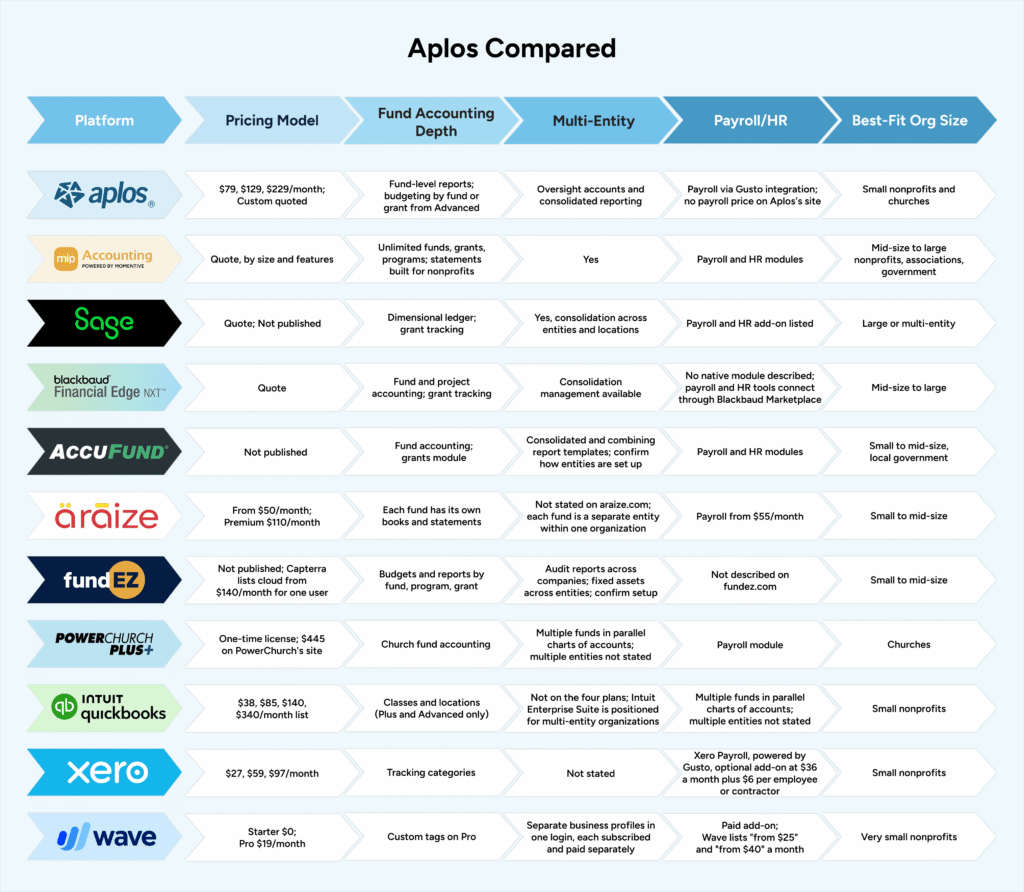
Use this table to compare Aplos and 10 alternatives by pricing model, fund accounting depth, multi-entity support, payroll and HR, and best-fit organization size.
| Platform | Pricing Model | Fund Accounting Depth | Multi-Entity | Payroll/HR | Best-Fit Org Size |
|---|---|---|---|---|---|
| Aplos | $79, $129, $229/month; Custom quoted | Fund-level reports; budgeting by fund or grant from Advanced | Oversight accounts and consolidated reporting | Payroll via Gusto integration; no payroll price on Aplos’s site | Small nonprofits and churches |
| MIP Accounting by Momentive | Quote, by size and features | Unlimited funds, grants, programs; statements built for nonprofits | Yes | Payroll and HR modules | Mid-size to large nonprofits, associations, government |
| Sage Intacct | Quote; not published | Dimensional ledger; grant tracking | Yes, consolidation across entities and locations | Payroll and HR add-on listed | Large or multi-entity |
| Blackbaud Financial Edge NXT | Quote | Fund and project accounting; grant tracking | Consolidation management available | No native module described; payroll and HR tools connect through Blackbaud Marketplace | Mid-size to large |
| AccuFund | Not published | Fund accounting; grants module | Consolidated and combining report templates; confirm how entities are set up | Payroll and HR modules | Small to mid-size, local government |
| Araize FastFund | From $50/month; Premium $110/month | Each fund has its own books and statements | Not stated on araize.com; each fund is a separate entity within one organization | Payroll from $55/month | Small to mid-size |
| FundEZ | Not published; Capterra lists cloud from $140/month for one user | Budgets and reports by fund, program, grant | Audit reports across companies; fixed assets across entities; confirm setup | Not described on fundez.com | Small to mid-size |
| PowerChurch Plus | One-time license; $445 on PowerChurch’s site | Church fund accounting | Multiple funds in parallel charts of accounts; multiple entities not stated | Payroll module | Churches |
| QuickBooks Online | $38, $85, $140, $340/month list | Classes and locations (Plus and Advanced only) | Not on the four plans; Intuit Enterprise Suite is positioned for multi-entity organizations | Payroll is an add-on and is not available through the TechSoup donation | Small nonprofits |
| Xero | $27, $59, $97/month | Tracking categories | Not stated | Xero Payroll, powered by Gusto, optional add-on at $36 a month plus $6 per employee or contractor | Small nonprofits |
| Wave | Starter $0; Pro $19/month | Custom tags on Pro | Separate business profiles in one login, each subscribed and paid separately | Paid add-on; Wave lists “from $25” and “from $40” a month | Very small nonprofits |
10 Aplos Alternatives for Nonprofit Fund Accounting
These 10 alternatives to Aplos software range from audit-ready fund accounting systems to free bookkeeping tools. Each entry covers pricing and fees, features, and who the tool is built for, and how it differs from Aplos, so you can compare them on the same terms.
1. MIP Accounting by Momentive

MIP Accounting is fund accounting software for nonprofits, associations, and government organizations, with more than 40 years behind it. Unlike Aplos, which is built for small nonprofits and churches, MIP is purpose-built for organizations that report to many funders.
MIP Accounting holds a 4.1 Capterra rating from 69+ reviews. G2 reviewers praise reporting and grant tracking.
Dana C., CFO of the Community Action Agency of Butte County, says: “A main advantage of MIP is we’re able to adapt to each funding stream’s unique conditions. This is vital because funding sources typically have diverse requirements, and even interpret regulations differently, sometimes within the same federal department.” The agency ran a $7.5 million budget across nearly 30 funding sources in QuickBooks before moving to MIP (Read the full story).
Pricing and fees: Momentive quotes MIP Accounting by organization size and feature needs. Request a demo for a quote.
Features:
- Fund accounting: Track unlimited funds, grants, programs, departments, and cost centers, and generate FASB- and GASB-compliant financial statements and the 990 worksheet.
- Budgeting: Create unlimited customized budgets, including for cross-year grant projects, and set overspend warnings before problems occur.
- Workflow automation: Multi-level approval workflows and multi-step allocations, with tamper-evident audit trails across every transaction.
- Payroll and HR: Payroll and HR with fund and grant allocation, direct deposit, tax filing, and accounting entries that post to your general ledger automatically.
- Implementation: A dedicated implementation team guides you from data migration and system configuration through acceptance testing and training, and a dedicated Customer Success Manager provides proactive check-ins.
Best for: Mid-size to large nonprofits, associations, and government organizations with grants and audits that have outgrown Aplos.
See MIP Accounting in Action
Track every fund, grant, and program in one system, with allocations, payroll, and audit-ready reporting built in.
2. Sage Intacct
Sage Intacct is a cloud financial management platform with a multi-dimensional ledger and nonprofit modules for fund accounting and grants. Unlike Aplos, Sage lists consolidations across entities and locations and positions the product for larger finance teams. Sage positions its Standard plan for established small and mid-size nonprofits and Premium for larger, more complex ones.
Pricing and fees: Sage does not publish pricing and directs you to request it.
Features: Dimensional general ledger, consolidations across entities and locations, grant tracking and billing, a Salesforce integration, and payroll and HR options.
Best for: Large or multi-entity nonprofits with a dedicated finance team and an implementation budget.
3. Blackbaud Financial Edge NXT
Blackbaud Financial Edge NXT is fund accounting software built for nonprofits. Unlike Aplos, it is a standalone accounting product that connects to Blackbaud’s Raiser’s Edge NXT donor CRM instead of bundling donor tools.
Pricing and fees: Blackbaud does not publish pricing and says quotes are customized to organization size and the solutions needed.
Features: A general ledger with multi-dimensional fund and project accounting, accounts payable and receivable, cash and budget management, fixed assets, purchase orders, and grant and project tracking.
Best for: Mid-size and larger nonprofits, foundations, and schools that already use Blackbaud products.
4. AccuFund
AccuFund is fund accounting for nonprofits and local governments, available online or as an on-premise installation. Unlike Aplos, it is sold in modules that you add as needed, so you can start with core accounting and add payroll or HR later. Its site lists grants management as a core capability, and its reporting includes consolidated and combining report templates and GASB- and FASB-compliant statements.
Pricing and fees: AccuFund does not publish pricing. Its site describes the pricing as competitive and scalable for any size nonprofit, and Capterra lists a one-time starting price of $2,995.
Features: Core financial and budget reporting, general ledger, bank reconciliation, and payables and receivables, with modules for grants management, payroll, and HR.
Best for: Small to mid-size nonprofits and local governments that want modular fund accounting and an on-premise option.
5. Araize FastFund
FastFund is cloud nonprofit accounting with fundraising and payroll sold as separate modules. Unlike Aplos, it treats each fund as its own entity, with separate trial balances and financial statements, and its published prices are lower.
Pricing and fees: Accounting Standard is $50 a month. Premium is $110 a month and adds accrual accounting, payables, receivables, and direct cost allocations. Fundraising starts at $50 a month and payroll at $55, priced by active donors and employees, and bundles run $75 to $130 a month. Araize lists no long-term contracts and free, unlimited phone and email support.
Features: Fund accounting, budgeting, project tracking, FASB-compliant statements, bank integration, recurring transactions, allocations, and 990 reporting.
Best for: Small to mid-size nonprofits that want fund-level books at a low price. Plan for Premium if your auditor expects accrual accounting.
6. FundEZ
FundEZ is nonprofit fund accounting software from a team that says it has simplified accounting for nonprofits. Unlike Aplos, which includes donor tools, FundEZ keeps donor management in an optional Fundraising module and focuses the core system on budgets, allocations, and audit reporting. Nonprofits that bill funders will notice that it can bill third-party funders for client groups and report by client or funder.
Pricing and fees: FundEZ does not publish prices on its site and invites you to schedule a demo. Capterra lists cloud pricing from $140 a month for one user.
Features: General ledger, bank reconciliation, budgeting by account segment, payables and receivables, and direct allocations, with a Pro add-on for purchase orders, encumbrances, and indirect allocations. Optional modules cover fundraising, fixed assets across entities and cost centers, Medicaid billing, and New York and Pennsylvania foster care accounting.
Best for: Small to mid-size nonprofits that want fund accounting with allocations and a long track record.
7. PowerChurch Plus
PowerChurch Plus is church management and accounting software. Unlike Aplos, it is sold mainly as a one-time license rather than a monthly subscription. Momentive’s guide to the best nonprofit accounting software names it the best fit for faith-based organizations.
Pricing and fees: PowerChurch’s site lists $445 for new users of its Windows desktop software and $175 to upgrade from an older version. Capterra lists a Basic plan at $359 one time. PowerChurch Online is a separate product.
Features: Fund accounting, contribution tracking with giving statements, membership records, and payroll.
Best for: Small to mid-size churches that want accounting and congregation records in one low-cost package.
8. QuickBooks Online
QuickBooks Online is a general small-business accounting tool that Intuit markets to nonprofits. In an Aplos vs QuickBooks comparison, the key difference is that Aplos builds funds into the ledger, while Intuit’s own guidance is to track nonprofit funds in QuickBooks with class tracking and bank sub-accounts.. See also Momentive’s MIP Accounting vs QuickBooks comparison.
Pricing and fees: Intuit’s list prices are $38 a month for Simple Start, $85 for Essentials, $140 for Plus, and $340 for Advanced. Intuit’s price-change notice says Essentials, Plus, and Advanced prices changed for renewals on or after August 1, 2026, and Simple Start did not change. Plus includes 5 users and Advanced 25. Eligible nonprofits can request one donated subscription through TechSoup: Plus for an $80 yearly admin fee or Advanced for $170. TechSoup allows one donated subscription per organization lifetime and does not provide payroll.
Features: Class and location tracking on Plus and unlimited classes and locations on Advanced, with payroll available as an add-on that TechSoup does not provide.
Best for: Small nonprofits with a few restricted funds and an accountant who already knows QuickBooks.
9. Xero
Xero is cloud accounting with no per-user license fees, which helps nonprofits where staff, volunteers, and board members all need access. Unlike Aplos, Xero is not built exclusively for nonprofits, and it does not describe native fund accounting on its pricing or nonprofit pages.
Pricing and fees: US list prices are $27 a month for Early, $59 for Growing, and $97 for Established, as shown on Xero’s US pricing page. Xero was also showing introductory offers for new customers. Xero’s pricing and nonprofit pages list no nonprofit discount, so ask Xero before assuming one.
Features: Bank feeds, invoicing and bills, no per-user license fees, and tracking categories. Xero Payroll, powered by Gusto, is an optional add-on listed at $36 a month plus $6 per employee or contractor.
Best for: Small nonprofits with several users and a bookkeeper comfortable with tracking categories.
10. Wave
Wave is free double-entry bookkeeping for very small organizations, so an outside accountant or volunteer treasurer can work in it. Unlike Aplos, Wave says it does not support true fund accounting and does not have a separate donation tracking feature. Its own nonprofit FAQ suggests using a custom tag for each fund, which requires the Pro plan, and 501(c)(3) organizations can request to mark their business as FUTA or payroll tax exempt.
Pricing and fees: The Starter plan is $0 and includes unlimited estimates, invoices, bills, and bookkeeping records. Pro is $19 a month or $190 a year and adds automatic bank import and tags. Wave states that it does not offer discounts for non-profit businesses. Card processing is 2.9% plus $0.60 per transaction on Starter; on Pro, the 60 cents is waived for the first 10 card transactions each month.
Features: Invoicing, bill tracking, basic financial reports, and receipt capture (listed with Pro and also priced as an add-on), with payroll as a paid add-on. Pro also adds user permissions and report sharing.
Best for: Very small nonprofits with simple books and almost no budget.
Which Aplos Alternative Is Best for Your Organization’s Size?
The best Aplos alternative depends on your organization’s size. Small nonprofits and churches often prefer a low-cost tool, while organizations with grants, audits, or several entities usually need deeper fund accounting. Match the tool to your funding complexity, then check budgeting, allocations, and audit controls before you switch.
For small nonprofits and churches
Our picks are Wave, QuickBooks Online, and PowerChurch Plus. Wave is free but doesn’t support fund accounting. QuickBooks Online Plus offers eligible nonprofits one donated subscription through TechSoup. And PowerChurch Plus adds payroll and contribution statements for churches.
For mid-size nonprofits with grants and audits
Our picks are MIP Accounting, AccuFund, Araize FastFund, and FundEZ. Each lists grant-related features: MIP Accounting tracks unlimited funds and grants, AccuFund lists grants management as a core capability, Araize FastFund lists grant tracking and 990 reporting, and FundEZ can bill third-party funders and report by funder.
For large or complex multi-entity organizations
Our picks are MIP Accounting, Sage Intacct, and Blackbaud Financial Edge NXT. Each lists consolidation across entities: MIP Accounting lists multi-entity consolidation, Sage Intacct lists consolidations across entities and locations, and Blackbaud lists Consolidation Management on its grant-funded organizations datasheet.
Momentive’s guide to the best nonprofit accounting software also names Aplos its choice for small nonprofits, PowerChurch Plus the best fit for faith-based organizations, Wave the best free option, and Sage Intacct the best choice for large nonprofits, and calls MIP Accounting the top choice for associations and nonprofits.
How Do You Switch From Aplos?
Switching from Aplos takes planning around your fiscal year, your chart of accounts, and your fund balances. Switch over at a year-end boundary, map funds and accounts before any data moves, and run one close in parallel. These five steps keep restricted balances and audit history intact:
- Time the switch to fiscal year-end: Switching over at a boundary avoids splitting one year across two ledgers, and keeps your audit, Form 990, and funder reports each tied to a single system.
- Map your chart of accounts and funds: Decide how each Aplos fund, account, and class translates before any data moves, including restricted and unrestricted balances and any grant that spans fiscal years.
- Export fund balances and open items: Run the balance sheet and income statement by fund and the general ledger report for each year you want to keep, and capture open payables and receivables before you cancel.
- Migrate donor data if you leave Aplos’s donor tools too: Confirm where gift history, giving statements, and tax receipts will live afterward, since Aplos pairs donor management with its accounting.
- Run parallel for one close: Reconcile fund balances in the new system to Aplos for a full close before you retire Aplos.
Ask every vendor what onboarding includes, and get it included in your contract. Momentive’s accounting implementation offers five stages: strategic planning, guided onboarding, team training, go-live support, and ongoing partnership. Its dedicated team guides you from data migration and system configuration through acceptance testing and training, and a dedicated Customer Success Manager provides proactive check-ins.
Frequently Asked Questions About Aplos Alternatives
Yes, for small nonprofits and churches. Aplos combines fund accounting with donor tools.. Its limits are tier gating: budgeting by fund or grant starts at Advanced, while allocations, fixed assets, and bill approval require a Custom plan.
Aplos costs $79 a month for Lite, $129 for Core, and $229 for Advanced, with 2-3 users included. Custom pricing is quoted for organizations with $1 million or more in annual revenue. A 15-day free trial requires no credit card, and payroll runs through a separate Gusto integration.
The best fund accounting software depends on your funding complexity. Small nonprofits often use Aplos or classes in QuickBooks Online Plus, organizations with several grants and audits compare MIP Accounting, AccuFund, and Araize FastFund, and large multi-entity organizations compare MIP Accounting, Sage Intacct, and Blackbaud Financial Edge NXT.
The accounting software most nonprofits use are purpose-built nonprofit accounting systems such as MIP Accounting, Aplos, Sage Intacct, and AccuFund. Each tool is built around funds and grants, which matters more as restricted grants, audits, and multiple entities enter the picture.
It depends on your fund count, data history, and fiscal calendar, so ask any vendor for a written timeline. Cut over at a fiscal year-end, map funds and accounts first, and run one close in parallel. MIP’s implementation team guides you from data migration and system configuration through acceptance testing and training.