AI for Nonprofit and Association Fundraising: A Strategic Guide

Has your nonprofit or association adopted AI into your fundraising strategy yet? Recent research found AI adoption jumped from 21% to 91% in a single year. That is a significant leap, but adopting AI and operationalizing the technology for your organization aren’t the same thing.
The best approach to AI in nonprofit and association fundraising isn’t to automate every donor interaction or relationship-building. Instead, AI can help fundraising teams spend less time on repetitive research, administrative work, and data analysis, and more time building meaningful donor relationships.
From prospect research and customized outreach to gift acknowledgment and donor stewardship, AI can support nearly every stage of the donor lifecycle. The key is knowing where it adds value, when human decision-making must stay in control, and whether your organization’s data and processes are ready.
With that distinction in mind, here’s an effective strategy for AI for nonprofit and association fundraising.
What Is AI in Nonprofit Fundraising?
AI in nonprofit and association fundraising means using an AI platform to analyze information, observe patterns, automate repetitive tasks, generate content, and support fundraising decisions.
In practice, that could mean using AI to:
- Research and prioritize prospective donors
- Analyze giving and involvement patterns
- Prepare staff for donor meetings
- Personalize routine donor communications
- Automate gift acknowledgments
- Identify lapsed or at-risk donors
- Surface predictive insights regarding possible giving behavior
- Help fundraisers manage donor stewardship workflows
AI shouldn’t serve as a standalone fundraising strategy. In many cases, it works best as a support layer within the systems and workflows your team already uses. The next question is where it adds the most value.
For small and midsize organizations, that distinction matters. The goal is to identify the tasks that use valuable staff time and determine whether AI can handle some of that work more efficiently.
AI Is Not a Replacement for Fundraisers
One of the biggest concerns about AI in nonprofit and association fundraising is also one of the most understandable: Will AI make donor relationships feel less personal? Only if you use AI to replace interpersonal connections instead of supporting them.
Fundraising has always depended on relationships. Major gifts depend on trust, empathy, context, and human discernment. Donors want to be understood and appreciated, not like they’re receiving an automated message generated from a database record.
That’s why the best AI strategies for nonprofit and association fundraising focus on the work behind the relationship.
AI can summarize a donor’s history before a meeting. It can help identify engagement trends across thousands of records. It can create a routine acknowledgment that a fundraiser can then review and personalize. It can flag a donor whose giving behavior has changed, so a staff member knows it’s time to contact them.
The technology handles more of the time-consuming work so staff can maintain the donor relationship.
Mapping AI Across the Donor Lifecycle
AI supports fundraising at nearly every stage of the donor lifecycle. Recent research found that top executives agree: 88% of leaders say organizations that don’t adapt to AI within two years will struggle to compete for donors.
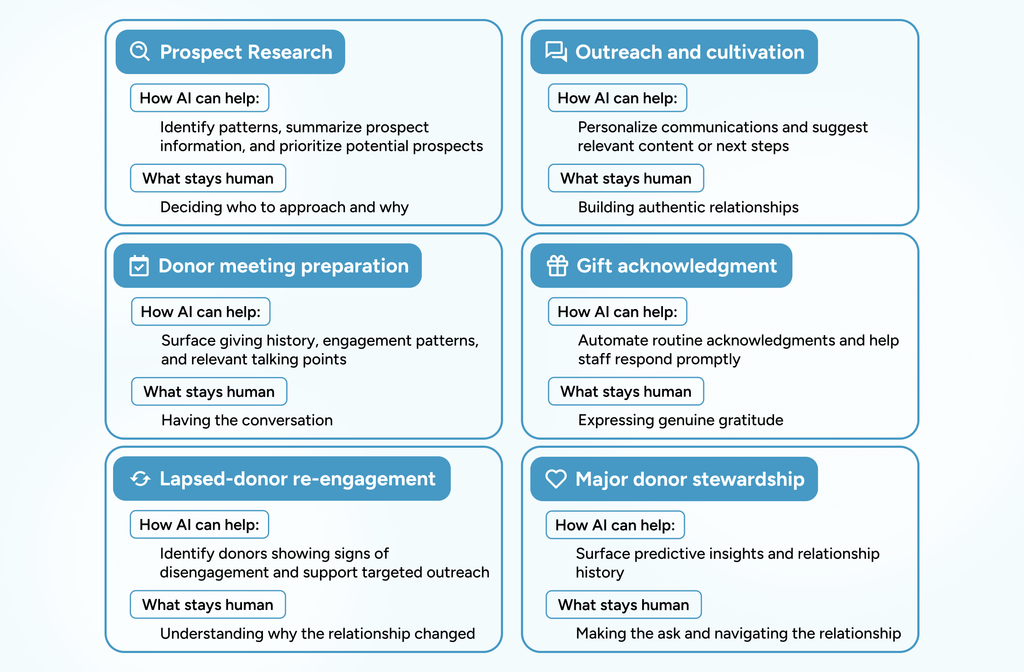
Look at where AI fits most naturally across common workflows. Start with the areas where it can support existing work without disrupting relationship-driven fundraising.
The most effective approach is to identify the repetitive, data-heavy, or time-consuming work AI can support, then free up fundraisers to focus on the conversations and decisions that require human decision-making.
Think of AI as a support layer across the donor journey.
| Donor stage | How AI can help | What stays human |
| Prospect research | Identify patterns, summarize prospect information, and prioritize potential prospects | Deciding who to approach and why |
| Outreach and cultivation | Personalize communications and suggest relevant content or next steps | Building authentic relationships |
| Donor meeting preparation | Surface giving history, engagement patterns, and relevant talking points | Having the conversation |
| Gift acknowledgment | Automate routine acknowledgments and help staff respond promptly | Expressing genuine gratitude |
| Lapsed-donor re-engagement | Identify donors showing signs of disengagement and support targeted outreach | Understanding why the relationship changed |
| Major donor stewardship | Surface predictive insights and relationship history | Making the ask and navigating the relationship |
Prospect Research and Identification
Prospect research can be one of the most time-consuming parts of fundraising. Staff may need to review giving histories, engagement records, event attendance, organizational affiliations, and other information to determine which prospects deserve additional attention.
AI tools can help make that process more efficient by detecting patterns and surfacing relevant information from existing data.
For example, AI prospect research could help a fundraising team identify individuals whose past engagement suggests they may be ready for deeper cultivation. Rather than replacing prospect research entirely, AI can help staff prioritize where to spend their limited time.
Staff should always review AI-generated recommendations and add the context that only someone familiar with the donor relationship can provide.
Personalized Outreach and Cultivation
Personalization is increasingly expected in donor communications, but creating genuinely relevant outreach at scale can be difficult for small teams.
AI can help fundraisers organize donor information and create communication starting points based on interests, past engagement, giving history, or other appropriate data.
Used well, AI donor engagement isn’t about sending every donor a different machine-generated email. It’s about helping staff understand what may be relevant to different audiences so communications can be timelier and more meaningful.
Human review continues to be essential. Fundraisers should guarantee the message sounds authentic, reflects the organization’s voice, and makes sense in the context of the donor’s relationship with the organization.
Donor Meeting Preparation
A donor meeting may last an hour, but preparation can take much longer.
An AI assistant for nonprofit and association fundraising can help staff quickly review a donor’s giving history, engagement activity, previous interactions, and other relevant information before a meeting.
That can turn hours of information gathering into a much shorter review process. However, a fundraiser still needs to understand the donor’s motivations, listen carefully, raise thoughtful questions, and respond to what the donor actually says.
Gift Acknowledgment
Timely acknowledgment is a relatively straightforward area where AI and automation can help. When a donor makes a gift, AI-assisted workflows can help trigger or prepare an appropriate acknowledgment, decreasing the risk that routine administrative work is missed.
This is highly beneficial for small fundraising teams managing large numbers of donors.
Automation shouldn’t mean identical communication for every situation. High-value gifts, first-time major contributions, memorial gifts, and other significant moments may require a more personal response from a member of the fundraising team.
Lapsed-Donor Re-Engagement
Donor retention is often less expensive and even more sustainable than constantly finding new donors, but it can be difficult to tell when a donor is beginning to disengage.
AI tools can examine historical giving and engagement behaviors to identify donors who are at risk of lapsing. This predictive donor analytics allows fundraisers to intervene before a donor disappears from the active file.
Major Donor Cultivation and Stewardship
AI can help fundraisers prepare for major donor interactions by surfacing relevant giving history, involvement trends, and relationship information. It may also detect patterns that would otherwise be difficult to spot across a large donor database.
These capabilities can make AI valuable for major donor cultivation. Fundraisers need to use AI-generated insights as one source of information alongside their own knowledge of the donor, conversations with colleagues, and professional judgment.
Where Should Fundraisers Start?
Not every AI initiative requires a major technology overhaul. Research found that 39% of organizations using AI cite repetitive administrative tasks as their top frustration and as the technology’s primary use case. Organizations that have moved AI from experiment to operation are already reporting meaningfully lower operational friction.
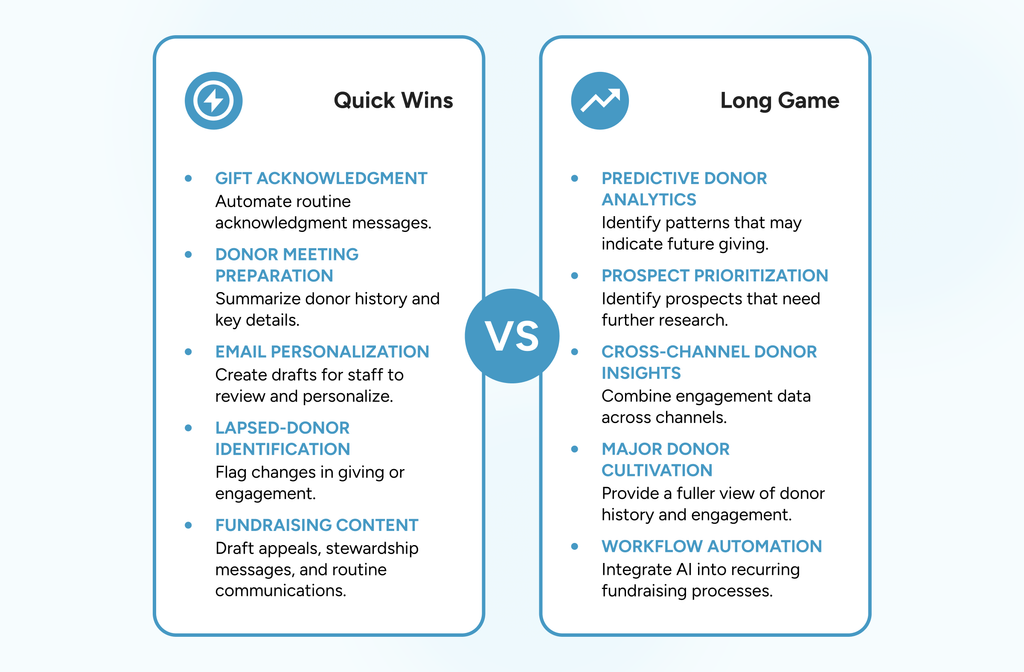
For a small fundraising team, the best first step may be to find one or two workflows where staff spend too much time on repetitive work. From there, the organization can build experience, establish governance practices, and determine where more advanced AI capabilities make sense.
Quick Wins
These opportunities can often provide value without requiring a major transformation:
- Gift acknowledgment: Help automate regular acknowledgment communications.
- Donor meeting preparation: Summarize donor histories and surface relevant information.
- Email personalization: Create communication starting points that staff can review and personalize.
- Lapsed-donor identification: Flag changes in engagement or giving patterns.
- Fundraising content: Support drafting appeals, stewardship messages, and routine communications.
Longer Initiatives
More sophisticated AI-powered nonprofit fundraising solutions generally require stronger data foundations and greater organizational alignment:
- Predictive donor analytics: Observe patterns that may indicate future giving behavior.
- Prospect prioritization: Help staff determine which prospects warrant additional research.
- Cross-channel donor insights: Bring engagement information together across fundraising touchpoints.
- Major donor cultivation: Give fundraisers a more complete picture of donor history and engagement.
- Workflow automation: Integrate AI into recurring fundraising processes instead of treating it as a standalone tool.
AI in Action: What Could This Look Like for a Fundraising Team?
Consider a small development team preparing for its year-end campaign. Instead of manually reviewing hundreds of donor records, the team could use AI to identify donors whose involvement patterns suggest they’re likely to respond to an appeal. Staff could then segment those donors and review suggested communication approaches.
Before meetings with higher-value donors, fundraisers could use an AI assistant to summarize giving history and recent engagement. After gifts arrive, AI-assisted workflows could help ensure prompt acknowledgments.
The team hasn’t handed fundraising over to AI. Instead, it has reduced the administrative workload surrounding fundraising.
The best AI solutions for automating nonprofit and association fundraising don’t remove the human relationship between donor and fundraiser. Instead, they create more room for them.
What AI Shouldn’t Do in Fundraising
AI has real limitations, and responsible organizations ought to acknowledge them before implementing new tools.
AI Can’t Replace Relationship-building
A donor relationship is more than data points. AI can offer context, but fundraisers need to build trust and understand the person behind the record.
AI Can’t Fix Poor-quality Data
If your donor records are incomplete, duplicated, outdated, or inconsistent, AI-generated insights may be unreliable. Strong data hygiene is a prerequisite for meaningful AI results.
AI Shouldn’t Make Every Fundraising Decision
AI can spot patterns and make recommendations, but staff should decide how to understand and act on those insights, especially when major gifts or sensitive donor relationships are involved.
AI Shouldn’t Operate Without Governance
Nonprofits and associations should create clear guidelines around privacy, security, appropriate data use, human review, and the types of information staff can enter into AI systems.
The goal isn’t to eliminate risk. It’s to create a framework for managing it.
Is Your Organization Ready for AI? A Fundraising Readiness Checklist
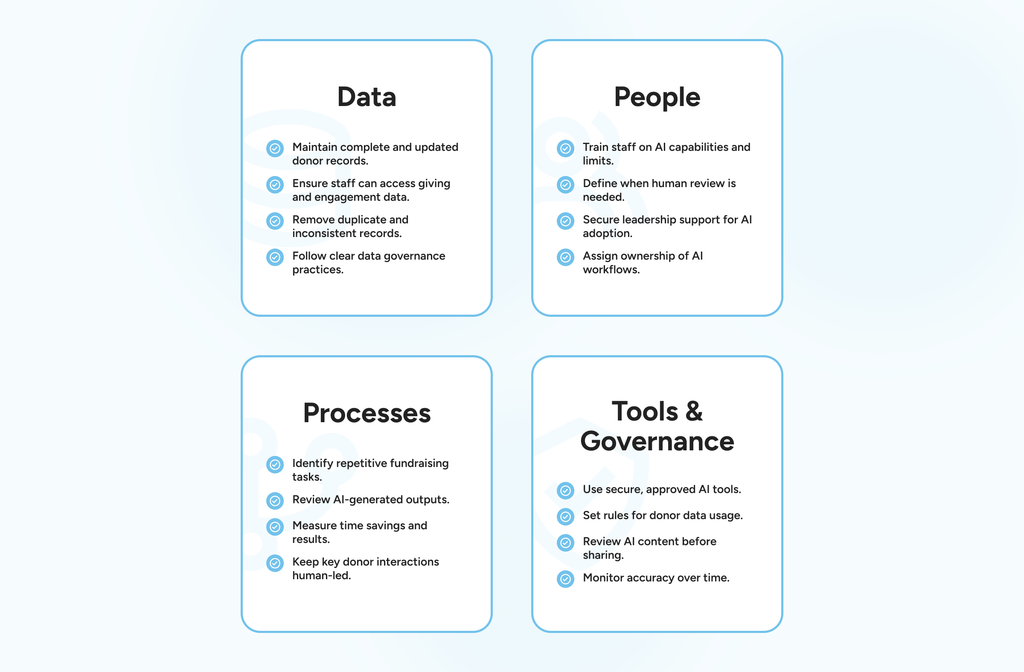
Before investing heavily in AI for nonprofit and association fundraising, take a close look at your organization’s data, people, processes, and technology.
You don’t need everything perfected to get started. But you should understand where your foundation is strong and where you may need to do more work.
Data
- Donor records are reasonably complete and up to date.
- Giving and engagement data is accessible to appropriate staff.
- Duplicate and inconsistent records are addressed.
- Your organization has clear data governance practices.
People
- Fundraising staff understand what AI can and cannot do.
- Staff know when human review is required.
- Leadership supports responsible AI adoption.
- Someone is accountable for monitoring AI-assisted workflows.
Processes
- You’ve identified repetitive fundraising tasks that consume staff time.
- You have workflows for reviewing AI-generated outputs.
- You can measure whether AI saves time or improves results.
- You’ve identified donor interactions that should remain human-led.
Tools and governance
- AI tools meet your organization’s privacy and security requirements.
- Staff understand what donor information can and cannot be entered into AI systems.
- Before reaching donors, you review AI-produced content and analysis.
- You have a plan to monitor accuracy over time.
If several boxes remain unchecked, that doesn’t necessarily mean your organization isn’t ready for AI. It may simply mean your first project should concentrate on improving data quality, clarifying workflows, or building staff confidence before moving into more advanced applications.
Where to Start with AI in Nonprofit and Association Fundraising
The most successful approach to AI in nonprofit and association fundraising solves a real problem at your organization.
Start by asking your fundraising team:
What takes up the most time that doesn’t actually require a human relationship?
That could be researching donor histories, preparing routine communications, acknowledging gifts, reviewing engagement data, or identifying changes in donor behavior.
Once you’ve identified that workflow, look for an AI solution that can make it faster or more useful, without removing the human insight that makes fundraising effective.
From there, measure the results. Did staff save time? Did response rates improve? Did fundraisers gain better insight into their donors? Did the technology make it easier to provide a more personal experience?
Those answers can help determine where AI should go next.
Put AI to Work Across your Donor Lifecycle
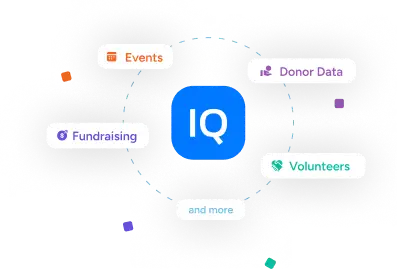
MomentiveIQ brings AI into fundraising workflows, saving your team’s time by automating routine outreach and acknowledgment, surfacing predictive giving insights, and keeping every action governed and auditable.
FAQ
AI in nonprofit fundraising uses artificial intelligence to analyze donor information, discover patterns, automate repetitive tasks, personalize communications, and support fundraising decisions. It can help with prospect research, donor engagement, gift acknowledgment, retention, and stewardship, while leaving relationship-building and key decisions to fundraising professionals.
It can if it replaces human interaction. Used strategically, however, AI can make donor relationships more personal by giving fundraisers more time and better information. AI can manage repetitive research and administrative work while fundraisers focus on conversations, stewardship, and understanding individual donor needs.
Small teams can start with repetitive, lower-risk workflows such as gift acknowledgment, donor meeting preparation, routine communication drafts, donor segmentation, and identifying lapsed or potentially disengaged donors. Starting small allows teams to demonstrate value before investing in more advanced AI capabilities.
It depends on the AI system, your organization’s policies, and how the technology handles data. Nonprofits should evaluate privacy, security, data governance, access controls, and human-review requirements before using AI with donor information. Staff should also have definite guidelines on what information they can enter AI tools.
Begin by assessing your data quality, staff readiness, workflows, technology, and governance practices. You don’t need a perfect infrastructure to begin. Still, your organization should know its data and have a clear use case, appropriate safeguards, and a process for reviewing AI-generated outputs.
Relationship-building, sensitive conversations, major gift strategy, interpreting donor motivations, and important fundraising decisions should remain human-led. AI can provide information and recommendations, but fundraisers should use professional judgment to determine how those insights affect a donor relationship.