
A first-time donor gives at your fall event. If nothing happens next, no thank-you, no update, no second ask, that gift is usually the last one you’ll see from them. Closing that gap is what donor management does. Get it right, and your donor base is retained and grows year over year instead of quietly shrinking.
What Is Donor Management?
Donor management is the ongoing practice of collecting donor information, tracking every interaction, and using that record to build relationships that lead to repeat giving. It spans the full donor journey, from a first gift through renewal, and it’s how a nonprofit turns one-time donations into dependable support.
It helps to separate three things that often get blurred together. Donor management is the practice. Donor management software (sometimes called a donor CRM or donor database) is the tool that supports the practice. Donation software is a narrower tool that only collects and processes gifts. You can raise money with donation software alone, but without the record and the follow-up that donor management provides, you’re starting from zero with every campaign.tware alone, but without the record and the follow-up that donor management provides, you’re starting from zero with every campaign.
Picture a food bank that runs a spring drive and a year-end appeal. Good donor management means the volunteer who gave in the spring gets a thank-you that references the spring drive, an impact update over the summer, and a year-end ask that already knows what they care about. Three touches, one donor, and a story that carries through instead of resetting every campaign.
How Does Donor Management Work?
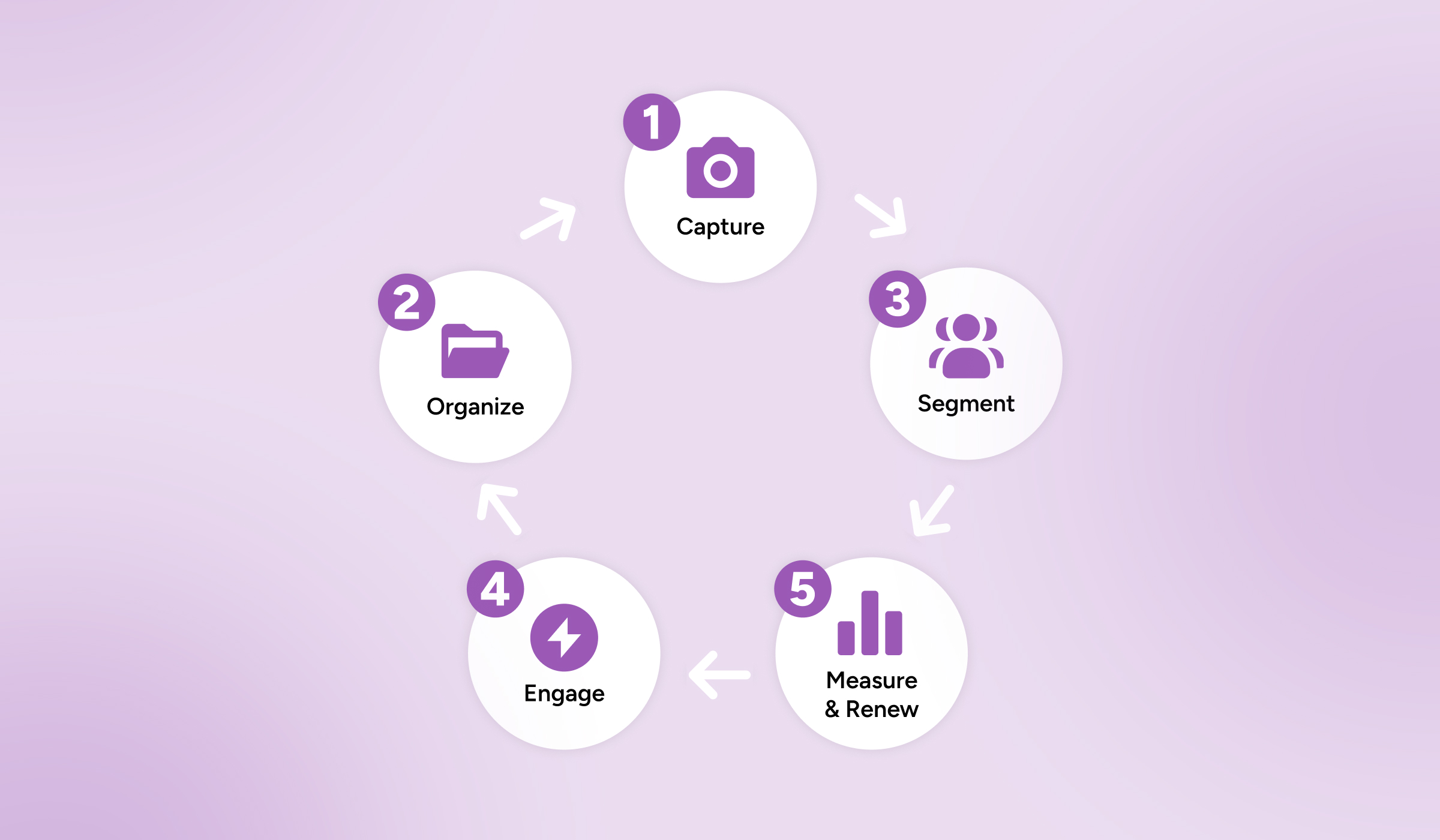
Donor management follows a repeating cycle. Each gift feeds the next relationship, so the process rarely has a true “end.”
Capture the data. Every gift, event registration, email open, and volunteer shift is recorded in a single donor profile, ideally the moment it occurs, rather than later through manual entry.
Organize and clean it. Duplicate records are merged, contact details are updated, and giving history is attached to the right person, so the profile stays trustworthy.
Segment your donors. Supporters get grouped by behavior or interest: first-time givers, lapsed donors, monthly sustainers, and/or event attendees. Good donor segmentation makes outreach more specific rather than generic.
Engage and steward. Each segment gets the right message at the right time, from an automated thank-you to a personal call for a major gift. This is where the relationship actually gets built.
Measure and renew. Retention, average gift, and campaign results tell you what worked, and those insights shape the next ask. Then the cycle starts again with better information.
None of these steps is heavy on its own. The value comes from doing them consistently, so no donor slips through the gap between a gift and the next conversation. That consistency is hard to hold in a spreadsheet and much easier when the record and the reminders live in one system.
Key Features of Donor Management Software
The market is crowded, and most tools sound similar, making them hard to tell apart. It’s easier to compare them by the jobs they actually have to do. Underneath the marketing, a donor management platform is responsible for three things: holding your donor data, moving it where it needs to go, and making it usable when you sit down to plan outreach.
A handful of features do most of that work. These are the ones worth checking for before you commit:
- Centralized donor profiles. One record per donor holds contact details, giving history, communication preferences, and notes from every interaction.
- Gift and pledge tracking. The system logs one-time gifts, recurring donations, and pledges, and it reconciles them without a manual spreadsheet. See gift and pledge tracking for what that looks like in practice.
- Segmentation and lists. Filters let you build audiences easily, so that your appeals can target your donor segments with the right messaging.
- Automated acknowledgments. Thank-you emails and tax receipts are automatically sent when a gift comes in, protecting the most time-sensitive moment in the donor relationship.
- Reporting and dashboards. Retention rate, donor lifetime value, and campaign performance surface in views your team and board can actually read.
- Integrations. Connections to your donation forms, accounting system, and email tools mean data moves between systems instead of getting re-keyed by hand.
You may not need every one of these on day one, and no single feature is the obvious starting point. Which ones matter most depends on how you raise money. An events-driven team leans hardest on tracking and integrations, while a team built around recurring giving cares more about segmentation and automated acknowledgments. Knowing your own priorities first keeps a demo from steering you toward capabilities you’ll never touch.
Types of Donor Management Tools
Nonprofits generally manage donors with one of three approaches, and the right one depends on size, budget, and how much you’re trying to grow.
| Approach | Best for | Trade-off |
| Spreadsheets | Very small or brand-new organizations | Free and familiar, but breaks down fast as data and volunteers grow |
| Standalone donor CRM | Teams that want a dedicated system of record | Strong donor data, but may need integrations for events or accounting |
| All-in-one fundraising platform | Teams that run events, online giving, and stewardship together | One connected system, so gifts and donor records stay in sync |
Most growing nonprofits eventually land on the third option. Once you’re raising money across events, online giving, and direct appeals, keeping gifts and donor records in the same place eliminates the manual syncing required by a standalone tool or a spreadsheet.
Benefits of Donor Management
It’s worth being specific about what donor management changes. Two things improve in ways you can measure: how many of your donors come back, and how much of your team’s week goes to administrative work instead of relationships. Almost every other benefit flows from those two.
Here’s where the difference shows up day to day:
- You keep more donors. Strategic follow-up is the single biggest lever for donor retention, and a managed record is what makes that follow-up possible.
Editorial note (remove before publishing): drop in the verified donor-retention or time-saved figure from the Momentive Nonprofit Research Study here once confirmed. Don’t ship an invented number.
- Your outreach gets specific. Segmentation lets you ask the right donor for the right thing, which boosts response rates compared to a single mass appeal.
- Manual work drops. Automated receipts, synced donation data, and built-in reporting eliminate hours of data entry, so a small team can act like a larger one.
- Your reporting gets trustworthy. When every gift lives in one place, board reports, and grant applications pull from real numbers rather than a reconciled guess.
- Decisions get sharper. Lapsed-donor reports, giving trends, and campaign results tell you where to spend limited time and budget.
Put together, these gains compound. A team that keeps more donors and spends fewer hours on data entry has more room for the relationships that fund the next campaign. Managing donors well means doing more than recording their gifts.
Donor Management vs CRM
A donor management system is a type of CRM built specifically for nonprofits, so the terms overlap, but they aren’t identical. A general CRM tracks sales pipelines and business contacts; a donor CRM tracks gifts, pledges, campaigns, and the donor journey. Here’s how they compare:
| General CRM | Donor management (donor CRM) | |
| Built for | Sales and business relationships | Nonprofit fundraising and donors |
| Core record | Leads, deals, accounts | Donors, gifts, pledges |
| Key metrics | Revenue, pipeline, close rate | Retention, lifetime value, campaign ROI |
| Money handling | Invoices and quotes | Donations, recurring gifts, receipts |
| Compliance needs | Standard business | Tax receipts, donor privacy, gift acknowledgment |
If you’re weighing a general CRM against a purpose-built donor CRM, the deciding factor is usually whether you need fundraising-specific features like automated tax receipts and gift tracking out of the box.
Who Needs Donor Management?
Any organization that relies on charitable giving benefits from donor management, and the need grows as the donor base grows. Nonprofits, foundations, faith-based organizations, schools and PTAs, healthcare and arts institutions, and membership associations that fundraise all fit here. A small group tracking 50 donors in a spreadsheet may get by for a while, but the moment giving spans multiple campaigns and channels, a real system pays for itself. If your team can’t tell you who gave, who lapsed, or who still needs a thank-you, you’ve outgrown manual methods.
If retention is where you’re losing ground, start with a few proven donor-retention strategies, then match the tool to them.
How to Choose Donor Management Software
Choosing a tool is less about finding the one with the longest feature list and more about matching a system to the way your team already works. Before you sit through a round of demos, it helps to agree internally on what you’re solving for, so a polished presentation doesn’t pull you toward features that look impressive but never get used.
A few questions to work through as a team:
- Match it to your size and growth. Don’t buy an enterprise platform for 200 donors, and don’t cap yourself with a tool you’ll outgrow in a year.
- Check the integrations. Confirm it connects to your donation forms, accounting system, and email platform, so data doesn’t have to be re-entered by hand.
- Look at reporting. You want retention and lifetime-value views your board can read, not just gift totals.
- Test the day-to-day. The team living in the tool should find it usable; a demo with your real workflow tells you more than a feature list.
- Weigh total cost. Include setup, training, and payment-processing fees, not just the subscription.
Once you’ve narrowed the field, run your top two or three options against a real scenario from your own calendar, like your year-end appeal or your biggest event of the year. The tool that makes your hardest week easier is usually the right one, regardless of the feature comparison.
Bring Donor Relationships Into One Place
Donor management works best when your gifts, records, and follow-up are in one connected system rather than scattered spreadsheets. Momentive Software’s donor management software gives nonprofit teams a single donor record, built-in segmentation and reporting, and automated acknowledgments, so you spend less time on data entry and more time on relationships. Our fundraising and donor management platform, GiveSmart, brings giving and donor management together in one place. See how it fits your team, and request a demo when you’re ready.
Frequently Asked Questions
What’s the difference between donor management and a CRM?
Donor management is a type of CRM built for nonprofits. A general CRM tracks sales leads and deals, while a donor CRM tracks gifts, pledges, campaigns, and the donor journey. Both centralize relationships, but a donor CRM adds fundraising-specific tools, such as tax receipts and gift acknowledgment.
What is donor management software?
Donor management software is a platform that stores donor information, tracks giving history and interactions, and helps nonprofits build relationships that increase repeat giving. It replaces spreadsheets with a single donor record and adds reporting, segmentation, and automated acknowledgments.
Why is donor management important for nonprofits?
Donor management is important because retention drives fundraising, and retention depends on consistent follow-up. A managed donor record lets a nonprofit thank, update, and re-engage supporters at the right time, turning one-time gifts into ongoing support and stabilizing revenue.
What should donor management software include?
At a minimum, donor management software should include centralized donor profiles, gift and pledge tracking, segmentation, automated acknowledgments, reporting dashboards, and integrations with your donation and accounting tools. These features cover the full cycle from capturing a gift to renewing the relationship.
How is donor management different from donation software?
Donation software only collects and processes gifts, such as an online donation form. Donor management goes further: it stores donor records, tracks every interaction, and supports follow-up that leads to a second gift. Many teams need both, and the strongest platforms combine them.