
Every organization that leans on volunteers has lived this moment: a shift goes uncovered, a text goes unanswered, and someone on staff quietly does the job themselves rather than chase it down again. Volunteers didn’t cause that gap. The process supporting them wasn’t strong enough to hold it.
That process has a name: volunteer management. Done well, it’s the difference between a rotating cast of well-meaning people and a team your programs can actually plan around. This guide breaks down what volunteer management means, how the lifecycle runs from recruitment through retention, what a volunteer manager owns day to day, and the habits that separate programs that keep their volunteers from those that quietly lose them.
What Is Volunteer Management?
Volunteer management is the ongoing work of recruiting, onboarding, scheduling, communicating with, recognizing, and retaining the people who give their time to your mission. It covers every touchpoint between your organization and a volunteer, from their first sign-up to their five hundredth hour served. Done well, it turns a list of names into a reliable, engaged team your programs can actually count on.
See how VolunteerMatters, Momentive’s volunteer management platform, brings it together: recruitment, scheduling, communication, and tracking in one connected platform, built for nonprofits and associations.
Why Volunteer Management Matters
Volunteers aren’t free labor, and treating them that way is the fastest way to lose them. Their time carries real, measurable value: Independent Sector and the Do-Good Institute estimate the worth of a single volunteer hour at $36.14 in 2025. Multiply that across a roster, even for a few hours a month, and the contribution can rival a paid position your budget could never cover. Protecting that contribution is the job.
Strong volunteer management pays off in three concrete ways:
- Lower recruiting costs. Every volunteer who returns is one you don’t have to find, screen, and train from scratch. Retention is cheaper than acquisition.
- Steadier program delivery. Experienced volunteers need less supervision and make fewer mistakes, so your programs run on a more predictable footing.
- A stronger pipeline. Today’s reliable Saturday volunteer is tomorrow’s shift lead, committee member, or board candidate.
The competition for people’s time is real, too. Roughly 75.7 million people formally volunteered in the United States between September 2022 and September 2023, and nearly 2 million registered nonprofits are competing for those hours. Keeping the volunteers you already have is usually easier than winning new ones.
How Does Volunteer Management Work? The Volunteer Lifecycle
Volunteer management follows a repeating cycle, often called the volunteer lifecycle. Each stage feeds the next, and a weak link anywhere tends to show up as people quietly dropping off.
- Recruitment. Define the role, then find people who fit it. A clear ask (“we need two drivers on Thursday mornings”) outperforms a vague one (“come help out”).
- Onboarding and training. Welcome new volunteers, set expectations, and give them the skills and context to contribute without guesswork. The first impression decides whether a person returns.
- Scheduling and coordination. Match the right people to the right shifts, avoid gaps and double-bookings, and make it easy for volunteers to see where they’re needed.
- Engagement. Keep volunteers connected to the mission through steady communication, feedback, and ongoing engagement, so the work continues to feel worth their time.
- Recognition. Thank people specifically and often. Recognition costs little and does more for retention than almost anything else.
- Retention and growth. Track who stays, learn why others leave, and move committed volunteers into larger roles.
The cycle doesn’t fully close, either. A volunteer you’ve retained well tends to re-enter recruitment on their own, as an advocate who brings friends.

What Does a Volunteer Manager Do?
The volunteer manager, sometimes called a volunteer coordinator, owns that lifecycle. At a small nonprofit, that might be one person wearing several hats. At a larger one, it might be a full team. Either way, the core responsibilities stay fairly consistent:
- Role design. Turning organizational needs into clear, doable volunteer positions.
- Recruitment and screening. Attracting candidates and, where the work calls for it, running background or reference checks.
- Training. Preparing volunteers for the task and for the culture around it.
- Scheduling. Covering every shift without burning out the reliable few.
- Communication. Being the steady point of contact volunteers can reach with a question.
- Recognition and retention. Noticing good work, saying so, and keeping people invested.
- Tracking and reporting. Recording hours, activity, and outcomes for grant reports, boards, and funders.
Volunteer Management Best Practices
A handful of habits tend to separate programs that hold on to volunteers from programs that churn through them.
- Write specific role descriptions. People commit to clear expectations, not open-ended favors.
- Onboard everyone, even for short roles. A 15-minute orientation prevents hours of confusion later.
- Communicate on the volunteer’s terms. Text reminders, simple sign-up links, and mobile-friendly schedules meet people where they already are.
- Ask for feedback, then act on it. A short post-event survey signals that opinions count, and volunteers who feel heard tend to stay.
- Recognize contribution publicly and personally. A named thank-you beats a generic one every time.
- Measure what matters. Track retention, hours, and no-show rates so you can see problems before they cost you people.
Common Challenges in Volunteer Management and How to Solve Them
Even committed programs run into the same problems, year after year.
- No-shows and last-minute cancellations. Usually a sign of weak reminders and fuzzy commitments. Automated confirmations, a waitlist for popular shifts, and a quick check-in the day before solve most of it.
- Volunteer burnout. Comes from a handful of dependable people carrying too much. Spread the load, rotate demanding roles, and watch your hours data for anyone trending toward overuse.
- High turnover. Often, this means volunteers never see the impact of their work. Close the loop by showing results (“your Saturday packed 400 meals”) and offer them a path to grow.
- Administrative overload. Builds up when spreadsheets, email threads, and paper sign-in sheets don’t talk to each other. Consolidate scheduling, communication, and tracking so the coordinator spends time on people, not paperwork.
The average nonprofit retains roughly 65% of its volunteers year over year, which means about one in three don’t return. Closing that gap usually comes down to how a program is run, not the volunteers themselves.
How Is Volunteer Management Different From Managing Employees?
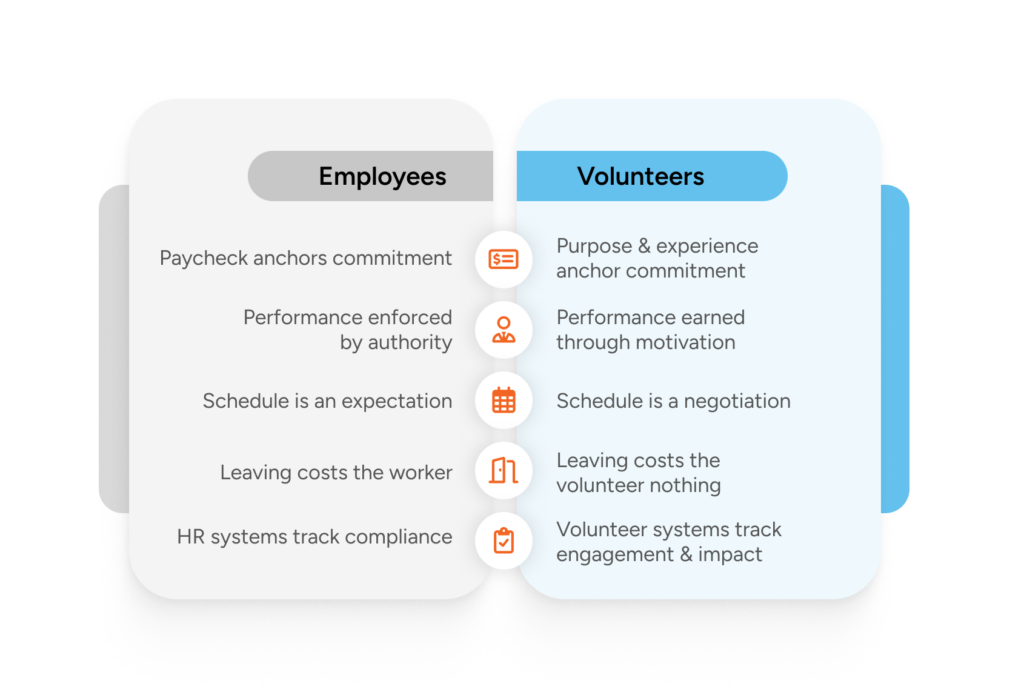
Managing volunteers and managing employees look similar on the surface. Both involve schedules, expectations, and feedback. But the relationship runs on entirely different terms, and the instincts that work for paid staff can quietly push volunteers away.
| Managing employees | Managing volunteers |
| A paycheck anchors the commitment | Purpose and experience anchor the commitment |
| Performance is enforced through authority | Performance is earned through motivation |
| The schedule is an expectation | The schedule is a negotiation around real lives |
| Leaving carries a cost to the worker | Leaving carries no cost to the volunteer |
| HR systems track compliance | Volunteer systems track engagement and impact |
With volunteers, you lead through meaning rather than obligation. Every process, from scheduling to recognition, should reduce friction and reinforce why the work is worth their time.
What Is Volunteer Management Software?
Once a program grows past a couple of dozen people, spreadsheets and group emails start to crack. Volunteer management software brings recruitment, scheduling, communication, hour tracking, and reporting into one place, so a coordinator can see the whole program at a glance and volunteers can sign up, swap shifts, and log hours on their own.
The right system doesn’t replace the human relationship at the center of volunteering. It removes the administrative drag, giving the coordinator more time for the parts of the job that a tool can’t handle. For nonprofits and associations already juggling membership, events, and fundraising, volunteer coordination tends to work best when it connects to those same systems rather than running in a silo.
How to Build a Stronger Volunteer Program
If you’re starting from scratch or rebuilding, work through the lifecycle in order. Start with roles, not recruitment: know exactly what you need before you ask anyone to fill it. Make the first experience excellent. A smooth first shift, backed by solid onboarding, is your best retention tool. Communicate more than feels necessary, in the channels volunteers actually use. Track a few numbers from day one: retention, hours, and no-shows. Then reinvest in the people who stay, since a growth path is often what keeps your strongest volunteers from drifting.
Put the people first, and the coordination stops feeling like paperwork. It’s how you make their time count.
Frequently Asked Questions About Volunteer Management
What is volunteer management in simple terms?
Volunteer management is how an organization recruits, trains, schedules, and retains its volunteers. It covers the entire experience, from the moment someone signs up to the follow-up that brings them back. The goal is simple: give volunteers meaningful work and a clear reason to return.
What does a volunteer manager do?
A volunteer manager designs volunteer roles, recruits and trains people to fill them, schedules shifts, and keeps volunteers engaged over time. They are the main point of contact for volunteers, and they usually handle recognition, retention, and the reporting that boards and funders rely on.
What are the key stages of the volunteer lifecycle?
The volunteer lifecycle usually has six stages: recruitment, onboarding and training, scheduling and coordination, engagement, recognition, and retention. Each stage feeds the next, so a strong onboarding experience makes later engagement and retention far easier. A gap at any stage tends to show up as volunteers quietly dropping off.
How is managing volunteers different from managing employees?
Volunteers are not paid, so their commitment rests on purpose and experience rather than a paycheck. You cannot lean on authority to enforce performance; you lead through motivation and meaning. Leaving costs a volunteer nothing, which makes a good experience the whole ballgame.
What tools do nonprofits use to manage volunteers?
Small programs often start with spreadsheets and email. As they grow, many adopt volunteer management software that combines recruitment, scheduling, communication, and hour tracking in one place. Organizations already running membership or event systems often prefer volunteer tools that connect to them.
How do you improve volunteer retention?
Improve retention by making the first experience smooth, communicating clearly in the channels volunteers use, recognizing contributions specifically, and showing people the impact of their work. Tracking retention and no-show data helps you spot problems early, and offering growth opportunities keeps your most committed volunteers invested.