10 QuickBooks Alternatives for Nonprofits in 2026

QuickBooks is general business accounting software, so nonprofits rely on workarounds to track funds through classes and locations rather than a fund-based chart of accounts. If you are comparing QuickBooks alternatives for nonprofits, you’re probably managing workarounds in grant reporting, board packets, or an audit.
A QuickBooks alternative for nonprofits is fund accounting software that hasa nonprofit uses instead of QuickBooks, typically to get native fund and grant tracking, nonprofit reporting, or an unlimited chart of accounts. different price.
This guide compares 10 alternatives to QuickBooks for nonprofits, including MIP Accounting by Momentive, Aplos, and Sage Intacct—and general-purpose tools such as Xero, Zoho Books, and Wave.
Key takeaways
- QuickBooks Online lists at $38-$340/month. Eligible nonprofits can get a complimentary Plus or Advanced plan through TechSoup, you just pay an annual admin fee.
- QuickBooks Online Plus tracks 40 classes and locations combined, and Advanced is unlimited. Intuit suggests tracking funds with classes and bank sub-accounts.
- Signs you might need a Quickbooks alternative include: Having more restricted grants than classes can track, a month-end close that depends on Excel or other workarounds, and requiring board reports by fund.
- Six of the 10 alternatives are built for nonprofits: MIP Accounting, Aplos, Blackbaud Financial Edge NXT, AccuFund, Araize FastFund, and MoneyMinder. Sage Intacct is an ERP with a nonprofit edition, and Xero, Zoho Books, and Wave are general-purpose.
- The time to switch depends on the complexity of your systems.is at fiscal year-end. Map classes to funds and grants first, and run one close in parallel before you retire QuickBooks.
Is QuickBooks Good for Nonprofits?
NoYes, QuickBooks is not a goodaa good fit for small nonprofits with few restricted funds. While iIt has a low entry price, accountant access on every plan, and class tracking that can stand in for funds, s. Iit stops fitting when grants, audits, or board reporting need fund-level balances, because QuickBooks doesn’t use a fund-based chart of accounts.
How Much Does QuickBooks Cost for Nonprofits?
QuickBooks nonprofit pricing runs from $38 to $340 a month, and eligible nonprofits can get Plus or Advanced through TechSoup for an annual admin fee. Class tracking starts at Plus, listed at $140 a month. Confirm current prices and terms with Intuit and TechSoup before you budget.
Sources: Intuit pricing page and Intuit usage limits, checked October 2026.
| QuickBooks Online plan | List price per month | Users | Classes and locations |
| Simple Start | $38 | 1 | Not available |
| Essentials | $85 | 3 | Not available |
| Plus | $140 | 5 | 40 combined |
| Advanced | $340 | 25 | Unlimited |
When Has Your Nonprofit Outgrown QuickBooks?
Your nonprofit has likely outgrown QuickBooks when fund tracking depends on manual workarounds, such as when your organization has more restricted grants than classes can hold, a single audit, an Excel-dependent close, or board reports by fund. A few of the signs below are reasonable triggers to start evaluating alternatives to quickbooks for nonprofits.
- More restricted grants than classes can track cleanly: The Plus plan caps classes and locations at 40 combined.
- A single audit or Uniform Guidance compliance: Federal award reporting needs fund and grant balances you can trace.
- A month-end close that depends on Excel exports: Each export is another place for a fund balance to drift.
- A board that wants budget versus actual, by fund: Check that fund budgets cover multi-year grants the way funders report them.
- Multiple entities or chapters: Affiliates, chapters, or a foundation need consolidation and intercompany entries.
- Expense allocations across programs: Shared salaries and overhead are easier to audit when allocations run in the system.
- Form 990 functional expense prep done by hand: Organizations that file the full Form 990 (gross receipts of $200,000 or more, or total assets of $500,000 or more, per the IRS) report expenses by function (Part IX), which is slow to prepare by hand.
What Should You Look For in a QuickBooks Alternative?
When you’re looking for a Quickbooks alternative, look for software that tracks restricted funds natively, ties grants to budgets and reports, produces nonprofit financial statements without exports, and handles allocations and multiple entities. From there, you can weigh controls, payroll, implementation, and total cost, because the subscription price is only one part of what a switch costs.
Software built specifically for nonprofits, such as MIP Accounting by Momentive, is designed around these needs. See how nonprofit accounting software handles funds, grants, and reporting in one system.
True fund accounting
Ask whether funds are part of the chart of accounts or a tag layered on top, and whether each fund balances on its own. Good fund accounting software is built around funds, programs, and grants rather than labels added later.
Grant tracking
Check that grants carry their own budgets, award periods, and spending reports, and that your budget software supports projects that span fiscal years.
Nonprofit financial statements
Look for a statement of financial position, a statement of activities, and a statement of functional expenses produced from the system, along with budget versus actual by fund.
Allocations
Shared salaries and overhead should split across programs, funds, and grants by rule.
Multi-entity accounting
If you run chapters, affiliates, or a foundation, ask how consolidation and intercompany entries work and whether extra entities cost more.
Controls and audit trail
Role-based access, workflow automation for approvals, and a change history make audits and single audits easier.
Payroll and HR
Nonprofit payroll that allocates labor costs by fund, grant, or program keeps those costs tied to the right funding source.
Implementation and data conversion
Ask who migrates your QuickBooks history, how long it takes, and whether conversion is included in the quote.
Total cost
Add subscription, modules, users, entities, implementation, training, and support, then compare with the staff time your workarounds consume.
QuickBooks Alternatives for Nonprofits Compared
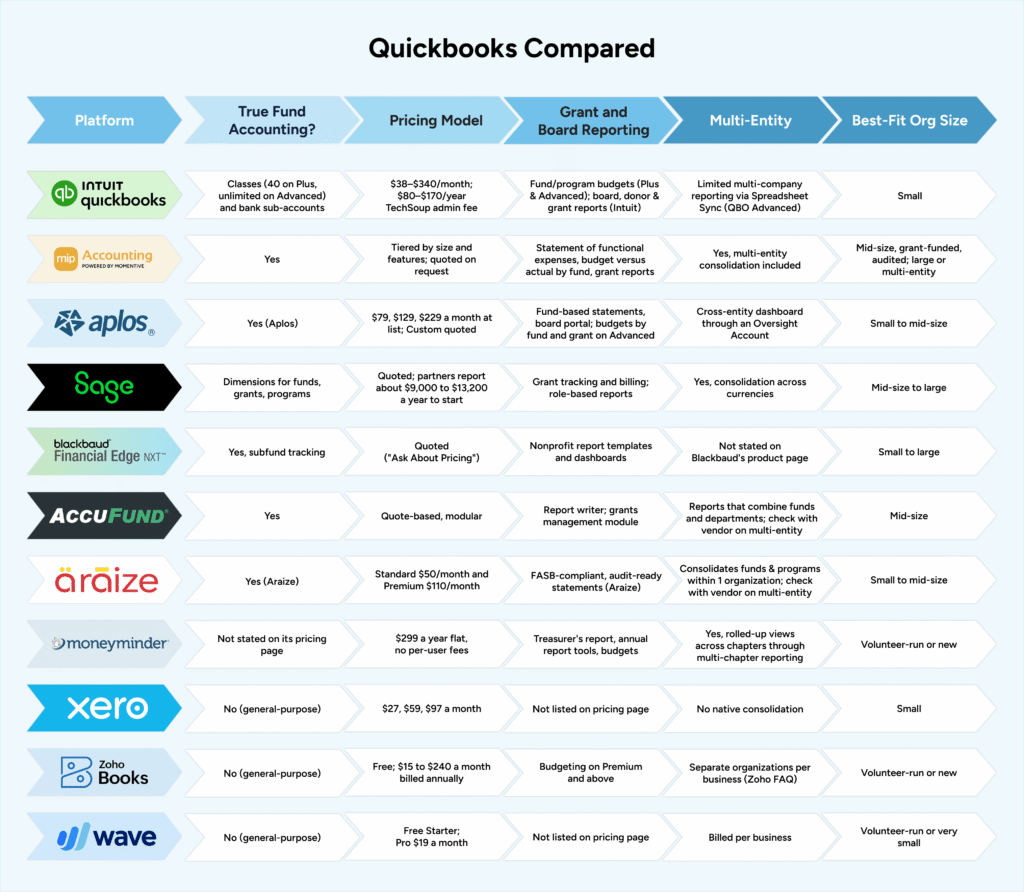
This table compares QuickBooks Online with 10 alternatives on fund accounting, pricing, reporting, multi-entity support, and organization size. Six are built for nonprofits, one is an ERP with a nonprofit edition, and three are general-purpose accounting software.
| Platform | True Fund Accounting? | Pricing Model | Grant and Board Reporting | Multi-Entity | Best-Fit Org Size |
| QuickBooks Online | Classes (40 on Plus, unlimited on Advanced) and bank sub-accounts | $38 to $340 a month; TechSoup admin fee: $80 a year (Plus) or $170 a year (Advanced) | Fund or program budgets on Plus and Advanced; board, donor, and grant reports (Intuit) | Limited: combined multi-company reports in QuickBooks Online Advanced via Spreadsheet Sync | Small |
| MIP Accounting by Momentive | Yes | Tiered by size and features; quoted on request | Statement of functional expenses, budget versus actual by fund, grant reports | Yes, multi-entity consolidation included | Mid-size, grant-funded, audited; large or multi-entity |
| Aplos | Yes (Aplos) | $79, $129, $229 a month at list; Custom quoted | Fund-based statements, board portal; budgets by fund and grant on Advanced | Cross-entity dashboard through an Oversight Account | Small to mid-size |
| Sage Intacct | Dimensions for funds, grants, programs | Quoted; partners report about $9,000 to $13,200 a year to start | Grant tracking and billing; role-based reports | Yes, consolidation across currencies | Mid-size to large |
| Blackbaud Financial Edge NXT | Yes, subfund tracking | Quoted (“Ask About Pricing”) | Nonprofit report templates and dashboards | Not stated on Blackbaud’s product page | Small to large |
| AccuFund | Yes | Quote-based, modular | Report writer; grants management module | Reports that combine funds and departments; check with vendor on multi-entity | Mid-size |
| Araize FastFund | Yes (Araize) | Standard $50/month and Premium $110/month | FASB-compliant, audit-ready statements (Araize) | Consolidates funds and programs within one organization; check with vendor on multi-entity | Small to mid-size |
| MoneyMinder | Not stated on its pricing page | $299 a year flat, no per-user fees | Treasurer’s report, annual report tools, budgets | Yes, rolled-up views across chapters through multi-chapter reporting | Volunteer-run or new |
| Xero | No (general-purpose) | $27, $59, $97 a month | Not listed on pricing page | No native consolidation | Small |
| Zoho Books | No (general-purpose) | Free; $15 to $240 a month billed annually | Budgeting on Premium and above | Separate organizations per business (Zoho FAQ) | Volunteer-run or new |
| Wave | No (general-purpose) | Free Starter; Pro $19 a month | Not listed on pricing page | Billed per business | Volunteer-run or very small |
10 QuickBooks Alternatives for Nonprofits
These 10 QuickBooks alternatives range from purpose-built fund accounting to general small-business tools. Each entry covers cost, features, and who it fits, including how it differs from QuickBooks.
1. MIP Accounting by Momentive

MIP Accounting by Momentive is fund accounting software for nonprofits, associations, and municipalities. Unlike QuickBooks, which tracks funds through classes and locations, MIP Accounting organizes its chart of accounts and reporting around funds, grants, programs, and projects.
Christina P., Director of Finance and Operations at USG Foundation, says of MIP: “I’m not having to manipulate data in order to get information to present.” For an in-depth breakdown of the difference between MIP and Quickbooks, read our MIP vs. Quickbooks blog.
Pricing and fees: Pricing is tiered by organization size and feature needs. Momentive’s implementation covers data migration, system configuration, testing, and training with a dedicated implementation team.
Features: FASB- and GASB-compliant financial statements and a 990 worksheet; statements of functional expenses, budget versus actual by fund, and grant-specific reports from hundreds of templates; approvals, allocations, and recurring entries with audit trails; and nonprofit payroll and HR modules.
Best for: Grant-funded, audited, or multi-entity nonprofits, associations, and municipalities that have outgrown class-based tracking.
2. Aplos

Aplos is fund accounting and nonprofit software for small and mid-size nonprofits and faith-based organizations. Unlike QuickBooks, Aplos has true fund accounting included in every plan.
Pricing and fees: Aplos lists Lite at $79 a month (2 users), Core at $129 a month (2 users), and Advanced at $229 a month (3 users) at list price, with Custom plans quoted.
Features: Every plan includes fund-based statements, bank reconciliation, and a board portal. Core adds basic budgeting, accounts payable and receivable, recurring transactions, and period close. Advanced adds budgeting by fund, grant, department, or project, and dimensional reporting. Expense allocations, fixed assets, bill approvals and bill pay are available on the Custom plan only.
Best for: Small to mid-size nonprofits and faith-based organizations that want published pricing and fund-based statements without an ERP.
3. Sage Intacct

Sage Intacct is a cloud financial management platform, or ERP, with a nonprofit edition built around dimensions for funds, grants, and programs. Unlike QuickBooks, it is a full ERP sold and implemented through partners, and its nonprofit plans include grant tracking and billing and multi-entity consolidation across currencies.
Pricing and fees: Sage Intacct publishes no prices publicly. Sage Intacct partners report subscriptions starting at $9,000/year. Rand Group estimates one-time implementation starting at $25,000.
Features: A dimensional general ledger, role-based reports and dashboards, and modules for fundraising, payroll and HR, nonprofit CRM, and fixed assets.
Best for: Larger or multi-entity nonprofits with finance staff and the budget for a partner-led implementation.
4. Blackbaud Financial Edge NXT

Blackbaud Financial Edge NXT is Blackbaud’s cloud fund accounting software for nonprofits, with subfund tracking for grants, projects, and endowments and automated workflows for restricted funds. Unlike QuickBooks, it is nonprofit-specific and connects to Raiser’s Edge NXT, Blackbaud’s fundraising CRM.
Pricing and fees: Blackbaud lists no prices and directs buyers to an “Ask About Pricing” form.
Features: Subfund tracking; role-based access and document attachments for audit trails; nonprofit report templates and dashboards; and bank and credit card reconciliation.
Best for: Nonprofits that already use Blackbaud’s fundraising products or put donor management first.
5. AccuFund

AccuFund Accounting Suite is modular fund accounting software for nonprofits and government agencies. Unlike QuickBooks, you start with a core system and add modules over time.
Pricing and fees: AccuFund publishes no prices; reach out for quote-based and modular pricing.
Features: A core of general ledger, budgeting, accounts payable, cash receipts, bank reconciliation, and a report writer, with optional modules for payroll, grants management, HR, fixed assets, and allocations.
Best for: Mid-size nonprofits and government agencies that want modular fund accounting and may add modules over time.
6. Araize FastFund

FastFund by Araize is cloud-based nonprofit software that combines fund accounting, payroll, and fundraising, and customers license only the modules they need. Unlike QuickBooks, which is sold in tiered plans, Araize licenses modules separately.
Pricing and fees: Araize lists Standard at $50 a month and Premium at $110 a month.
Features: Fund accounting for restricted funds, grants, programs, and budgets; FASB-compliant, audit-ready statements; payroll allocated by fund, grant, or program; and a separate donor management and online giving module.
Best for: Small to mid-size nonprofits that want modular fund accounting, payroll, and fundraising from one vendor, according to Toolradar’s assessment.
7. MoneyMinder

MoneyMinder is accounting software for small, volunteer-run nonprofits and brand-new organizations, according to MoneyMinder. It includes dues tracking, reimbursement approvals, treasurer reports, and custom budgets. Unlike QuickBooks, it charges one flat annual price with no per-user fees.
Pricing and fees: MoneyMinder lists $299 a year and says there are no setup fees and no per-user charges.
Features: Unlimited bank registers, a reconciliation wizard, a treasurer’s report, membership and dues tracking, reimbursement approvals, and role-based permissions.
Best for: Volunteer-run and brand-new nonprofits with simple bookkeeping needs.
8. Xero
Xero is cloud accounting software for small businesses. Unlike QuickBooks, Xero charges no per-user license fees, so board members and reviewers do not add to the subscription.
Pricing and fees: Xero lists its Early plan at $27 a month (20 invoices and quotes, 5 bills), Growing at $59, and Established at $97.
Features: Invoicing and bills, auto-reconcile (a $5 monthly add-on on Early), and cash flow forecasts from 30 to 180 days by plan. Tracking categories are limited to two, which makes fund-level reporting harder to scale.
Best for: Small nonprofits with some restricted funds that want general-purpose cloud accounting and are comfortable tracking funds with their own account structure.
9. Zoho Books

Zoho Books is general-purpose small-business accounting software. Zoho Books has a nonprofit page and a 15% discount for registered charities. Funds are tracked with separate accounts and reporting tags rather than a built-in fund accounting module. Each business runs as its own organization, so there is no consolidated view.
Pricing and fees: Free; Standard at $20/month ($15 billed annually for 3 users); Professional at $50/month ($40 billed annually for 5 users); Premium at $70/month ($60 billed annually for 10 users); and higher tiers up to $275 a month. Extra users cost $3 a month.
Features: Projects and multi-currency start at Professional, and budgeting starts at Premium. You can set up multiple businesses as separate organizations.
Best for: Volunteer-run or brand-new nonprofits that need basic bookkeeping and no restricted-fund reporting.
10. Wave

Wave is accounting software that’s free to start. Wave’s Starter plan costs $0 and covers unlimited invoices, bills, and bookkeeping records. Wave has no nonprofit discount, but unlike QuickBooks, its Starter plan costs nothing.
Pricing and fees: Starter is $0, and Pro is $19 a month or $190 a year. Payroll is an add-on from $25 a month.
Features: Starter records bookkeeping entries manually. Pro adds automatic bank transaction imports through Plaid for supported banks and users with admin, editor, or viewer access.
Best for: Volunteer-run or brand-new nonprofits that have no restricted-fund reporting needs yet.
Which QuickBooks Alternative Fits Your Nonprofit’s Size?
Match the tool to your complexity, not only your budget. QuickBooks sometimes makes sense when you are starting out, but as an organization grows, it is more likely to need a dedicated nonprofit solution such as MIP Accounting by Momentive. Nearly 60% of U.S. nonprofits are “very small,” with annual budgets under $50,000, according to Candid (May 2025), so start with your funding complexity, then compare options by size.
- For large or multi-entity: MIP Accounting, Sage Intacct, and Blackbaud Financial Edge NXT.
- For mid-size, grant-funded, audited: MIP Accounting, AccuFund, and Araize FastFund.
- For small, with some restricted funds: Aplos and Xero. Aplos is built for nonprofits and publishes its prices; Xero is general-purpose and needs a fund structure you design.
- For volunteer-run or brand-new: Stay on QuickBooks Online, or use MoneyMinder, Wave, or Zoho Books.
How Do You Switch From QuickBooks?
Begin planning a switch before you pick a go-live date, this keeps the process from stretching across two systems. Switch at a fiscal year-end, map your classes and locations to funds, grants, and programs, and export your trial balance and open items. From there, you can rebuild your board and grant reports, and run one close in parallel.
- Time the switch to fiscal year-end: That keeps a year of funds and grants in one ledger.
- Map classes and locations to funds, grants, and programs: Decide whether each is a fund, grant, program, or department, and retire workarounds.
- Export the trial balance and open items: Pull the chart of accounts, a trial balance as of the cutover date, open bills and invoices, and contacts from QuickBooks.
- Rebuild board and grant reports: Recreate budget versus actual by fund, grant status, and functional expense reports before go-live.
- Run one close in parallel: Close the first month in both systems and reconcile the differences before you retire QuickBooks.
Momentive’s implementation for MIP Accounting covers data migration, system configuration, testing, and training with a dedicated implementation team.
FAQ: QuickBooks Alternatives for Nonprofits
No, QuickBooks is not a good a good fit for nonprofits. While it has a low entry price, accountant access on every plan, and class tracking that can stand in for funds, it stops fitting when grants, audits, or board reporting need fund-level balances, because QuickBooks doesn’t use a fund-based chart of accounts.
No. Intuit’s guidance is to track funds with class tracking and bank sub-accounts, and QuickBooks Online Plus caps classes and locations at 40 combined, while Advanced is unlimited. That can work with a few funds. But with many grants, expect more setup, more exports, and more manual reconciliation to confirm fund balances.
Comparison pages tend to group options by size. Small nonprofits often look at Aplos or MoneyMinder, while grant-funded, audited organizations compare MIP Accounting, AccuFund, Sage Intacct, and Blackbaud Financial Edge NXT.
Large nonprofits move to MIP Accounting when QuickBooks workarounds start costing time. This MIP vs. Quickbooks comparison says standard QuickBooks reports don’t reach the funder-by-funder detail that growing grant portfolios require. MIP tracks every dollar by fund, grant, program, or project, compares budget to actual by fund, and includes a complete audit trail.
Yes. MIP Accounting is fund accounting software, so it can replace QuickBooks for organizations that track funds, grants, programs, and projects. Momentive’s implementation covers data migration, system configuration, testing, and training with a dedicated implementation team. Ask how your QuickBooks history converts and what the timeline looks like for your organization.