How to Use an Online Community to Exceed Member Expectations

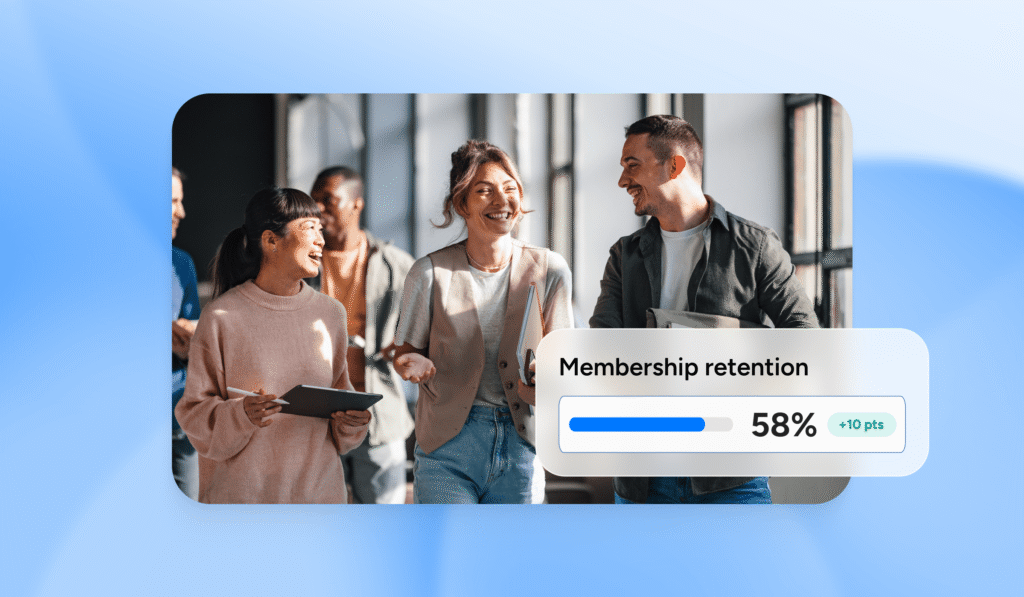
How connected do your members feel to your association? In recent Momentive research, only 29% of members said they feel extremely connected to their association, down from 34% last year.
Satisfaction and members’ likelihood to renew have also slipped, and the steepest drops came from Millennials and mid-career members.
VISUAL STAT: We can reuse an existing visual to accompany that above sentence.
One association professional put the goal simply: “I never want a member to feel like a record in a database.” An online member community is one of the most direct ways to deliver on that mission.
What is an online member community?
An online member community can help your association build connections and offer networking opportunities that keep members engaged between your events. Members ask questions, trade advice, find mentors, and share resources with peers. Unlike a newsletter or a social media page, members talk to each other, building a sense of belonging that keeps them coming back.
Keep reading for what members say makes a community worth their time, and how to build one with the team you have.
Members Want Trusted Peers and Direct Access to Experts
Momentive research examined members’ and nonmembers’ responses to what would make an online member community worth their time. In a survey, they could pick up to five areas. Members chose:
- Trusted peer advice (38%)
- Access to experts (36%)
- Meaningful discussions (36%)
- Career development opportunities (35%)
- Connections with industry leaders (31%)
- Fast answers to questions (30%)
Fast answers to questions (30%) and the latest technology support and best practices (30%) followed closely. Your members want someone who knows the answers, giving them a reason to return to their association and invest in their online community.
Offering Career Value Improves Member Retention and Loyalty
In this year’s research, younger professionals have clearly defined expectations. Among Gen Z nonmembers, 47% say trusted peer advice would make an online community worth their time, 46% say career development, and 40% want fast answers. Gen Z members are more likely to join an online community that helps them move forward professionally.
Older nonmembers respond differently when it comes to their careers. Only 17% of Boomers+ nonmembers rank career development as a draw, and 21% say nothing on the list would make an online community worth their time. Members at different stages of life will need different doors into your association.
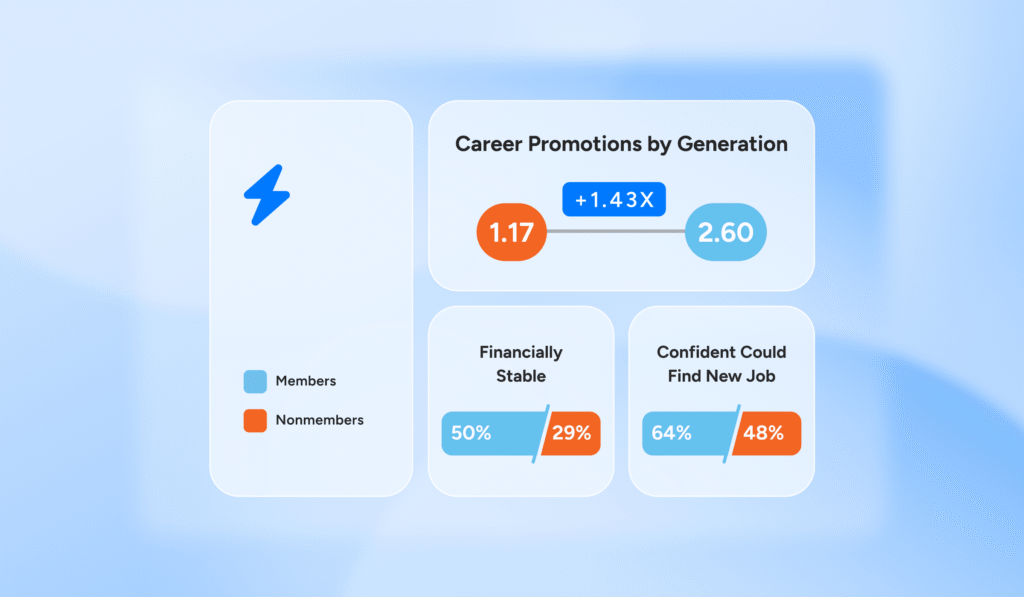
The payoff for those who join associations is easy to see:
THREE VISUALS (ONE STAT AND TWO MEMBERS VS NON COMPARISONS):
| 75% of members say their membership contributed to their professional success. | Average promotions in current job: 2.12 vs 1.22 | Worked with a mentor in the last two years: 20% vs 7% |
TIP: Organize your online member community in easy-to-access groups for your members. For example, create groups by career stage, interest, or chapter so members at different stages can find their own conversation. Help your members connect by generation and consider offering personalized career advice based on their professional life stage.
Give members a reason to stay. Get the Member Retention Playbook for ways to improve onboarding, engagement, and renewals, plus a free four-week email course.
Members Ask People First, Associations Second
When members have a work or professional development question, where do they go? Research shows 49% name their colleagues as one of the sources they use most, and 48% choose their professional association. Search engines follow at 31%, AI tools at 25%, and LinkedIn at 19%.
People bring more people into your organization. Employers (25%) and colleagues (20%) are the top ways members first heard about their association. Every conversation an existing member has with a coworker is an opportunity to increase membership.
TIP: Your association is already a top source for answers. Utilize your online community to provide easy-to-find forums with career resources for your members. Being a go-to resource can strengthen member retention and loyalty.
Your Online Community Is a Major Renewal Strategy
In last year’s association research, peer collaboration was named the number one driver of member renewal intent. This year’s research shows that among members who feel extremely connected to their association, 81% say they are extremely likely to renew. Among members who feel less connected (3 or lower on a five-point scale), only 21% say the same. The data shows a link, not proof that connection causes renewal, but it points to where to focus.
Belonging matters, too: 54% of members feel a sense of belonging and community, compared to 32% of nonmembers. Members who feel a strong sense of community are more satisfied, more likely to promote their association, and more likely to renew.
Most associations already know the importance of creating this sense of community to drive member retention and loyalty:
- 43% of association professionals say their organization uses online community software.
- 44% of members report a strong sense of community.
Owning an online community doesn’t guarantee your members will feel a strong sense of connection. Association teams see that. The 2026 Association Trends Report shows engagement (52%) and helping members network and collaborate (51%) are both among their top priorities for the next year.
TIP: Your online member community doesn’t have to be perfect for your members to connect. But you do need to offer engagement opportunities to create a vibrant community. Consider electing member ambassadors to post conversations in your online community and keep conversation flowing.
How to Build a Healthy Online Member Community
If members want to connect and association professionals are prioritizing the online member communities to make meaningful connections happen, what gets in the way? Not having enough work hours.
A healthy online community needs hosts. Your member community needs someone to welcome new members, nudge a stalled thread, and follow up if a member goes quiet. However, your staff already has their hands full with renewals, records, and reaching new members.
One association professional named this among their biggest fears:
“Trying to do more with current staff being more stretched and staff burnout.”
AI can take on these manual processes, making it much easier to run an online community. Those already using AI report saving about six hours a week, and many say they spend that time on members.
TIP: Membership Assistant works inside the Momentive AMS suite to improve member data, draft personalized renewal outreach, and flag members whose logins and activity are falling off. You review, edit, and approve every automated message before it goes out. A daily brief shows your team who needs attention each morning. You also receive an activity log showing what Membership Assistant did.
Members are more open to using AI to help facilitate connections in an online community than many association teams may expect. Momentive’s research found that 61% of members are comfortable with AI helping facilitate discussions in an online community. Over half of the surveyed members (58%) are comfortable with AI matchmaking for networking, events, and mentoring.
However, association professionals are more cautious about using AI in an online community. Data privacy is the top concern for 76% of association professionals who are considering using AI, the most-cited concern. Members also want people in charge: only 41% are comfortable with AI making decisions without human review. With real humans in the loop reviewing AI-assisted moderation, you can save time and eliminate these data privacy concerns.
TIP: Momentive Community uses AI-assisted moderation to flag spam and harassment for staff review, so AI surfaces what needs attention, and your team decides what happens next.
Three Ways to Start Your Online Member Community
- Launch one group where demand is clear, organized by career stage or interest.
- Invite your mentors to answer first, as only 13% of members served as a mentor to young professionals in the last 12 months.
- Hand routine outreach to agentic workers, so your staff can join the real conversations that matter.
Build Your Online Community to Exceed Member Expectations
As you build your online member community, remember your members want trusted peers, direct access to experts, and a clear path to career growth. Unfortunately, fewer members feel connected to their associations than last year. And the steepest drops occurred in Millennial and mid-career member groups.
Choosing the right online community software–-and using it correctly–-can help mitigate this retention risk. Organize your online member community by career group, interest, or chapter. Use AI tools like Membership Assistant to facilitate discussions and clean up data.
Learn more tips to host your online community with AI tools to exceed member expectations today.
FAQ
An online community is a powerful tool that helps your association deliver member value. With an online member community, you can foster connections and personalize experiences to enhance overall satisfaction.
Members join an online community to learn from their peers, and they stay only if the space feels safe and useful. Offering clear guidelines will tell members what to expect, from how to disagree respectfully to what should stay off the platform. Moderation enforces those guidelines by catching spam and harassment before they push members away.
Guidelines also protect your members’ data and your association’s reputation. With AI-assisted moderation, like, AI flags problems for staff review. Your team decides what happens next.
A passive audience simply reads what you publish. An online community, however, engages with your posts and talks to each other. For example, your members might ask questions, share advice, and answer questions they see posted. That peer-to-peer exchange is what builds the sense of belonging in your online community.
A professional online community is a space where members connect around their work, career stage, or shared interests. In a professional online community, members can ask questions, trade advice, find mentors, and share resources with peers in their field. Many associations organize these spaces into groups by career stage, interest, or chapter, so each member can find a relevant conversation.
Associations that offer online communities are more likely to retain their members and increase loyalty. Peer collaboration is the top driver of member renewal intent. Members who feel a strong sense of community are also more satisfied and more likely to promote their association to professional colleagues. This matters because employers and colleagues are the top ways new members first hear about your association.
Communities also deliver career value. Members ask peers and their association first when they have a work question, and an online community gives them one place to get answers. Over time, that makes your association the go-to resource in their professional life.