
Selecting the right learning management software is one of the most consequential technology decisions an organization can make. Whether you’re a corporate L&D team, a nonprofit, a higher education institution, or an association delivering continuing education programs, an LMS shapes how your learners engage with content, how your administrators manage programs, and how your organization tracks outcomes.
A well-crafted LMS request for proposal (RFP) is the most reliable way to compare vendors on equal footing, surface the right questions early, and ultimately select a platform that fits your real needs — not just the demo.
This article gives you a complete LMS RFP template, step-by-step process, and evaluation framework you can adapt and use immediately.
What Is an LMS RFP and When Do You Need One?
An LMS RFP (request for proposal) is a structured document organizations send to learning management system vendors to solicit detailed, comparable responses about their platform’s capabilities, pricing, and implementation approach.
You need an LMS RFP when:
- You’re replacing an existing LMS and need a rigorous vendor comparison
- Multiple stakeholders (IT, L&D, finance, leadership) are involved in the decision
- You have complex integration requirements — such as an AMS, CRM, or HRIS
- Your budget requires a formal procurement process
- You need documentation for board or leadership approval
For smaller organizations with simpler needs, a vendor scorecard and demo checklist may suffice. But for most mid-to-large organizations, an RFP provides structure, fairness, and defensibility throughout the LMS RFP process.
Pre-RFP Planning: Laying the Groundwork
Before you write a single requirement, invest time in planning. Skipping this stage is one of the most common LMS RFP mistakes organizations make — and one of the most costly.
Defining Your Requirements
Start by auditing your current state:
- What learning programs do you deliver today, and what do you want to deliver in 12–24 months?
- What are the pain points in your current system or process?
- How many learners will use the platform, and across what devices?
- What systems must the LMS integrate with — AMS, SSO, HR systems, certification bodies?
- What are your reporting and compliance needs?
Document each requirement and classify it as either a “must-have” (eliminates a vendor if absent) or “nice-to-have” (weighted in scoring). This distinction will shape the entire LMS vendor evaluation process.
Aligning Stakeholders Before You Write
A cross-functional team should review and sign off on requirements before the RFP goes out. Include representatives from:
- Learning and development or education
- IT and information security
- Finance or operations
- Member services or HR (depending on your org type)
- A senior sponsor with budget authority
Misalignment at this stage leads to scope creep, mid-process pivots, and frustrated vendors. Alignment here means faster, cleaner decisions later.
LMS Requirements to Include in Your RFP
The specificity of your requirements determines the quality of vendor responses. Vague requirements produce vague proposals. Use the categories below as a starting point and tailor each to your organization.
Core Feature Requirements
- Course creation and authoring tools (native builder, SCORM/xAPI/AICC support)
- Self-paced, instructor-led, blended, and virtual learning delivery
- Assessment and quiz engine with branching logic
- Certification issuance and CE credit tracking
- Learner portal with progress dashboards and notifications
- Gamification features: badges, leaderboards, completion incentives
- Mobile responsiveness or dedicated mobile app
- E-commerce and tiered pricing for non-member or public course sales
- Discussion forums and social/peer learning tools
Integration and Technical Requirements
Integrations are where LMS implementations most often run into delays and cost overruns. Be explicit here.
- AMS or CRM integration (specify the platform, e.g., Salesforce, iMIS, YourMembership)
- Single sign-on (SSO) via SAML 2.0 or OAuth
- API availability and documentation standards
- HRIS or payroll system connectivity
- Webinar and video platform integrations (Zoom, Teams, Vimeo)
- Data migration plan from your current LMS
- Hosting environment (cloud, SaaS) and uptime SLA
- Security standards: SOC 2, GDPR, FERPA, or other applicable frameworks
- WCAG 2.1 AA accessibility compliance
Reporting and Analytics Requirements
Robust reporting is a consistent differentiator between LMS platforms. Define exactly what you need:
- Learner progress and course completion reports
- CE credit and certification status tracking by individual
- Cohort and group-level performance dashboards
- Revenue and enrollment reports for e-commerce programs
- Custom report builder or data export to BI tools
- Real-time vs. scheduled reporting cadence
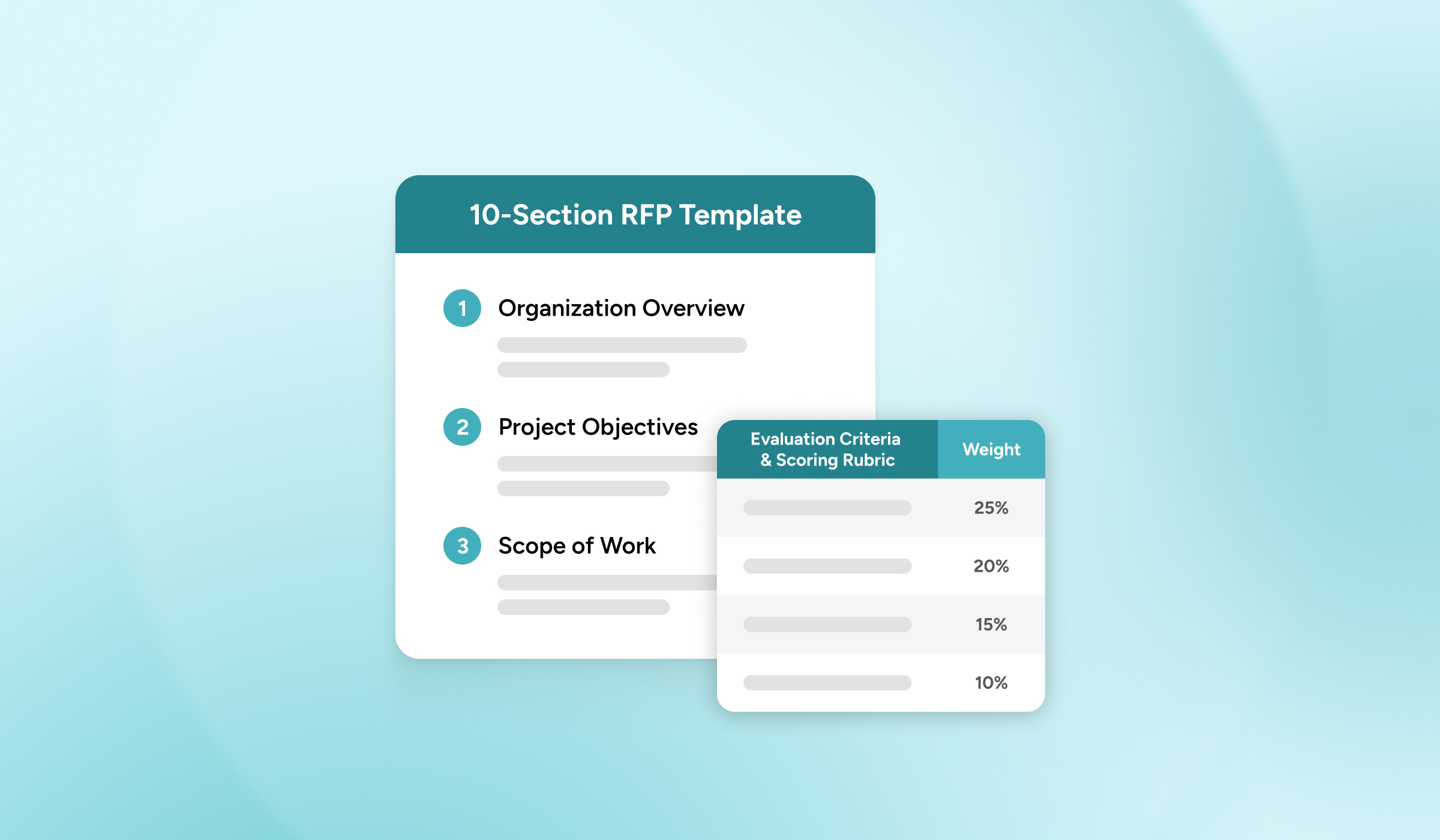
LMS RFP Template: Section-by-Section Outline
Use this template as a structural foundation. Adapt section titles, add your organization’s specifics, and remove sections that don’t apply.
| Section 1: Organization Overview |
| Mission, size, and member/learner demographics Current technology stack and existing LMS (if applicable) Overview of learning programs (volume, format, frequency) |
| Section 2: Project Objectives and Success Criteria |
| Why you are replacing or implementing an LMS Key performance indicators you aim to improve (completion rates, revenue, admin hours) Timeline and go-live target |
| Section 3: Scope of Work |
| Implementation phases Data migration requirements Integration scope (list each system) Training and change management expectations |
| Section 4: Functional Requirements |
| List each requirement with a “Must Have / Nice to Have” designation Organize by category: Core Features, Integrations, Reporting |
| Section 5: Technical Requirements |
| Hosting, security, and compliance specifications API and SSO requirements Accessibility standards |
| Section 6: Vendor Qualifications |
| Years in business and customer base size Experience with organizations similar to yours (size, sector) References from current clients (request 2–3) Product roadmap highlights for the next 12–18 months |
| Section 7: Pricing and Licensing |
| Request all-in pricing: licensing, implementation, training, ongoing support Clarify the LMS pricing model: per-user, tiered by active users, flat annual fee Request a total cost of ownership estimate for Years 1–3 |
| Section 8: Implementation Approach |
| Proposed implementation timeline and milestones Vendor-provided vs. client-provided resources Post-launch support model and escalation paths |
| Section 9: Evaluation Criteria |
| Explain how proposals will be scored (see Scoring Rubric section) Note whether a demo or follow-up Q&A is part of the process |
| Section 10: Submission Guidelines |
| Proposal format, page limits, and required attachments Submission deadline and delivery method Primary contact for questions during the Q&A window |
How to Write Effective LMS Requirements
Requirements are the functional heart of your LMS RFP. Weak requirements produce non-comparable proposals. Follow these principles:
- Be specific and outcomes-oriented
Instead of “The system must support webinars,” write: “The LMS must integrate with Zoom to deliver live webinars with a capacity of at least 500 concurrent attendees, including Q&A, polling, and attendance tracking that feeds directly into CE credit records.”
- Use “must” and “should” deliberately
“Must” signals a hard requirement that eliminates non-compliant vendors. “Should” signals a preference you’ll factor into scoring.
- Quantify where possible
“The system must support 10,000 concurrent users without measurable performance degradation” is far more useful than “The system must be scalable.”
- Tie requirements to outcomes
Each requirement should trace back to a stated organizational goal. If you can’t articulate why a feature matters, it may not belong in the RFP.
- Avoid vendor-specific language
Requirements like “must replicate the Salesforce experience” inadvertently favor one vendor. Write to outcomes, not to interfaces.
LMS RFP Evaluation Criteria and Scoring Rubric
Standardized scoring is what turns an LMS RFP into a defensible decision. Define your criteria, assign weights, and use a consistent scoring scale across all reviewers.
Recommended Scoring Scale
1 = Does not meet requirements • 2 = Partially meets • 3 = Mostly meets • 4 = Fully meets • 5 = Exceeds requirements
| Evaluation Criterion | Weight |
| Alignment with functional requirements | 25% |
| Technical capabilities and integrations | 20% |
| User experience (learner and admin) | 15% |
| Vendor experience and references | 10% |
| Implementation approach and timeline | 10% |
| Support and training offerings | 10% |
| Pricing and total cost of ownership | 10% |
Adjust weights to reflect your organization’s priorities. An organization with complex integration requirements might increase the technical weight to 30% and reduce the pricing weight accordingly.
After initial scoring, invite the top two or three vendors for live demonstrations. Use a structured demo script tied to your highest-weighted requirements to keep comparisons consistent. After demos, check two or three references per shortlisted vendor — ask specifically about implementation experience and support responsiveness, not just feature satisfaction.
The LMS RFP Process: From Draft to Vendor Selection
A well-run LMS RFP process typically spans 8–14 weeks from internal kickoff to final selection. Here’s a stage-by-stage outline:
- Internal kickoff and requirements gathering (Weeks 1–2): Align the cross-functional team, audit current state, and draft requirements.
- RFP drafting and internal review (Weeks 2–3): Write the RFP, circulate for stakeholder review, and finalize.
- Vendor identification and distribution (Week 3–4): Identify 4–8 qualified vendors. Distribute the RFP with a clear Q&A deadline.
- Q&A period (Weeks 4–5): Compile all vendor questions and issue a single response document to all vendors simultaneously to maintain fairness.
- Proposal receipt and initial scoring (Weeks 6–7): Score proposals against your rubric. Create a shortlist of two to three finalists.
- Vendor demonstrations (Weeks 8–9): Run structured demos with shortlisted vendors. Include end-users where possible — their feedback on usability matters.
- Reference checks (Week 9–10): Contact two to three references per finalist. Focus on implementation and long-term support experience.
- Final scoring and recommendation (Weeks 10–11): Incorporate demo and reference insights. Prepare a recommendation memo for leadership or the board.
- Contract negotiation and selection (Weeks 12–14): Negotiate pricing, SLAs, and implementation terms. Execute the agreement.
Common LMS RFP Mistakes and How to Avoid Them
It’s not uncommon for organizations to make mistakes when creating RFPs for their LMS. Here are some best practices to avoid common mistakes:
- Writing requirements that are too vague
Generic requirements produce generic proposals. Specificity is what makes proposals comparable and defensible.
- Focusing on features instead of outcomes
Every requirement should trace to an organizational goal. Feature lists that aren’t tied to outcomes often inflate scope without improving the decision.
- Underestimating integration complexity
AMS, SSO, and CE tracking integrations are where most LMS implementations encounter delays and added costs. Vet integration depth explicitly — ask vendors for references who use the same integrations you need.
- Neglecting total cost of ownership
Platform licensing is often just 30–50% of the real three-year cost. Ask vendors for a complete cost picture including implementation, data migration, training, custom development, and ongoing support.
- Rushing the process
Compressing the timeline creates pressure to gloss over red flags. A poor LMS selection is far more expensive than an extra two weeks in the evaluation process.
- Excluding end-users
L&D teams and IT should not be the only voices evaluating the platform. Including actual learners or frontline staff in demo sessions frequently surfaces usability issues that wouldn’t otherwise surface until post-launch.
- Ignoring scalability
Evaluate the platform not just for your current learner volume, but for where you expect to be in three to five years. Re-implementing an LMS because you outgrew it is a significant cost and disruption.
Ready to take the next step?
FAQ
What should an LMS RFP include?
A complete LMS RFP should include an organization overview, project objectives, detailed functional and technical requirements, vendor qualification questions, a pricing request, an implementation scope, evaluation criteria and scoring weights, and submission guidelines. The most commonly missing element is a clear scoring rubric — without it, vendor responses become difficult to compare objectively.
How long does an LMS RFP process typically take?
Most LMS RFP processes run 8–14 weeks from internal kickoff to final vendor selection. Organizations with a complex procurement process, multiple stakeholders, or board approval requirements should plan for the longer end of that range. Compressing the timeline by skipping the demo or reference-check stages is one of the most common and costly shortcuts.
What are the most important LMS requirements to evaluate?
The highest-stakes requirements tend to be integration capabilities (especially AMS or CRM connectivity), reporting and CE credit tracking, and administrative usability. Learner-facing features are important but are often easier to evaluate through demos — the integration and reporting depth is harder to surface in a live product walk-through and is where most organizations encounter post-launch surprises.
How do you evaluate LMS vendors after receiving proposals?
Start with a structured scoring rubric applied independently by each member of your evaluation team. Compile individual scores before discussing as a group to avoid anchoring bias. Shortlist two to three vendors for live demonstrations using a scripted demo agenda tied to your highest-priority requirements. Follow demos with reference checks — specifically ask about implementation experience, support responsiveness, and whether the platform delivered on what was promised in the RFP.
What is a reasonable budget to include in an LMS RFP?
Providing a budget range in your RFP is recommended — it helps vendors propose appropriately scoped solutions and saves both parties time. For most mid-market organizations, a realistic Year 1 LMS budget includes platform licensing, implementation services, data migration, and training. Typical ranges vary widely by organization size and complexity, but a Year 1 total investment of $25,000–$150,000+ is common. Ask vendors for a three-year total cost of ownership figure, not just the annual license fee.
How does LMS integration with existing systems affect RFP requirements?
Integrations have an outsized impact on both the RFP and the eventual implementation. An LMS that doesn’t integrate cleanly with your AMS, SSO provider, or CE tracking system will require manual workarounds that erode the efficiency gains you’re purchasing the platform to achieve. In your RFP, name each integration specifically, describe the required data flows (unidirectional vs. bidirectional), and ask vendors to provide references who use the same integrations. Integration claims in proposals are often aspirational — references validate whether they hold up in production.