
From Resistance to Buy-In: How AI Is Impacting Change Management for Associations

Your board wants to know what you’re doing about AI. Your staff wants to know what AI will do to them. Both conversations are happening right now and landing on your desk.
For most of the last two decades, associations earned a reputation for being the last to move on technology. That story is over. The association executives in the room today are not dragging their feet—they are asking for support yesterday. Interestingly, the pressure is coming from the top, not the bottom, even though younger generations are supposed to be the tech-savvy adopters. And that flip creates a change management problem most playbooks were not written for, and something we’re seeing more and more in our conversations with leaders of associations. So, how do you bring a cautious, mission-driven staff along when the leaders are already sold, and the clock is running?
AI change management is the defining leadership competency for associations in this moment. A few years ago, it seemed the question on everyone’s minds was “Do we adopt AI?” In 2026, it’s clear your peers and your board have already answered that. The work now is bringing your staff, volunteers, and members along—without losing trust, burning people out, or repeating the technology disappointments of the last decade.
This article is written for association executives and department heads managing constant change with lean teams and no fully dedicated change management function. It draws on direct insight from our Executive Advisory Board, proprietary workforce research from Momentive Software, Wakefield Research, and Edge Research, everyday conversations with our clients, and an effective framework built for the association context—not adapted from a corporate playbook.
Your Association Is Already in Change Mode
Associations have notoriously been considered among the slowest industries to adapt to change and have spent decades operating under the assumption that slow, steady technology adoption was a reasonable posture. It was. Until now.
The leaders who showed up to conversations about AI this year were not skeptics who needed convincing. They were executives who had already decided—and needed help moving their organizations fast enough to matter. The immediacy is real, the board pressure is real, and the gap between an executive team ready to move and a staff still processing what AI means for their jobs is where change management actually lives.
Leaders have context that their staff doesn’t yet have. Closing that gap is the work.
The push for leaders or boards on existing association staff to adopt AI is arriving on top of an already stretched workforce. This means often there are often two conflicting fears related to adoption: “I won’t be able to learn something new quickly enough” or possibly “Will my role matter anymore?” One of the most important benefits of AI adoption among your staff is to make them feel more efficient and able to spend time on the work they’re passionate about, rather than feeling overwhelmed and stressed at doing too much with too few resources.
The CHALLENGE
47% of mission-driven employees cite burnout as their top job dissatisfaction.
However, burnout is not the only pressure that can be addressed by AI tools. Almost half (46%) of mission-driven employees point to lack of growth opportunities as a close second source of dissatisfaction. AI agents, deployed thoughtfully, address both directly. They take the repetitive work off your team’s plate and create a skills development opportunity your staff is actively asking for.
Association leaders can reframe the conversation about incorporating AI into the daily work habits of their staff. It’s important to emphasize how AI, introduced correctly, is one of the most meaningful investments you can make in your team. Rather than being afraid of how to use new technology, you can offer training and resources to increase their skills and professional capabilities.
The Opportunity
66% of mission-driven employees would choose focused skills development over a pay raise.
What AI Actually Does in a Change Management Context
AI does not manage change for you. It does not write your strategic plan, repair a culture of resistance, or substitute for a leader willing to have honest conversations with their team.
What AI does—specifically, capabilities like agentic workers and AI analytics—is give leaders better visibility into how change is landing. It surfaces signals that would otherwise stay invisible until they become problems: patterns in member feedback, drops in adoption of new tools, shifts in engagement data that precede churn.
Three Things AI Can Address for Associations:
- Detecting resistance earlier—before it becomes a retention problem or a failed rollout
- Shaping communications so the same message lands differently for a membership director, a chapter volunteer, and a board member
- Supporting adoption through personalized onboarding that meets staff and volunteers where they are, not where your training calendar assumes they are
The Hidden Cost of Ignoring AI
63% of employees experiencing technology frustration are already exploring other opportunities.
The Five-Step Association AI Change Management Framework
The following framework was built from direct conversations with association leaders. It is designed for the association operating environment, which often includes teams that are lean-staffed, board-governed, and carrying the weight of prior technology disappointments.
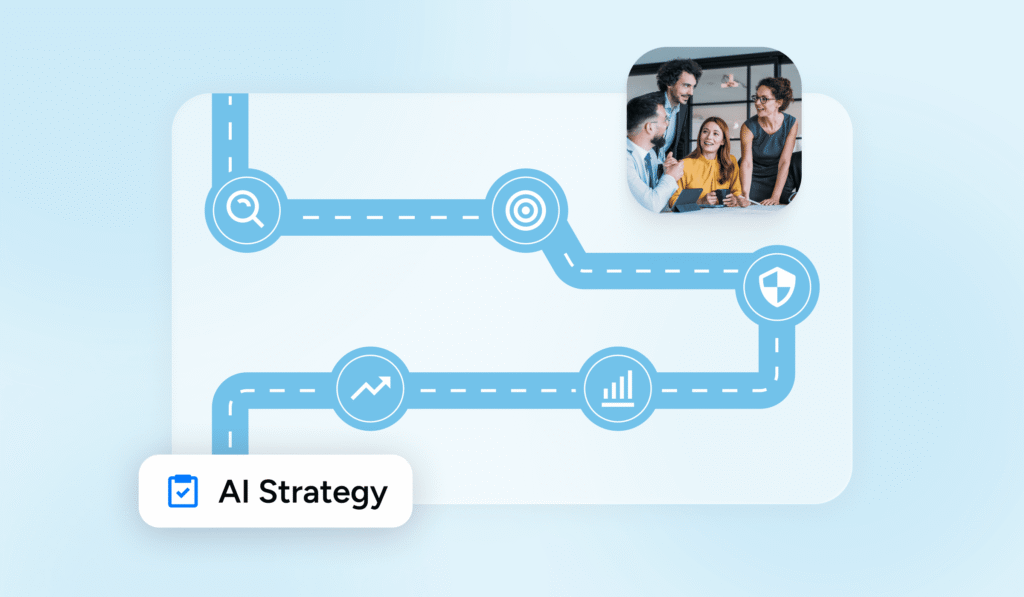
STEP 1 Prepare: Name the pressure your team is already feeling—burnout, repetitive work, capacity limits—before you introduce the solution. Staff need to understand why change is coming, not just what is changing. Hold the conversation before launch day. Leaders who skip this step pay for it in resistance later.
STEP 2 Vision & Plan: Define what success looks like before anyone touches a configuration. What specific workflow changes? Who owns it? What does a win look like in actual hours recovered or volume handled—not vague efficiency claims? Who signs off at each stage?
STEP 3 Implement: Start with one department, one workflow, one champion. Do not attempt to shift the entire organization at once. Expand only after you have a real, visible result to show. An early win is the most powerful tool in your change management arsenal.
STEP 4 Embed: Make the new behavior a part of your strategic business processes. Build AI use into onboarding, role expectations, and team workflows so it does not quietly revert when attention moves on. The most common cause of failed AI rollouts: setting and forgetting.
STEP 5 Review & Iterate: Run a structured debrief after the first deployment. What worked? What did not? What is the next workflow? The organizations that scale AI effectively treat the first rollout as a learning process that is refined over and over.
How AI Sharpens Change Communications Across Differing Audiences
One of the most underrated challenges in association change management: the same message has to work for audiences with radically different relationships to your organization and to technology. An announcement about a new AI-powered member portal lands differently for your IT director, your membership manager, your chapter volunteer who checks email twice a week, and your board chair watching how three other organizations in the sector handle the same decision.
Associations have historically managed this by sending generic communications that might not be applicable to each audience.
This is where agentic works can help your team. Agentic workers help associations tailor communications by role and audience segment. This doesn’t mean writing a dozen different emails from scratch, but by helping teams adjust tone, emphasis, and detail level based on who is receiving the message. Which angle your staff hears first matters.
Audience-Specific Framing That Works
- For staff: Lead with “this handles the queue so you can focus on the work that actually takes a human.”
- For committee volunteers: Lead with the member experience improvement, not the operational mechanics.
- For chapter leaders: Lead with what stays the same, then introduce what changes.
- For board members: Use a specific frame—“We are deploying AI to [workflow] to achieve [outcome]. Our team will [benefit]. We expect [measurement] by [timeframe].”
Board members are professionals whose own industries are being reshaped by AI. If you are not briefing them with a clear, specific frame, they will fill the silence with their own assumptions—and those assumptions are not always optimistic. Keeping your board informed on AI strategy is both a governance responsibility and a smart move to prove you’re meeting your strategic goals.
The Volunteer-Heavy Organization Problem
Corporate change management assumes you can mandate adoption. Association leaders know this is not how it works. You cannot require a chapter volunteer who has been running your certification program for eleven years to immediately embrace a new AI-powered workflow.
This is where AI tools that offer support, such as personalized onboarding, matter. The same intelligence that routes a member to the right resource can route a volunteer to training that matches their actual comfort level with technology—not a one-size-fits-all webinar recorded two years ago.
The Staff Readiness Gap
85% of mission-driven professionals agree that leaders cannot succeed without building AI and automation skills.
Our research shows your staff wants to build these skills. The 66% who would choose skills development over a pay raise are telling you directly: development is a retention strategy, and AI adoption is a development opportunity—if you position it that way.
The practical move for volunteer-heavy organizations: find your superusers first. In every association, staff members and volunteers are most likely already using AI tools on their own, often without oversight or vetted technology.
Trust, Governance, and Member Data: The Non-Negotiable Foundation
Before AI plays a meaningful role in any association’s change management or member engagement strategy, there are questions that must be answered at the board level and communicated clearly to staff, members, and volunteers.
Questions Your Board Should Be Able to Answer
- What member and staff data is being used by AI tools, and who approved that use?
- Where is that data stored, and what are the security and compliance controls?
- How will members be informed about how their data shapes their experience?
- What is the process for assessing and revising the AI governance policy as capabilities change?
Associations hold highly personal data about their members, including career history, health credentials, financial contributions, and professional certifications. The trust attached to that data is one of the association’s core assets. AI governance is an important aspect that is often overlooked as part of your association’s brand protection.
It’s smart to invest in robust and safe AI built on a data model that already understands dues structures, CE compliance, fund accounting, and donor lifecycle dynamics. Software providers able to provide AI tools that show how each action is logged with audit trails, configured by your team’s confidence thresholds, and surfaced in plain language are the safest bet. Your board can see it, audit it, and defend it. Most generic AI tools adapted to the nonprofit context do not offer this. When evaluating AI capabilities, the governance architecture should be one of the most important aspects to consider.
Where to Start: One Initiative, One Practice
The most common mistake in association AI adoption: waiting for a comprehensive strategy before taking any action. Thorough plans could take up to eighteen months to develop and are outdated by the time they are approved. The organizations that started small already have results, champions, and stories.
Pick one initiative already on your roadmap:
- An AMS rollout or upgrade
- A strategic planning process that will require communicating change to staff and members
- A governance restructure that needs to land with a volunteer board
- A new learning or certification program involving onboarding diverse stakeholders
Then apply one or two AI-assisted practices before you scale.
THREE THINGS YOU CAN DO THIS WEEK
1. Have the conversation. Schedule a 30-minute team meeting and put the fear on the table. Ask staff what they are hearing about AI and what concerns they have. Listen first. Do not bring solutions to this meeting.
2. Name your first workflow. Pick one repetitive, high-volume task your team owns. Write it down. That is your starting point.
3. Brief your board chair. One paragraph: “We are deploying AI to [workflow] to achieve [outcome]. Our team will [benefit]. We expect [measurement] by [timeframe].” That is the entire first brief.
How Momentive Can Help Your Association’s AI Change Management Strategy
The associations that lead in an AI-enabled sector will not be the ones with the most sophisticated technology stacks. They will be the ones who brought their people along.
Your staff wants to succeed. Your volunteers want to contribute. Your members want to see that your organization is investing in their future—not just updating its back office. AI change management is the leadership work that makes all of that possible.
Necessity for Board Alignment
75% of mission-driven leaders say integrated technology would reduce staff burnout.
You do not need a perfect AI strategy. You need a first deployment, a champion, and a story to tell.
- Agentic Workers are AI teammates that execute the renewal outreach, data cleanup, and follow-ups your team runs out of hours for. Your staff reviews, the agent executes.
- Connections are pre-built, plug-and-play links across Momentive products and the third-party tools you already use. No rip-and-replace required.
- AI Analytics unifies that data and surfaces what’s changing and why, before you have to go looking for it.
- Experience puts all of it in front of your members and donors, through single sign-on, live dashboards, and journeys that feel personal because the data behind them finally is, too.