
What Is Member Management? A Complete Guide

Every organization that runs on members carries the same quiet workload behind the scenes. Someone has to track who joined, who is due to renew, who has gone quiet, and who to welcome next. When that work lives in spreadsheets and inboxes, records drift out of date, renewals slip through, and keeping members engaged turns into guesswork. Member management is how you pull all of it into one place, so member retention stops depending on who remembered to send the reminder.
This guide explains what member management is, how the member lifecycle works, what membership management software does, and how to tell whether your group is ready for it. Whether you run a gym, a professional society, an alumni network, or a growing association, the ideas apply the same way.
What Is Member Management?
Member management is the process of tracking, organizing, and supporting the people who belong to your organization across their entire relationship with you, from the day they join through every renewal that follows. It covers member records, communication, dues, engagement, and reporting, usually handled in one system rather than scattered across separate tools.
In practice, member management answers a few basic questions at any moment: Who are our members? What have they paid for? How are they engaging with us? And what do we need to do next to keep them? A small climbing gym tracking 400 monthly members and a national association serving 40,000 professionals are doing the same core work, only at different scale.
Done well, it gives every member a consistent experience and gives your team a single, trustworthy source for member data. Done informally, it tends to live in one person’s head and a handful of spreadsheets, which works right up until that person is out or the membership grows.
Key Functions of Member Management
Member management pulls several jobs into one workflow. Most organizations are already doing all of these, whether or not they call it member management:
- Member records: a central profile for each member with contact details, membership type, payment history, and activity, kept current in one place.
- Dues and payments: collecting fees, issuing receipts, and tracking who has paid, who is overdue, and who is about to lapse.
- Communication: sending welcomes, reminders, newsletters, and event invitations, targeted by member type instead of one message to everyone.
- Engagement tracking: seeing who attends events, opens emails, takes courses, or logs in, so you can spot rising and fading interest early.
- Renewals: prompting members before their term ends and making it easy to renew in a few clicks, ideally with dues and automated renewals handled for them.
- Reporting: showing growth, retention, and revenue trends so leadership can act on real numbers instead of rough estimates.
- Self-service: letting members update their own details, register for events, and pay online without waiting on staff.
The Member Lifecycle: From Recruitment to Renewal
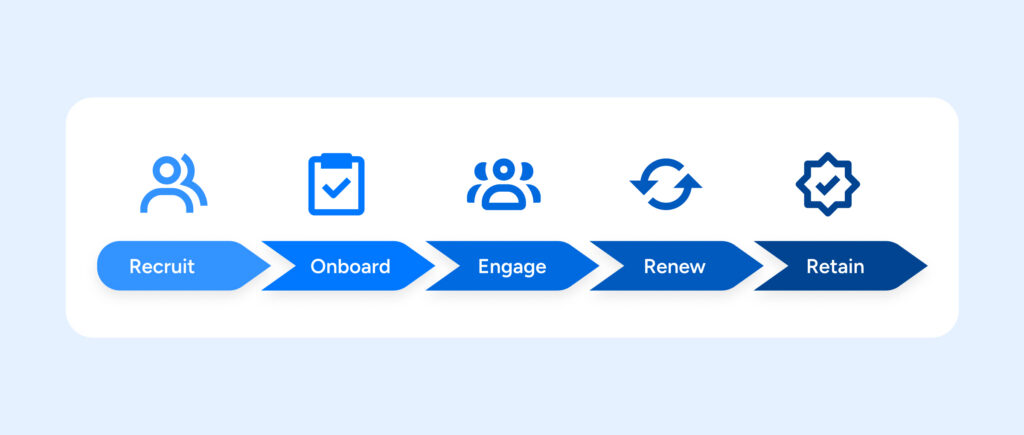
Member management follows a lifecycle. Each member moves through the same five stages, and good management means having a plan for every one of them: Recruit, Onboard, Engage, Renew, and Retain.
- Recruit. You reach prospective members and give them a clear reason and an easy way to join. This is where a simple, working sign-up path matters most.
- Onboard. A new member gets a warm welcome, knows what their membership includes, and takes a first action. Strong onboarding sets the tone for everything after.
- Engage. Members use what they joined for: events, content, community, courses, or discounts. Engagement is the single best predictor of whether someone renews.
- Renew. As the term ends, you remind members in good time and make renewing effortless. Automated reminders and online payment keep more members from lapsing by accident.
- Retain. Beyond a single renewal, you keep delivering value and watch for members who are drifting, so you can reach out before they leave for good.
The lifecycle is a loop, not a line. A retained member becomes an advocate who helps you recruit the next one, and the cycle starts again.
What Is Membership Management Software?
Membership management software is a system that handles the member lifecycle in one place: it stores your membership database, processes dues, sends communications, tracks engagement, and reports on the health of your membership. Instead of stitching together a spreadsheet, a payment tool, and an email platform, you run the whole relationship from a single record.
The difference shows up fastest in the day-to-day work. Here is how the same tasks look with and without a dedicated system:
| Task | Manual management | Software-assisted management |
| Member records | Spreadsheets updated by hand, with duplicate and outdated entries | One database that updates in real time as members change |
| Dues and renewals | Invoices and reminders sent one at a time | Automated billing, receipts, and renewal reminders |
| Communication | The same email to a static list | Messages segmented by member type and activity |
| Reporting | Hours spent pulling numbers together by hand | Dashboards you can open on demand |
| Member self-service | Staff answers every profile and payment request | Members update details and pay online themselves |
For smaller groups, this might be one connected system. For larger associations, it often takes the shape of an association management system, which adds member engagement tools, events, learning, and accounting on top of the core member database.
Benefits of Membership Management Software
The point of the software is not the features. It is what changes for your members and your team when the busywork goes away:
- Higher retention: timely renewal reminders and early warning on disengaged members mean fewer people lapse without anyone noticing.
- Time back for staff: when renewals, receipts, and profile updates run on their own, a small team spends its hours on members instead of data entry.
- Reliable data: one record per member removes the duplicate and out-of-date entries that make reporting untrustworthy.
- Stronger engagement: segmented communication reaches the right members with the right message, which beats sending everyone the same email.
- Predictable revenue: automated dues and clear renewal tracking smooth out the cash flow that so many membership organizations run on.
- Room to grow: a system that handles 400 members the same way it handles 40,000 lets you add members without adding headcount.
Based on the patterns we see across the organizations we work with, the biggest gains usually come first from renewal automation and clean data, because both directly protect the revenue you already have.
Who Uses Member Management Systems?
Any group whose work depends on a base of members can use member management, not just associations. That includes:
- Professional and trade associations tracking members, chapters, and continuing education.
- Gyms, studios, and clubs managing recurring memberships and attendance.
- Alumni networks and universities keeping graduates connected over decades.
- Religious and community organizations coordinating members, giving, and events.
- Chambers of commerce and networking groups managing dues and directories.
The common thread is a recurring relationship you need to nurture over time. Organizations that also coordinate people who give their time, rather than pay dues, often pair member management with volunteer management software, since the lifecycle of recruiting, onboarding, and keeping volunteers looks a lot like the member lifecycle.
How to Choose Member Management Software
The right system depends on your size, budget, and how complex your membership is. A short checklist keeps the evaluation grounded:
- Fit for your size: will it serve you at your current membership and still work if you double it?
- Dues and renewal automation: can it collect payments, send reminders, and process renewals without manual chasing?
- Member self-service: can members update details, register, and pay on their own?
- Reporting you will actually use: does it show retention, growth, and revenue clearly, not just export raw data?
- Integrations: does it connect to the email, accounting, events, and learning tools you already run?
- Support and setup: will you get help migrating your data and training your team, or are you on your own?
The difference between member management and a CRM comes up here often. A CRM tracks contacts and deals; a member management system is built around membership itself, with dues, renewals, and the member lifecycle at its core. For a membership organization, that focus matters.
Simplify Your Member Management with Momentive
When your membership outgrows spreadsheets, a purpose-built system keeps the whole lifecycle in one place. Momentive Software builds association management software that handles member records, dues, communication, events, and reporting together, so your team can spend its time on members rather than admin.
Our member management tools help organizations of every size recruit, engage, and retain members, and they scale with you as you grow. If you are moving off manual processes for the first time, that is exactly the shift they are built for.
Frequently Asked Questions About Member Management
Member management software stores member records, collects dues, sends communications, tracks engagement, and reports on membership health, all in one system. It automates renewals and lets members update their own details, so your team spends less time on manual admin and more on members.
Any group with a recurring member base uses it: professional and trade associations, gyms and clubs, alumni networks, religious and community organizations, chambers of commerce, and networking groups. If you track people who join, pay, and renew over time, membership management applies to you.
A CRM is built to track contacts and sales opportunities. A member management system is built around membership itself, with dues, renewals, member types, and the full lifecycle at its core. For a membership organization, that membership-first focus is the key difference.
It collects dues online, issues receipts, and tracks who has paid. As a term nears its end, it sends automated reminders and lets members renew in a few clicks. That reduces lapsed memberships caused by missed notices and keeps revenue steady.
Look for a central member database, dues and renewal automation, member self-service, clear reporting on retention and revenue, and integrations with your email, accounting, events, and learning tools. Good onboarding and support matter too, especially if you are migrating existing data.
Yes. Small teams often gain the most, because automation gives back hours they cannot spare. A system that handles renewals, payments, and communication frees a lean staff to focus on members, and it scales as the organization grows.
Struggling to keep your volunteer program organized? Discover what volunteer management software can do for your organization.