What Is Donor Segmentation? Definition, Types & How It Works

You know the difference between the supporter who makes a year-end gift every December and the one who gave once after a fundraising gala and never came back. The problem is that your fundraising appeals often treat them the same way. Sending one message to everyone is fast, but it flattens those differences, and the people most likely to give more rarely hear anything built for them. Donor segmentation fixes that.
What Is Donor Segmentation?
Donor segmentation is the practice of grouping the people who support your organization into smaller sets based on shared traits, such as giving history, interests, location, or how they first got involved. Instead of one message for your whole list, each group gets outreach shaped around what it actually cares about. The goal: send the right message to the right donor at the right time.
Those traits can be anything you track. A community foundation might group donors by the fund they give to. A church might separate weekly tithers from one-time holiday givers. A school booster club might split parents of current students from alumni. The segments differ, but the logic holds across every kind of mission-driven group that raises money: people who share a reason for giving tend to respond to the same ask.
Segmentation isn’t a one-time sort, either. A first-time donor who sets up a monthly gift moves into a different group, and your outreach should move with them. Done well, it turns a static mailing list into something you can actually act on.
Why Donor Segmentation Matters
A generic appeal asks everyone to do the same thing regardless of what they’ve already done. Your most loyal monthly givers get the same “please give” email as someone who’s never donated, which wastes the relationship you’ve built and can even feel careless to the people who show up most.
Segmentation changes the economics of your outreach. In our work with nonprofit and association fundraising teams, the pattern is consistent: when a message reflects what a donor has actually done, response rates climb, and unsubscribes drop. Here’s what teams see when they get it right:
- Higher response and gift size. A lapsed donor and a major donor need different asks. Matching the request to the relationship lifts both the odds of a gift and its size.
- Stronger donor retention. Relevant, well-timed outreach is one of the main reasons donors keep giving. Segmentation is what makes it possible at scale.
- Less wasted effort. Your team stops sending every message to every contact. Time and postage go to the outreach most likely to land.
- Better data over time. As you watch how each segment responds, you learn what works, and your next campaign starts smarter than the last.
Segmentation is the foundation of data-driven fundraising: You can’t personalize what you haven’t grouped. You can’t measure what you haven’t defined.
Common Types of Donor Segments
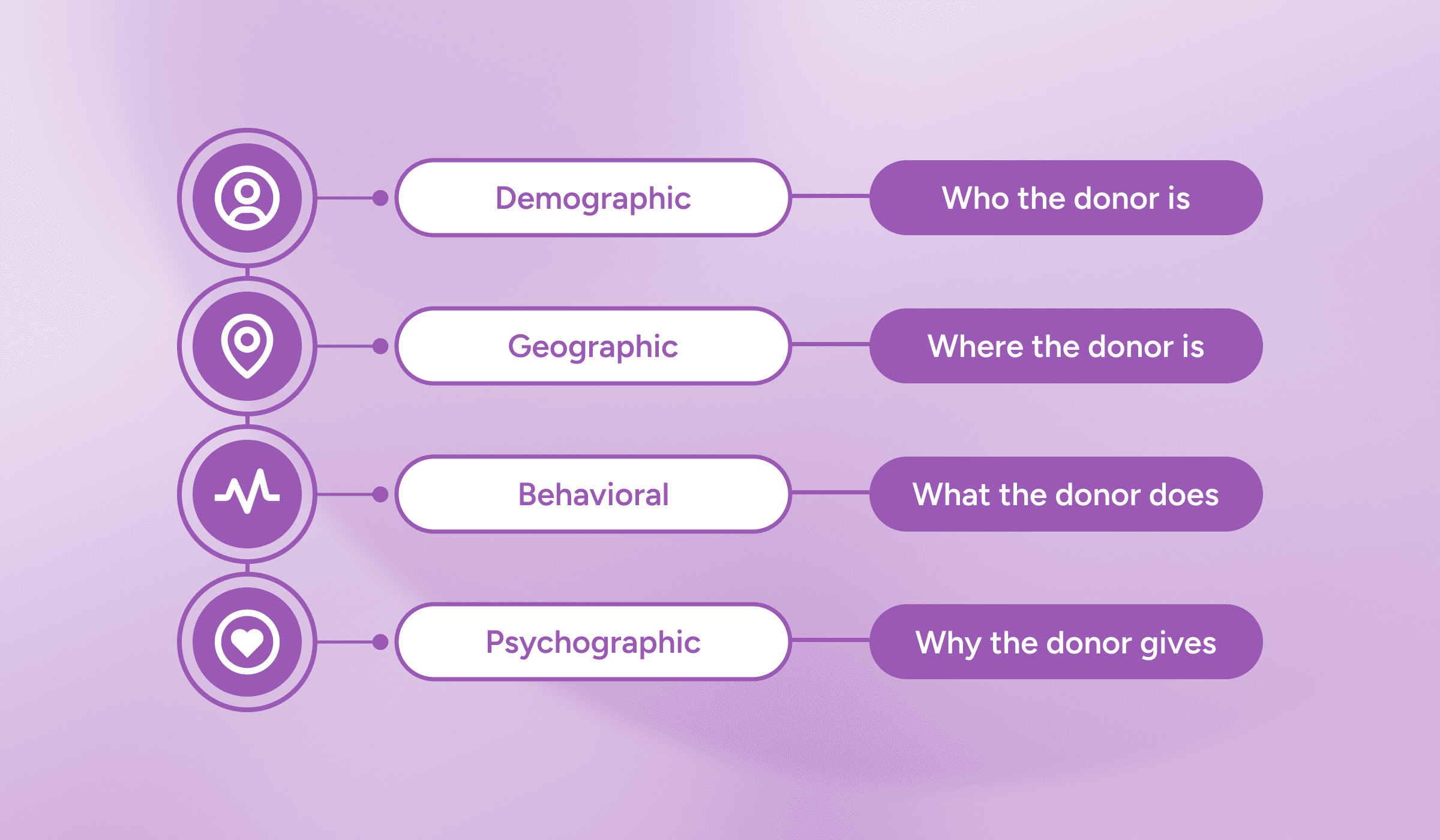
Most segments fall into four broad categories. You’ll rarely use just one; the strongest strategies layer them, grouping donors by behavior first, then refining by demographics or interest.
| Segment type | What it groups by | Example criteria |
| Demographic | Who the donor is | Age, income, profession, household, membership status |
| Geographic | Where the donor is | City, region, proximity to an event or chapter, rural vs. urban |
| Behavioral | What the donor does | Gift frequency, recency, amount, event attendance, volunteer history |
| Psychographic | Why the donor gives | Values, program interest, motivation, cause affinity |
Beyond those four, fundraisers lean on a handful of practical, behavior-based labels worth knowing:
- New or first-time donors. People who’ve given once. The priority is a strong thank-you and a reason to give again before they lapse.
- Recurring donors. People on a monthly or scheduled gift. These supporters drive predictable revenue, so recurring giving programs deserve their own stewardship track.
- Major donors. Your largest givers, who usually warrant personal, one-to-one attention rather than mass email.
- Lapsed donors. People who gave before but haven’t recently. Two shorthand terms show up constantly here: LYBUNT (Last Year But Unfortunately Not This Year) flags donors who gave last year and haven’t yet given this year, and SYBUNT (Some Year But Unfortunately Not This Year) flags donors who gave in some prior year but not this one. Both are re-engagement lists.
How to Build a Donor Segmentation Strategy
You don’t need a data science team to start. You need clean records and a clear first question. Here’s a practical sequence.
- Set your goal. Decide what this segmentation is for:
.Re-engaging lapsed donors, growing recurring gifts, and stewarding major donors each call for different segments. Start with one goal, not all of them.
- Audit your data. Look at what you already track: gift history, contact details, event and volunteer records, communication preferences. Fix duplicates and fill obvious gaps. Clean data is the whole game.
- Choose your segments. Pick two or three groups that map to your goal. Resist the urge to build twenty. A small set you actually use beats a complex system you abandon.
- Define each segment clearly. Write the rule in plain language, for example, “donors who gave in the last 12 months and attended an event.” Anyone on your team should be able to apply it the same way.
- Tailor the outreach. Give each segment its own message, ask amount, and cadence. This is where the donor journey becomes real: the content follows where the person actually is.
- Measure and adjust. Track response, gift size, and retention by segment. Keep what works, retire what doesn’t, and move donors between segments as their behavior changes.
RFM Analysis: A Proven Donor Segmentation Framework
When you’re ready to go deeper than basic labels, RFM is the framework most fundraisers reach for first. RFM stands for Recency, Frequency, and Monetary value, the three behaviors that predict future giving better than almost anything else.
- Recency: How recently did the donor last give? Recent givers are the most likely to give again.
- Frequency: How often do they give? Repeat donors are more committed than one-time givers.
- Monetary: How much do they give? Gift size helps you spot major-donor potential and set appropriate asks.
You score each donor on all three, then combine the scores to rank your list. The result sorts everyone into a matrix: your most committed supporters on one end, your at-risk donors on the other::
| Gives often / recently | Gives rarely / long ago | |
| High gift amount | Champions: steward closely, invite to give more | At-risk major donors: reach out personally, fast |
| Low gift amount | Loyal small donors: nurture, invite to recurring giving | Lapsed low-value: light-touch re-engagement or rest |
The power of RFM is that it’s built entirely on what donors have done, not on guesses about who they are. A donor who scores high on all three is a champion worth personal attention. One who once gave generously but hasn’t in two years is an at-risk major donor you’d want to reach before it’s too late.
Common Donor Segmentation Mistakes to Avoid
- Building too many segments. Twenty groups you can’t maintain help no one. Start with two or three and grow only when each earns its keep.
- Segmenting on dirty data. Duplicate records and missing gift amounts produce segments that quietly mislead you. Clean first, segment second.
- Setting it and forgetting it. Donors move between groups constantly. A segmentation you built last year and never revisited is describing donors who no longer exist.
- Over-personalizing. Referencing details a donor never expected you to have can feel invasive. Relevance builds trust; surveillance breaks it.
- Confusing segments with personas. A segment is a real group in your database. A donor persona is a composite portrait you create to understand donors’ motivations. You need both, but they’re not the same tool.
How Fundraising Software Makes Segmentation Easier
You can segment a small list by hand in a spreadsheet. It stops working the moment your list grows, your data lives in more than one place, or you want segments to update automatically. That’s where a donor database earns its place.
Purpose-built donor management software keeps giving history, contact records, and event and volunteer activity in one place, so a segment can pull from everything you know about a person. Donor segmentation tools let you build a group once and have it refresh automatically as donors give, lapse, or upgrade, and connected fundraising software carries those segments straight into your appeals so the right message reaches the right list without manual exports. For a step-by-step walkthrough, our guide to donor segmentation goes into more detail on setup. goes deeper on setup.
FAQ
Segmentation groups real donors in your database by shared traits such giving history or location. A persona is a fictional, composite profile that represents a type of donor and their motivations. Segments tell you who to contact; personas help you understand why they give and how to speak to them.
Start by isolating everyone whose first gift arrived recently, then split by gift size, channel, or campaign if your volume is high enough. The immediate priority is a strong thank-you and a clear reason to give again, since the window to convert a first-time donor into a repeat donor is short.
RFM stands for Recency, Frequency, and Monetary value. You score each donor on how recently they gave, how often they give, and how much they give, then combine those scores to rank supporters and tailor your outreach to each group, from loyal champions to lapsed donors.
LYBUNT means “Last Year But Unfortunately Not This Year,” a donor who gave last year but hasn’t yet given this year. SYBUNT means “Some Year But Unfortunately Not This Year,” referring to a donor who gave in a prior year but not this one. Both are re-engagement segments worth a targeted appeal.
There’s no fixed number, but most teams do best starting with two or three that map to a clear goal. A handful of well-maintained segments you actually use will outperform a complex system nobody keeps current. Add segments only as each one proves its worth.
At a minimum, giving history (dates and amounts) and basic contact details. From there, event attendance, volunteer activity, communication preferences, and program interest all sharpen your segments. Clean, consistent donor data management matters more than having every possible field.
Struggling to keep your volunteer program organized? Discover what volunteer management software can do for your organization.