
How to Create and Use Donor Personas

In marketing, you are always being reminded to create a buyer persona to identify your ultimate customer. In the nonprofit world, you may not have a buyer, but you do have a donor, and it is just as important to know who that person is.
A donor persona is a detailed profile of the people who give to your cause. It guides targeted appeals, helping you acquire new donors, retain existing ones, and increase their giving over time.
In practice, a donor persona is set up as a fictional person whose description fits a group of your donors, complete with a name, a bio, and a lot more detail than you might expect.
Here are the four steps to building and using them.
Step 1: Ask the Right Questions
The first thing to do is figure out what you actually need to know about your donors. It helps to break it down into five categories. You may want to add more, but these are the basics.
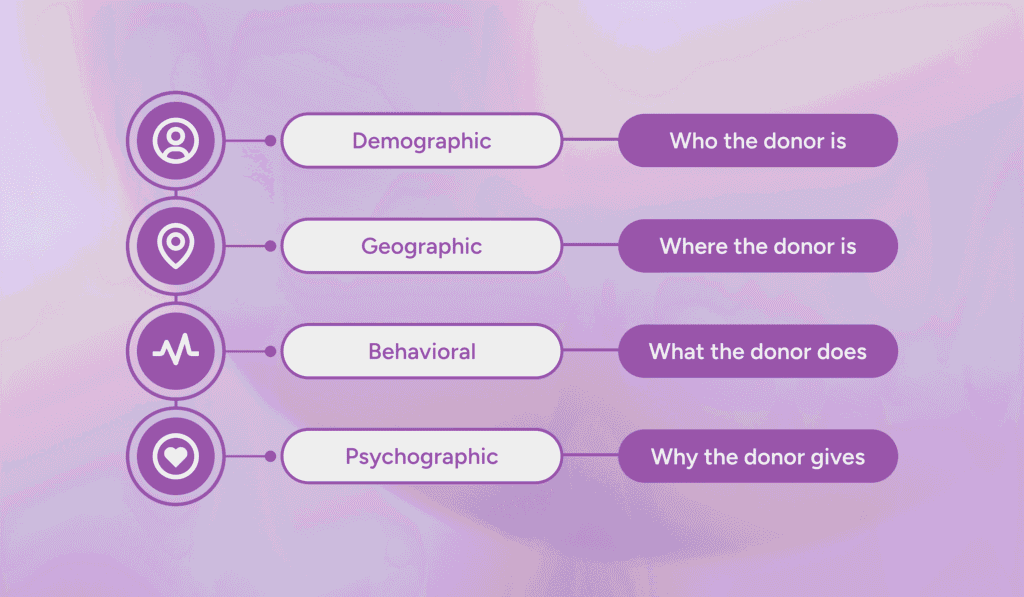
Before drafting questions, it also helps to understand the four lenses you will use to group donors later, because those lenses should shape what you ask from the very beginning. More on that at the end of this step.
Background
A little background information on your donors goes a long way. Think about questions like:
- Where did they go to school, or are they currently in school?
- What is their occupation?
- Do they volunteer? If so, where?
- What do they do for fun? What are their hobbies?
Demographics
Getting specific about who this person is matters.
- What is their gender?
- How old are they?
- What is their household income?
Identifiers
These questions get at how donors operate day to day.
- How do they find information or do research?
- What social media platforms do they use, if any?
- What is their preferred communication method?
- How do they use the internet?
- What are their passions?
Donor Habits
This is the category that matters most: how and why they give.
- How much do they tend to donate per year?
- How do they decide where to donate?
- Do they typically volunteer with an organization before donating?
- Do they charity-hop, donating once and moving on, or do they tend to stick with one or a few organizations they love?
Goals and Challenges
- What are their goals, both in general and when it comes to donating or volunteering?
- What are their biggest challenges?
- How do they try to overcome those challenges and accomplish their goals?
The Four Lenses You Will Use to Group Donors
Before finalizing your questionnaire, understand the four ways you will eventually slice your donor data. These lenses should shape the questions you ask from the start, so you collect the right information to use later.
RFM: Recency, Frequency, and Monetary Value
RFM is a framework borrowed from direct marketing that helps you rank donors based on three behaviors:
- Recency: When did they last give? A donor who gave 30 days ago is far more likely to give again than one who gave three years ago.
- Frequency: How often do they give? Annual donors, monthly donors, and one-time donors each need very different outreach.
- Monetary Value: How much do they give in total? This helps identify major gift prospects versus your broader donor base.
Score each donor 1 to 5 on each dimension, then combine the scores to create donor segments. For example:
- High across all three (5-5-5): These are your champions. Thank them well and consider inviting them to upgrade or join a recurring giving program.
- High frequency, low monetary (5-5-2): Loyal but smaller givers. Strong candidates for a monthly giving ask.
- High monetary, low recency (2-2-5): Lapsed major donors. Worth a personal, direct reactivation outreach.
- Low across the board: Nurture with content and stories before making another ask.
This data can be pulled directly from your CRM or donor database before you ever send a survey.
Motivational Segmentation
Not all donors give for the same reason and knowing the difference changes everything about how you talk to them. Common motivations include:
- Belief in the mission: They give because the cause deeply aligns with their values.
- Social influence: They give because someone they trust asked them to.
- Recognition: They want to be acknowledged, publicly or privately.
- Impact-driven giving: They want to know exactly what their dollar does.
- Tax or financial planning: More common among major and planned gift donors.
Surveys and interviews (coming up in Step 2) should specifically try to uncover motivation. It will shape the tone of every appeal you write.
Giving Capacity
Motivation tells you why someone gives. Capacity tells you how much they could give. Wealth screening tools like DonorSearch, as well as publicly available data such as real estate holdings, business affiliations, and philanthropic history, can be used to estimate giving capacity. This helps avoid under-asking your best prospects and over-asking your smaller donors.
Channel Preferences
Where and how donors engage with you matters a lot when it comes to getting them to actually respond. Try to segment by:
- E-mail: Look at open rates, click rates, and whether e-mail campaigns drive donations.
- Direct mail: Track response rates by mailing list.
- Social media: Note which platforms drive engagement, whether Facebook, Instagram, or LinkedIn.
- Events: Did they first give at an event? Do they come back year after year?
- Peer-to-peer or crowdfunding: Did they come in through a friend’s fundraising page?
A donor who first gave through a Facebook fundraiser needs very different cultivation than someone who responded to a direct mail letter.
Creating Your Donor Persona Questionnaire
Now that you understand both what to ask and how you will eventually use the answers, sit down and draft your full questionnaire. Then move on to Step 2.
Step 2: Conduct Research
Now that you know what you want to find out, it is time to find it out. There are many ways to research your donors, and you will likely want to use a few of them.
Go Through Your Databases
There is probably more information already on hand than you realize. Going through existing records first may answer a surprising number of questions, and RFM scores can be pulled directly from here before doing anything else.
Online Research
Online research can help build a general picture of donor behavior. It is useful for spotting broad tendencies, but should not be relied on too heavily. The general donor may not reflect your donors at all. Use it as a starting point, then build on it with your own research.
Colleague Research
Sit down with your team, your board, your volunteers, and even friends at organizations working on similar causes. Ask them how they would describe your typical donor. They may notice things that have been overlooked.
Interviews, Surveys, and Focus Groups
This is the most valuable step. Nothing beats actually talking to your donors. Set up surveys, interviews, or focus groups with willing participants. Offering a small incentive for longer conversations is always a good idea.
When sitting down with donors, go beyond the standard questions and ask things like:
- “What almost stopped you from giving to us?”
- “What would make you give more, or give again?”
- “What communication from us has felt most meaningful?”
- “Do you give to other organizations? What keeps you coming back to them?”
These questions surface the kinds of insights that will directly shape retention and upgrade strategies later.
A few practical tips: if any questions feel personal, reassure participants upfront that their answers will be kept confidential. Let them know why this research is happening and how it will help the organization. And if the budget allows, hiring someone to help facilitate is well worth it.
Step 3: Build Your Donor Personas
The research is done. Time to organize everything and put it to use.
Develop a Matrix
Start by organizing your research into a matrix or spreadsheet. List your questions down one side and your survey respondents across the top. Use fictional names to protect their information. Then fill in the blanks.
Before populating the matrix with survey answers, add RFM scores as the first three columns for each respondent. This ensures your donor personas are grounded in actual giving behavior, not just what people said in an interview. A persona built only on interviews can skew toward your most engaged donors, the ones willing to sit down with you, rather than your average or lapsed givers.
Look for Common Threads
Once the matrix is filled in, look for patterns that let you group people together. Similar age ranges, comparable income levels, and matching giving frequency are all good places to start. A persona for every single person who has ever donated is not the goal. The goal is to identify a handful of distinct groups that consistently give.
Create Three or Four Personas
Once you have your groups, create a fictional persona for each one. Give them a name, a short bio, and the key characteristics that define that segment. HubSpot has a template you can use as a starting point if needed.
Create One or Two Ideal Donor Personas
Now that the real personas are built, create one or two aspirational ones. Maybe the research showed plenty of small donors but very few large ones. That is worth addressing.
Think through what a major donor might look like. Where do they get their information? How do they decide where to give? What platforms are they on? What would their RFM scores look like? Creating a persona for this type of donor will help target outreach in the next step.
Step 4: Put Your Donor Personas to Work
The hard work is done. Now use it.
Share Your Personas with the Team
Make sure everyone, including staff, board members, and volunteers, knows who these personas are. Hopefully they have been involved along the way, but either way, share the finished product. These personas should inform decisions across the whole organization, not just the fundraising team.
Acquisition: Find More Donors Who Look Like Your Best Ones
Use your highest-RFM persona as a model for finding new donors. On Facebook and Instagram, uploading your top donor e-mail list and creating a lookalike audience is a straightforward place to start. On LinkedIn, if your major donors tend to be professionals, you can target by job title, industry, or company size. Write acquisition content around that persona’s specific motivations, not a generic version of your mission.
Retention: Communicate Based on Where Each Donor Stands
Match outreach to where each segment sits on the RFM scale:
- Champions (high RFM): Send impact reports, behind-the-scenes updates, and personal thank-you calls from leadership. Make them feel like insiders.
- At-risk donors (gave once, more than 12 months ago): Send a reactivation sequence. Acknowledge the gap, share a specific impact story, and make a clear, low-effort ask.
- Monthly donors: Focus on reinforcing the relationship. Show cumulative impact with messaging like “Your monthly gift has added up to $360 this year. Here is what that made possible.”
Upgrades: Know When and How to Ask for More
Use RFM data combined with wealth screening to identify donors who may be giving below their capacity. If someone gives $100 per year but screening suggests they could comfortably give $1,000, they are a priority for an upgrade conversation.
Trigger upgrade asks based on behavior: after two consecutive annual gifts, after attending an event, or when someone consistently opens and clicks your e-mails. Frame the ask around impact rather than the dollar amount: “For $50 more per year, you could fund an additional month of programming.”
For frequent small-gift donors, consider a monthly giving conversion ask. It increases lifetime value and tends to improve retention rates across the board.
Build a Channel-Specific Content Plan
For each persona, document:
- Their primary channel (e-mail, direct mail, social media, events)
- The best timing for an ask (year-end, Giving Tuesday, post-event follow-up)
- The content format they respond to (impact story, data, video, personal letter)
- The tone that fits them (emotional, practical, community-focused)
This is what turns a persona from a document that sits in a folder into something the team actually uses.
Always Be Refining
The ABCs of sales is always be closing. The ABRs of donor personas is always be refining. Your donor base evolves, and your personas need to keep up. Revisit and update them at least once a year, or after any major campaign.
Donor personas are one of the most practical tools available to a fundraiser. They help you design events donors will actually enjoy, send appeals through the channels they actually use, and make asks at the right time in the right amount. Layering in data like RFM scores, giving capacity, and channel preferences means fewer guesses and more decisions grounded in what donors have already shown you through their behavior and their words.
It takes some work up front. But once your personas are in place, every campaign, e-mail, and appeal becomes a whole lot easier to write, and a whole lot more likely to work.
Struggling to keep your volunteer program organized? Discover what volunteer management software can do for your organization.