
Volunteer Recruitment Strategies: 15 Tactics That Fill Open Shifts

Volunteers make your mission possible: the events, the programs, the work your staff cannot absorb alone. Volunteers’ impact is indispensable and mission-critical.
So how can you stand out from other organizations and build a healthy volunteer base? This guide covers 15 proven volunteer recruitment strategies and how your organization can use them.
Give your mission the tools to thrive. See how volunteer management software can support recruitment, scheduling, and reporting in one place.
What is Volunteer Recruitment?
Volunteer recruitment is how your organization identifies and brings in people to serve your organization without compensation. Whether that’s staffing an event, handling administrative tasks, or recruiting more volunteers, you recruit volunteers to ease your staff’s administrative load and better accomplish your mission.
Volunteer recruitment differs from volunteer retention because you’re forming a relationship with someone, not retaining an existing volunteer.
Quick Answer: How to Recruit Volunteers Fast
Five things to do today:
- Send a single-shift ask to lapsed volunteers: one email, specific date, no ongoing commitment required.
- Ask your five most active volunteers for one peer referral each. Takes ten minutes and reaches warm prospects immediately.
- Post to VolunteerMatch or Idealist with a role-specific landing page. Free and indexed by people actively searching for opportunities.
- Add a volunteer sign-up option to your next donor or event email. Your existing list is your fastest path to new volunteers.
- Fix your sign-up form. Cut it to eight fields or fewer and add a 48-hour follow-up to every new submission.
Why Volunteer Recruitment Got Harder
Recruiting volunteers has gotten harder, and many coordinators are struggling. Sometimes it feels like it’s the same four people on the schedule every week, you’re trying to fill a shift that’s been open for three weeks, and your coordinator is stepping in to do the work themselves.
You’re not wrong or alone. Industry research shows organizations need volunteers. 46.8% of nonprofit CEOs say recruiting enough volunteers is “a big problem,” according to research from the Do Good Institute.
Volunteer coordinator burnout erasesinstitutional knowledge, disrupts relationships, and costs six to nine months of salary to recover from. That’s all before new staff can recruit a single new volunteer.
So what can your organization do?
Embrace the Direct Ask
Your most effective volunteer recruitment tool is the direct ask: a conversation with a peer.
The personal ask outperforms every other channel. Every strategy in this guide is built on that premise of asking the right person at the right moment, in a specific, personal way.
How to Build a Volunteer Recruitment Plan in 5 Steps
Every good charitable campaign starts with a plan. Follow these five steps to create an actionable volunteer recruitment plan:
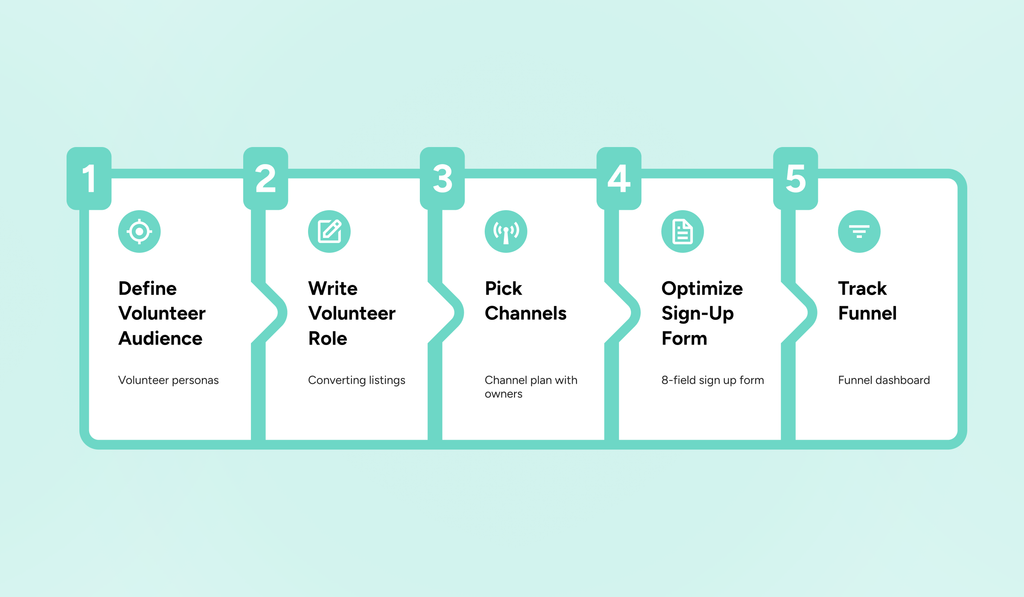
Step 1: Define Your Target Volunteer Audience
Look at your volunteer roster and group people into profiles based on what they do and when they show up. Patterns emerge, forming the basis of your volunteer personas.
Each persona should include a name, a motivation for volunteering, schedule constraints, and a typical barrier to entry. Your volunteer roster already has the data; you need to sort through it. An example persona looks like this:
Persona A: The Event-Day Volunteer
Role types: registration, crowd management, food service
Motivation: community connection, low-stakes contribution
Schedule: weekend half-days, 4–6 hour blocks
Barrier: unclear time commitment; doesn’t want to feel locked in
Once you have defined personas, every channel and message decision is clear.. This may depend on whether you’re recruiting for a targeted role or a non-targeted role.
Targeted vs. non-targeted recruitment
Non-targeted recruitment means posting a generic opportunity and waiting. Targeted recruitment means identifying which persona you’re short on, finding where they are, and building a specific ask for them. High-performing volunteer recruitment programs use targeted recruitment for hard-to-fill roles and non-targeted for general volume.
Step 2: Write Volunteer Role Descriptions That Convert
If your description doesn’t tell a volunteer exactly what they’ll do, when they’ll do it, what it costs them, and what they’ll get out of it, the prospective volunteer is never hitting the apply button.
A volunteer role description that converts should follow these best practices:
- Title: Specific and active. Food Pantry Shift Lead beats Volunteer Opportunity.
- Purpose: One sentence on why this role exists and what it enables.
- Responsibilities: Three to five bullets, each a real task.
- Logistics: Location (or remote), shift days and times, and any physical requirements.
- Time commitment: Weekly hours and minimum term.
- Training provided: What you teach them and how long it takes.
- Qualifications: What’s actually required vs. preferred, and what isn’t required.
- Benefit to the volunteer: Skills, experience, community, impact. What do they walk away with?
An example listing looks like this:
Food Pantry Shift Lead — Saturdays, 8–11 a.m.
You’ll run a three-person team distributing groceries to 80–120 families during our Saturday morning distribution window. Responsibilities include setting up distribution stations, managing flow at the intake desk, and completing an end-of-shift count. No experience required; we provide 45 minutes of onboarding before your first shift. The minimum commitment is four Saturdays; scheduling after that is flexible. Volunteers receive a reference letter and hands-on logistics management experience.
Your listing should answer every question a prospective volunteer has before they think to ask it. Specific listings convert and grow your volunteer roster.
Step 3: Choose Your Volunteer Recruitment Channels
Your volunteer personas tell you which channels to use. Retired professionals won’t find you on TikTok. College students won’t see your press release. Match the channel to the persona, not to what’s easiest for your team.
For every channel you activate, assign an owner and a cadence before you launch it. A channel without an owner is a channel you’ll abandon in six weeks.
A breakdown of channels and responsibilities looks like this:
| Channel | Best persona fit | Owner | Cadence |
| Email to existing database | Lapsed volunteers, donors | Coordinator | Monthly |
| VolunteerMatch / Idealist | General public, skills-based | Coordinator | Update quarterly |
| Campus service-learning offices | Students, first-time volunteers | Programs staff | Each semester |
| Corporate VTO outreach | Group volunteers, skilled pro bono | Development | Quarterly |
| Social media (organic) | Event-day, younger volunteers | Marketing | Weekly |
| Faith/civic partner referral | Recurring, mission-aligned | Program staff | Biannual relationship |
Step 4: Optimize Your Volunteer Sign-Up Form and Landing Page
Eight fields or fewer is the rule. Every field above that reduces your conversion rate.
Include these five questions on every landing page:
- What will I actually do?
- When and where?
- Do I need any experience or qualifications?
- How much time will this take?
- What happens after I fill out this form?
The longer a form is, the less likely a prospective volunteer is to complete it.
Apply the 48-hour rule when creating forms. If no one on your team reviews the answer within 48 hours of receiving it, delete the question because it’s costing you applicants.
The biggest gap in most volunteer pipelines is the window between form submission and first contact.
Step 5: Track Your Volunteer Recruitment Funnel
Most volunteer programs measure applications, but if that’s all you track, you’re missing crucial conversion points.
| Stage | What it measures | Signal |
| Reach | How many people saw the opportunity | Impressions, email opens |
| Click | How many expressed interest | Link clicks, landing page visits |
| Apply | How many submitted the form | Form completions, conversion rate |
| Screen/Clear | How many passed onboarding or background check | Clearance rate, drop-off reason |
| First shift | How many showed up | Show rate, no-show rate |
Your drop-off rate between apply and first shift is almost always the biggest leak in the funnel, and the one most coordinators never track.
Tracking the full funnel tells you where to spend your time. For example, if you’re losing people between apply and their first shift, the fix is in your follow-up sequence.
Volunteer Recruitment Strategies That Start With Your Existing Base
Re-engaging someone already in your database costs a fraction of acquiring a stranger. They know your mission, they’ve cleared your screening process, and they’re more likely to complete a shift. Before using an external channel, start here:
Re-engage Lapsed Volunteers With a Single-Shift Ask
The most common mistake with lapsed volunteers is treating them like strangers. They aren’t strangers; they just got busy.
A single-shift ask removes the barrier that caused them to step back: open-ended commitment. One shift, no obligation, no guilt. Try this email:
Subject: We’d love to have you back for one morning
Hi [First Name],
It’s been a while since we’ve seen you at [Organization], and we’ve missed having you on the team.
We’re not asking you to commit to a regular schedule — we know life gets busy. We’re just asking if you’d be willing to help us out for one [morning/afternoon] on [specific date].
[Specific role, specific date, specific time. Three hours. That’s it.]
If it works for your schedule, you can sign up here: [link]. No pressure if the timing isn’t right.
[Signature]
Send this to everyone who hasn’t volunteered in 12–18 months. Personalize the date and role to the shift you need filled. Remember specificity is what gets a response.
Metric to track: Reactivation rate from lapsed segment (target: 15–25%).
Ask Current Volunteers for Peer Referrals
Your active volunteers are your most credible recruiters; ask them for a peer referral. Give them something to share, like a link to the specific role, a pre-written post they can copy, and a way to track that they were the source.
Consider a post like:
“I volunteer with [Organization], and it’s one of the best things I do. They’re looking for help with [specific role]; it’s [time commitment], no experience needed. Here’s the link: [URL].”
Set up UTM parameters or a dedicated referral sign-up link so you can identify which volunteers are your best ambassadors. Recognize your top referrers by name in a newsletter or during an event.
Metric to track: Referral sign-up rate (referral applications ÷ total referral invites sent).
Recruit Volunteers From Your Donor Database
Donors who have never volunteered are often ignored, but shouldn’t be. You’re not asking them to give more; you’re inviting them to give their time.
Segment your donor database for people who have given at least once but have no volunteer history. Reach them separately from your standard donor communications. Try a message like:
“You’ve supported [Organization] financially, thank you. We’d love for you to see the work up close. We have an opening for [specific role] on [date] that we think you’d find meaningful.”
Metric to track: Donor-to-volunteer conversion rate (first-time volunteer applications from donor segment ÷ total donor segment contacted).
Convert Event Attendees Into Volunteers
If someone attended a gala, a 5K, or an open house, they’re interested in volunteering. Most organizations treat their attendee list as a donor prospect list, but it’s also your warmest volunteer pipeline, and deserves its own segment.
Create a post-event sequence with a thank-you message within 24 hours that mentions a specific volunteer opportunity with a link to apply. Follow up with a reminder email 3-5 days later.
Metric to track: Attendee-to-volunteer conversion rate (volunteer applications from attendee segment ÷ total attendees).
Recruit Volunteers From Your Member and Chapter Rosters
For associations and chapter-based organizations, your member database is your best source of volunteers. While you can reach out to your members at any time, renewal time is an opportune volunteer recruitment moment.
At renewal time, add a single question: “We’re looking for members who want to get more involved. Are you open to hearing about volunteer opportunities?”
Treat every yes as a warm lead, not a commitment. Follow up within a week with a role matched to what you know about them from their member profile.
For chapter-based organizations: a referral from a chapter leader to a national volunteer role carries the same trust signal as a peer referral.
Metric to track: Member participation rate in volunteer roles (active volunteer members ÷ total member base).
Once you’re effectively leveraging internal opportunities, it’s time to shift to external opportunities.
Volunteer Recruitment Strategies for Reaching New Audiences
External recruitment takes longer, converts at lower rates, and requires more onboarding investment. Look at your internal lists first. External recruitment can be worth it because it grows your total pool, but make sure you have a strong internal strategy first.
Post Volunteer Opportunities on VolunteerMatch, Idealist, and Points of Light
These three platforms carry strong search equity for people actively looking for volunteer opportunities. Keep role descriptions current, write to the persona rather than the role, and use role-specific landing pages rather than your general volunteer page.
Apply UTM parameters to every listing and refresh quarterly even if nothing has changed. Activity affects your placement in search results.
Metric to track: Applications per platform per month (tracked by source UTM).
Build Corporate Volunteerism and VTO Partnerships
Find a company that matches your benefits and reach out to them.
Many companies have a Volunteer Time Off (VTO) policy and someone tasked with finding service opportunities. Approach the coordinator and lead with what your organization can provide: a team event, a skills-based engagement, a cause that aligns with their ESG goals, and make logistics frictionless: a single point of contact, a defined role description, a flexible date window.
A good corporate volunteering program relationship can nearly fill your volunteer pipeline.
Tip: Once you establish the relationship, ask whether they have a volunteer grant program. Many corporate partners will donate dollars for every hour their employees volunteer, turning a volunteer shift into additional revenue.
Metric to track: Active corporate partnerships per quarter.
Partner With Faith Communities and Civic Organizations
Service organizations have volunteerism at their core. When approaching them, you’re not selling your mission; you’re matching theirs.
Skills-based roles fit professional associations. Group service days fit civic clubs. Seasonal campaigns fit congregations with high attendance windows.
Attend one meeting before you make the ask because a relationship with the program chair or community liaison is worth more than a cold email to a general inbox.
Metric to track: Partner referrals per month (applications attributed to each partner organization).
Recruit Student Volunteers Through Campus Service-Learning Offices
Most universities have a service-learning or community engagement office, and coordinators actively look for student placements.
Contact the community engagement office directly and ask specifically about service-learning course placements, which require structured hours and a learning agreement, and student organization partnerships, where a club commits to a recurring shift.
The detail that makes you easy to say yes to: offer a verification letter at the end of the term confirming hours served and role performed.
Metric to track: Youth volunteers as a share of total active roster.
Pitch Your Volunteer Program to Local Media
Pitching a story to local media isn’t a recruitment play, but it puts your organization and the good it does in front of the general public.
Consider highlighting the volunteer who’s been coming every Saturday for eleven years, the corporate team that overhauled your warehouse in a weekend, the service-learning student who is now a shift lead.
If a story happens, you have 72 hours to capture the traffic spike. Make sure your volunteer landing page is updated, your form is live, and someone is responding to inquiries within 24 hours.
Metric to track: Press mentions per quarter and resulting inquiries (track via form source question: “How did you hear about us?”).
These final five strategiesoffer best practices around overcoming common objections.
Volunteer recruitment strategies that remove barriers to signing up
Expanding your opportunity formats opens the door to a larger pool of people who genuinely want to help.
Offer Micro-Volunteering and Episodic Volunteer Roles
Two hours or less. No training required. No recurring commitment. Micro-volunteering is one of the fastest-growing segments of volunteering.
Offering smaller, lower-commitment shifts turns many one-time volunteers into recurring volunteers.
Metric to track: Share of shifts filled by first-time volunteers.
Create Virtual and Remote Volunteer Opportunities
Virtual and hybrid volunteers contribute more annual hours than their in-person-only counterparts: 95 hours per year versus 64, according to U.S. Census Bureau data.
Caregivers, rural supporters, people with mobility limitations, and remote workers with flexible daytime schedules are all looking for remote volunteer opportunities. Many back-office and project-based roles are perfect for remote volunteers.
Metric to track: Virtual roles as a share of total openings.
Make Volunteer Opportunities Accessible
Remove every barrier that makes it harder for someone to help. Run an ADA audit of your volunteer landing page and sign-up form. Offer role descriptions in languages common to your service population.
Include a logistics line in every role description, including transportation, parking, and physical requirements, so nothing is a surprise.
Metric to track: Accommodations requested and met.
Add Flexible Evening and Weekend Volunteer Shifts
For untrained or low-complexity roles, a drop-in model removes the scheduling barrier entirely: post a time period, track attendance at the door, and reserve fixed-time commitments for roles that require continuity.
Metric to track: Percentage of shifts filled within 48 hours of posting.
Shorten Time-to-First-Shift for New Volunteers
The gap between when someone applies and when they complete their first shift is where many volunteer programs stumble.
Aim for seven days or fewer from application to first shift for low-screening roles.
For roles requiring a background check, run orientation and onboarding in parallel with the clearance process rather than using clearance as a gate. Automate status updates so new volunteers hear from you at every stage.
Metric to track: Median days from application to first completed shift.
How to Recruit Volunteers for Associations and Member Organizations
Association volunteer recruitment looks different from direct-service nonprofit recruitment.
Members volunteer for different reasons than the general public. For a direct-service nonprofit, the pitch is mission impact. For associations, the pitch is professional: visibility within the field, credentialing or continuing education credit, a path to leadership, and peer relationships with people in their industry.
Association volunteer roles are also different. The most common needs are committee service, chapter leadership, conference and session volunteers, mentorship program participants, abstract reviewers, and award judges.
Match your ask to what members want from their membership. The time put into customizing asks converts. Here are more best practices on how to recruit from these organizations:
How to Recruit Committee and Chapter Volunteers From Your Member Base
Start with members who are already active. Members who’ve gone quiet may not be ready.
The sequencing rule: ask for time before money. Volunteers give substantially more than non-volunteers, and involvement precedes the gift. Tag every volunteer interest flag in your AMS so development and programs aren’t working from separate records.
At renewal, add one question: “Are you open to hearing about volunteer opportunities?” Follow up within a week with one specific role. For chapter-based organizations, treat a chapter leader referral to a national role (or vice versa) as a peer referral, and build that channel explicitly.
Volunteer Screening, Background Checks, and Compliance
If your roles require background screening, build additional time into the process. If your clearance process takes three weeks, recruit three weeks earlier, and build in time to keep a warm lead warm.
Some roles require additional credential verification: driver’s license and insurance for transport volunteers, professional license verification for medical or legal roles, TB testing for healthcare-adjacent programs.
Name the screening requirement and the expected turnaround time in every role description.
A prospective volunteer who discovers a background check is required after they’ve already applied is more likely to abandon than one who knew upfront.
How to Speed Up Volunteer Background Check Turnaround
Consider having your volunteer complete orientation, review their role description, shadow an experienced volunteer, and get a shift on the calendar, all contingent on background check clearance.
This keeps momentum and significantly reduces the silent drop-off rate.
State the expected timeline in the application itself. “Background checks take up to 10 business days” clearly tells applicants what to expect.
Automated status updates are the difference between a volunteer who waits patiently and one who assumes the process fell apart.
Where to Post Volunteer Opportunities
No single platform reaches every volunteer type. The rule that works: mix at least three, including one national platform for scale, one local channel for trust, and one persona-specific platform matched to the volunteer type you’re actively recruiting.
| Platform | Type | Best for | Cost |
| VolunteerMatch | National board | General public, cause-driven | Free / paid plans |
| Idealist | National board | Mission-motivated, career-adjacent | Free |
| Points of Light | National board | Corporate and group volunteers | Free |
| All for Good | National board | Broad general audience | Free |
| JustServe | National/regional | Faith community volunteers | Free |
| HandsOn Network | Regional hubs | Local community volunteers | Varies by hub |
| Catchafire | Skills-based | Professional pro bono | Nonprofit membership |
| Taproot Plus | Skills-based | Marketing, HR, strategy skills | Free |
| Campus service-learning office | Campus | Students, course placements | Free |
| Nextdoor | Hyperlocal | Local residents, community roles | Free |
| LinkedIn (volunteer section) | Professional network | Skills-based, career-motivated | Free |
| Facebook (volunteer tab) | Social | General public, local awareness | Free |
Update every listing quarterly. Stale listings lose ranking on search-driven platforms and signal to prospective volunteers that the program isn’t actively managed.
Compare Volunteer Recruitment Strategies by Time, Cost, and Impact
| Strategy | Time to Launch | Cost | Skill Level | Expected Impact | Primary Metric |
| Re-engage lapsed volunteers | < 1 day | Free | Low | High | Reactivation rate |
| Peer referrals | < 1 day | Free | Low | High | Referral sign-up rate |
| Donor database | 1–2 days | Free | Low | High | Donor-to-volunteer conversion |
| Event attendees | 1–2 days | Free | Low | High | Attendee conversion rate |
| Member/chapter rosters | 2–3 days | Free | Low | High | Member participation rate |
| VolunteerMatch, Idealist, Points of Light | 1 day | Free | Low | Medium | Applications per platform |
| Corporate VTO partnerships | 2–4 weeks | Low | Medium | High | Active partnerships/quarter |
| Faith and civic partners | 2–4 weeks | Free | Medium | Medium | Referrals/month |
| Campus service-learning | 1–2 weeks | Free | Low | Medium | Youth volunteer share |
| Local media pitch | 1–2 weeks | Free | Medium | Medium | Inquiries from coverage |
| Micro-volunteering/episodic | 1–2 days | Free | Low | High | First-time fill rate |
| Virtual/remote roles | 3–5 days | Low | Medium | High | Virtual role share |
| Accessibility improvements | 1–2 weeks | Low–Med | Medium | Medium | Accommodations met |
| Evening/weekend shifts | 1–2 days | Free | Low | Medium | 48-hr fill rate |
| Shorten time-to-first-shift | 1–2 weeks | Free | Medium | High | Median days to first shift |
Your First 30 Days: A Week-by-Week Volunteer Recruitment Plan
Here’s how to turn this guide into a four-week plan:
Week 1: Audit and Role Descriptions
Pull your roster and flag everyone inactive for 12–18 months. Audit your five most-needed open roles: does each have a specific title, time commitment, screening requirement, and volunteer benefit? Rewrite any that don’t.
Owner: Coordinator
Output: Revised role descriptions, lapsed volunteer segment
Week 2: Landing Page and Form
Cut your sign-up form to eight fields or fewer. Write a confirmation email that tells applicants exactly what happens next and when. Build UTM parameters for every channel you’ll activate in Week 3 and set up automated follow-up: same-day confirmation, day-three check-in, day-seven nudge.
Owner: Coordinator + Marketing
Output: Optimized form, automated sequence, UTM structure
Week 3: Activate Your Existing Base
Send the single-shift lapsed volunteer email. Ask your five most active volunteers for a peer referral. Go live on one national board, one local channel, and one persona-specific platform. If renewals are going out this month, add the volunteer interest question.
Owner: Coordinator
Output: outreach live; three platforms active with source tracking
Week 4: Launch, Measure, and Reallocate
Review source data by channel — where are your highest-quality applications coming from, not just the most? If apply-to-first-shift drop-off exceeds 30%, look at your follow-up sequence before your recruitment message. Double down on the two best channels; pause the weakest. Block 30 minutes to document what changes before Month 2.
Owner: Coordinator + supervisor
Output: Source quality report, revised channel plan
How to Measure Volunteer Recruitment Success
The volunteer programs that improve year over year measure what’s diagnostic.
- Application completion rate (started ÷ submitted): Below 60% means your form is too long or your landing page isn’t answering the five core questions.
- Apply-to-cleared rate (submitted ÷ passed screening): Below 70% usually signals a screening delay, a communication gap, or expectations set incorrectly at application.
- Cleared-to-first-shift rate (cleared ÷ completed first shift): Below 75% means the window between clearance and scheduling is too long.
- Second-shift return rate (returned ÷ completed first shift): A low return rate signals a problem with the volunteer experience, not the recruitment message.
- Cost per volunteer acquired (total spend ÷ volunteers who completed first shift): Useful for benchmarking channels against each other.
- Source quality by channel: a channel that generates 40 applications and 2 completions is worse than one that generates 8 applications and 7. Track which channels produce volunteers who clear, show up, and return. That’s what separates programs that improve from programs that try harder.
How Volunteer Management Software Supports Recruitment
Administrative hurdles in volunteer recruitment can derail a program before it even starts. Manual scheduling, chasing waiver forms, and tracking background check status in a spreadsheet don’t scale. It all compounds when you’re running a recruitment push at the same time.
VolunteerMatters by Momentive Software is built for organizations that need recruitment, scheduling, screening, and reporting in one place, including associations managing member volunteer programs alongside direct-service ones.
For organizations already running an AMS, fundraising, or events platform on the Momentive ecosystem, VolunteerMatters connects to the records you already have, so volunteer activity flows into the same member or donor profile without a manual sync.
Frequently Asked Questions
Volunteer recruitment is the process of identifying, attracting, and onboarding people to serve your organization without compensation. It differs from volunteer retention in that you’re forming a new relationship rather than maintaining an existing one. Recruitment builds the pipeline; retention keeps the people in it.
Run two moves in parallel: send a single-shift ask to everyone who hasn’t volunteered in 12 to 18 months, and ask your five most active volunteers for one peer referral each. Both take under an hour to execute and reach the warmest prospects available to you — people who already know your mission and cleared your process.
Mix at least three types: one national platform (VolunteerMatch, Idealist, or Points of Light) for scale, one local or community channel for trust, and one persona-specific platform matched to the volunteer type you need. Apply UTM parameters to all three so you know which produces the best applications, not just the most volume.
Mission connection and personal recognition consistently outrank tangible rewards. For association members specifically, motivators differ: professional visibility within their field, credentialing or continuing education credit, access to peer networks, and a pathway to board or leadership roles. The pitch that works for a food bank won’t work for a professional membership organization.
It depends on the role. Low-risk roles — events, administrative, general fundraising — typically require little or no screening. Client-facing adult program roles usually require a criminal background check. Roles involving youth, elderly, or vulnerable populations often require enhanced background checks and may be mandated by state law. Name the screening requirement in every role description so prospective volunteers know before they apply, and run onboarding in parallel with clearance to keep warm leads from going cold.
Start with your existing database: the lapsed volunteer email, peer referral asks to current volunteers, and the donor-to-volunteer pitch all cost nothing but staff time. Then post to VolunteerMatch, Idealist, or Points of Light (free). Contact your local campus service-learning office (free). Attend one Rotary or civic club meeting and ask for five minutes (free). That covers strategies 1 through 9 in this guide with no spend.
Industry data suggests a first-year drop-off of 40 to 50% is common, which means most programs need to recruit roughly twice what they want to keep to maintain consistent staffing. Track second-shift return rate as an early signal — below 65% usually points to a gap in the first-shift experience that no volume of recruitment will fix. Recruitment and retention are connected; a strong pipeline doesn’t compensate for a poor first shift.
Volunteers give substantially more than non-volunteer donors, and the sequence matters: involve first, cultivate second, solicit third. Once someone has volunteered, record that activity in your donor database so your development team can see the full engagement history. For organizations in the Momentive ecosystem, VolunteerMatters automatically connects volunteer activity to the same member or donor profile, so no touchpoints fall through the gap between systems.
Struggling to keep your volunteer program organized? Discover what volunteer management software can do for your organization.