
If you’ve searched “certificate vs. certification” expecting a quick, clear answer and landed on jargon-heavy pages aimed at HR specialists or credentialing bodies — you’re not alone. The two terms are genuinely confused, even by professionals who hold both.
This blog cuts through this noise. Whether you’re an individual deciding which credential to pursue, an L&D manager building a training program, or an organization designing a credentialing pathway, here’s what you need to know.
What Is a Professional Certificate?
A professional certificate is an educational credential awarded when you complete a defined course or curriculum. It signals that you’ve received instruction in a specific subject — not necessarily that you’ve been tested against an independent competency standard.
Certificate programs are typically:
- Offered by universities, community colleges, training providers, professional associations, or online platforms
- Completed in a matter of weeks or months (though some span a year or more)
- Focused on a specific skill, tool, or knowledge domain
- Non-expiring — once issued, the certificate doesn’t require renewal
Examples of professional certificate programs:
- Google’s Digital Marketing & E-commerce Certificate (Coursera)
- Cornell University’s Executive Leadership Certificate
- HubSpot Content Marketing Certification (note: despite the name, this functions more like a certificate — more on that distinction below)
- Association-issued continuing education certificates for member professional development
Certificates are especially common in fast-moving fields like technology, marketing, and healthcare continuing education, where employers and learners both value demonstrated exposure to current tools and practices.
What Is a Professional Certification?
A professional certification is a credential that validates your competency in a field or role, typically through a formal examination process. It’s issued by an independent certifying body — usually a professional association, industry organization, or government agency — and is not simply tied to completing coursework.
Certifications typically:
- Require passing a standardized exam (often multiple-choice plus practical components)
- May require documented work experience or educational prerequisites
- Are issued and maintained by a credentialing body or professional association
- Expire and require periodic renewal or recertification (CEUs, re-examination, or both)
Examples of professional certifications:
- CPA (Certified Public Accountant) — issued by the AICPA
- PMP (Project Management Professional) — issued by PMI
- SHRM-CP / SHRM-SCP — issued by the Society for Human Resource Management
- CompTIA Security+ — IT security certification
- Healthcare licensure and specialty nursing certifications (e.g., CCRN)
Certifications carry significant weight with employers because they reflect a third-party validation of skill — not just self-reported or course-provider-reported learning. The rigor of the process, and the requirement to maintain the credential over time, is what gives certifications their professional credibility.
Certificate vs. Certification: Key Differences at a Glance
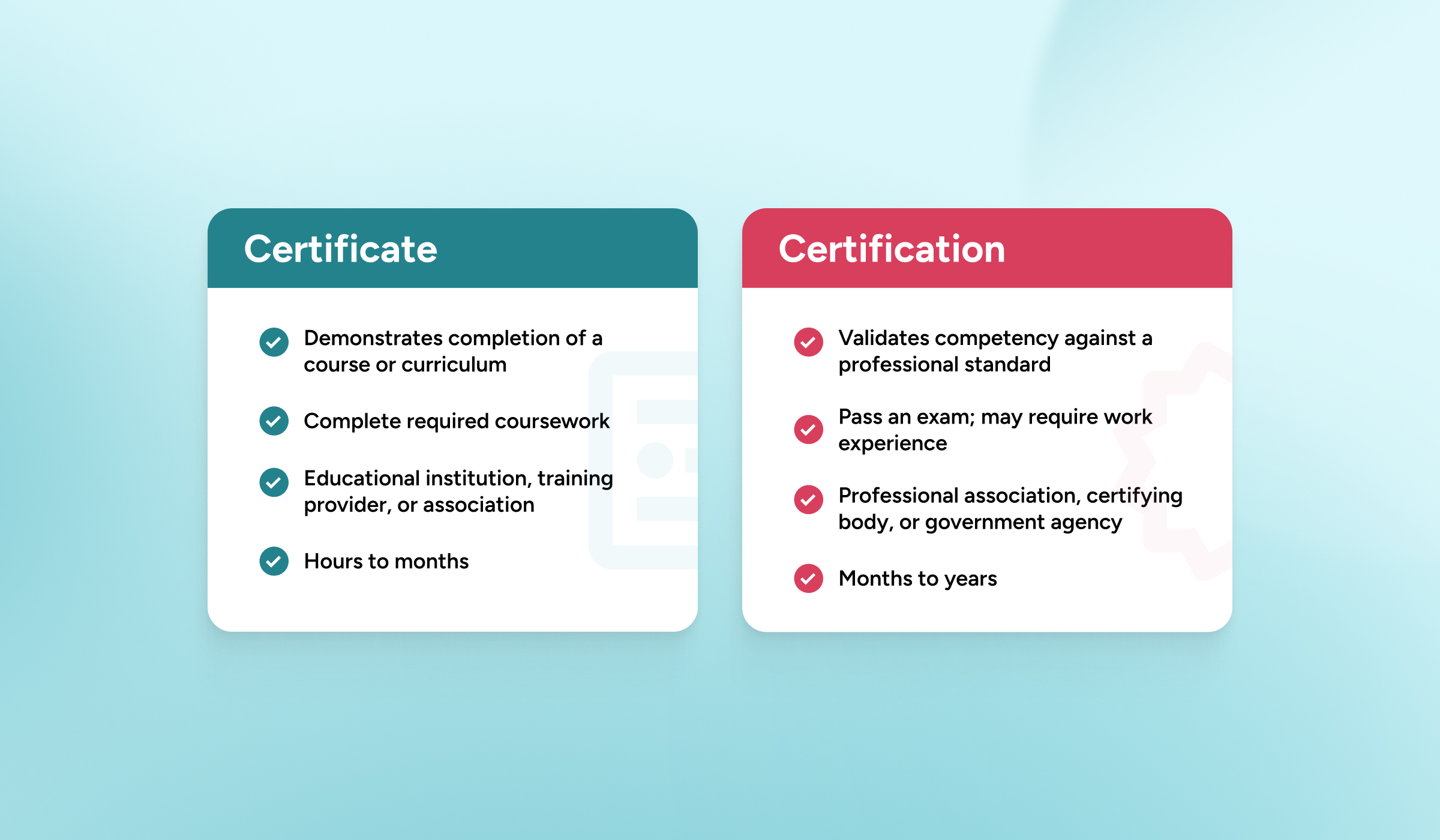
The table below summarizes the core differences between the two credential types:
| Dimension | Certificate | Certification |
| Purpose | Demonstrates completion of a course or curriculum | Validates competency against a professional standard |
| How it’s earned | Complete required coursework | Pass an exam; may require work experience |
| Issued by | Educational institution, training provider, or association | Professional association, certifying body, or government agency |
| Does it expire? | Typically no | Usually yes — renewal or recertification required |
| Who verifies competency? | Course provider | Independent third party or credentialing body |
| Common industries | Technology, healthcare continuing ed, project management, marketing | Healthcare (RN, CPA), IT (CompTIA), legal, finance |
| Time to earn | Hours to months | Months to years |
| Cost | Low to moderate | Moderate to high (exam fees, prep, renewal) |
One important caveat: terminology is inconsistent in the real world. Some programs use “certification” in their name but function structurally as certificates (no independent exam, no renewal). Always look at the structure of the credential — not just the label — when evaluating what it signals to employers.
Which Credential Is Right for You?
The right credential depends on your goal, timeline, and the field you’re in. Here’s a practical framework:
Choose a certificate program if:
- You want to build or refresh skills in a specific area quickly
- You’re entering a new field and need to demonstrate foundational knowledge
- Your employer or role requires continuing education credits (CEUs) rather than formal credentialing
- You’re exploring a subject before committing to a full certification track
Choose a certification if:
- Your industry has a recognized standard (CPA, PMP, CISSP, etc.) that employers actively screen for
- You want a credential that signals validated competency, not just coursework completion
- You’re preparing for a specific role or career advancement where the certification is expected or required
- You’re willing to invest more time and money upfront in exchange for a credential that carries more weight
How Employers and L&D Teams Use Both Credentials
For organizations building workforce development programs, both credential types serve distinct and often complementary roles.
Certificate programs in organizational training:
- Onboarding and role-specific training (e.g., a certificate in compliance basics for new hires)
- Upskilling initiatives where speed and flexibility matter
- Continuing education requirements tied to maintaining professional status
- Microlearning pathways that can be completed asynchronously via an LMS
Certifications in workforce strategy:
- Benchmarking employee competency against industry standards
- Sourcing and recruiting — many job postings list certifications as preferred or required
- Demonstrating organizational commitment to quality (e.g., requiring all project managers to hold PMP certification)
- Meeting regulatory or compliance requirements in fields like healthcare, finance, or safety
L&D teams increasingly manage both credential types within a single learning platform. Tracking who has completed certificate programs, when certifications are due for renewal, and surfacing that data to managers requires a learning management system built for credentialing — not just course completion.
Common Mistakes Organizations Make with Credentialing Programs
When it comes to your credentialing program, it’s not uncommon to make mistakes. Here are the most common mistakes organization make:
- Using “certificate” and “certification” interchangeably in program marketing, which confuses potential participants and undermines the credential’s perceived value
- Building certificate programs without a renewal or re-engagement path, leading to credentials that age out without learner action
- Launching certifications without a formal exam development and psychometric validation process — a shortcut that reduces employer confidence
- Tracking credentials in spreadsheets instead of a credential management system, leading to missed renewals and compliance gaps
- Failing to communicate the difference to members or employees — if your audience doesn’t understand what they’re earning, they’re less likely to pursue or value it
How Associations Can Build a Credentialing Ecosystem
For professional associations, credentialing is one of the highest-value services you can offer members. A credentialing ecosystem typically includes both certificate and certification programs — each serving different member segments and career stages.
A well-designed association credentialing strategy might look like this:
- Entry-level certificate programs that introduce members to core competencies and drive initial engagement
- An advanced certification program that validates mastery and commands career-level recognition
- Continuing education requirements tied to certification renewal, which drives recurring member activity and engagement
- A digital badging or credential-sharing system that lets members showcase credentials on LinkedIn and professional profiles
This model does more than generate non-dues revenue. It positions the association as the authoritative credentialing body in the profession — which is a durable competitive advantage.
How to Manage Certificate and Certification Programs at Scale
As your credentialing programs grow, managing them manually becomes untenable. You’re tracking thousands of learners, expiration dates, recertification cycles, and compliance records — often across multiple programs simultaneously.
A purpose-built learning management system (LMS) with credentialing capabilities should handle:
- Automated renewal reminders and recertification workflows
- Exam delivery and scoring
- Certificate and credential issuance (including digital badges)
- CEU and continuing education tracking
- Reporting dashboards for administrators and compliance auditors
- Integrations with your association management system (AMS) for member data sync

FAQ
What is the difference between a certificate and a certification?
A certificate is an educational credential awarded after completing a course or curriculum. A certification validates competency through an independent exam and is typically issued by a professional or industry body. Certificates demonstrate learning; certifications demonstrate verified competency.
Do certifications expire?
Most professional certifications do expire and require renewal. Renewal typically involves completing continuing education units (CEUs), paying a renewal fee, or retaking an exam. The renewal period varies by certifying body — commonly one to three years. Certificate programs generally do not expire.
Which credential is better for career advancement?
It depends on the field and the specific credential. In industries with a well-recognized certification standard (accounting, HR, IT security, project management), holding that certification is often a prerequisite for advancement and can directly impact salary. In fields where no dominant certification exists, a respected certificate from a recognized provider can still add meaningful credibility. In many cases, both are valuable at different career stages.
Can an organization offer both certificates and certifications?
Yes — and many do. Associations in particular commonly offer certificate programs for continuing education and skill development alongside formal certification programs for advanced members. Managing both effectively usually requires a learning management system with credentialing features, not just a basic course delivery tool.
How do you manage certification renewals at scale?
Managing renewals at scale requires more than a spreadsheet. A dedicated certification management system handles automated reminders, CEU tracking, renewal workflows, and reporting. For associations managing thousands of certified members, integration with the membership database ensures that lapsed certifications are flagged automatically and renewal data stays current.
What’s the difference between accreditation and certification?
Accreditation applies to programs or organizations, not individuals. An accredited certification program has been reviewed by a recognized body (such as the National Commission for Certifying Agencies, NCCA) and meets established standards for exam development, psychometrics, and governance. Certification is the credential an individual earns. Accreditation validates the quality of the certifying body itself.