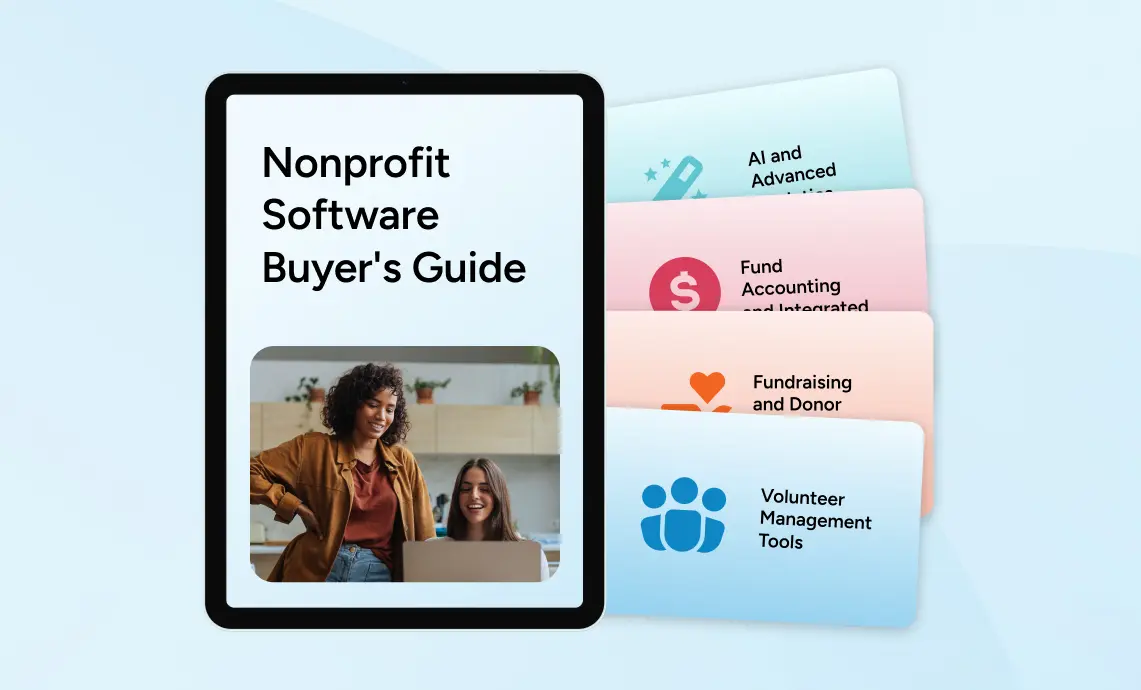
Nonprofit Software Buyer’s Guide
For a nonprofit, technology is not just a utility; it is a megaphone for your cause. When your digital tools are outdated, the friction is felt by the people who matter most: the donor who wants to give quickly, the volunteer looking for a meaningful role, and the beneficiaries waiting for services.
A modern tech stack should be invisible and effective, allowing your mission to take center stage. This guide is designed to help you move beyond keeping the lights on so you can focus on scaling your impact and deepening your community’s trust.
Struggling to keep your volunteer program organized? Discover what volunteer management software can do for your organization.
Nonprofit Operation Priorities
In this economic and political climate, every dollar matters for nonprofits. As your organization works to maximize its mission, your technology should help your team do more.
Your team can’t function without technology, but inefficient tech can also hold your organization back. So how do you know if your technology is right for your organization? The questions explore the most common operational challenges that nonprofits face.
Separate pieces of technology slow down efficiency and contribute to burnout. Research found that 8 in 10 nonprofit and association professionals agree that inefficient or disconnected technology systems contribute to burnout.
If your nonprofit uses separate tech for processes like email marketing, donor engagement, payment processing, and more, the result is tons of manual work that’s time-consuming and error-prone.
If your team is manually transferring data between systems, updating spreadsheets constantly, or even manually check a donor’s status, they’re wasting time with inefficient processes. The time spent sorting through these inefficiencies can be better spent on strategic activities focused on meeting your mission or engaging with external stakeholders.
Are you treating your $25-a-month recurring donor the same as a first-time gala attendee? If your software cannot segment your audience or track their unique history with your organization, you are losing the personal connection that drives long-term loyalty.
Stakeholders demand to see where their money goes. If it takes your team three days to pull a report on program outcomes or financial allocation, your technology is a barrier to the level of transparency needed in today’s economic landscape.
Is it time to upgrade?
If your team is juggling multiple systems, reliant on manual entry, fighting back declining donor figures, or looking for ways to increase efficiency, your technology is key. When considering an upgrade, your team should be at the heart of the process.
Ask these questions to figure out if it’s time to upgrade your tech:
Too often, nonprofits stick with what’s working because it’s worked before. Just because you’re using the technology doesn’t mean it’s the best option available today. Ask your team questions about the software, like:
- What are the benefits?
- What are the drawbacks?
- What does support look like?
- Is the software regularly updated?
- Does the software feature cross-compatibility?
After compiling all of your team’s feedback , common themes will emerge and become more apparent. The challenges will influence your go-forward plan.
Solving inefficiencies your team is working through not only helps them do their job better but also increases the effectiveness of your entire organization. Consolidating multiple, disparate systems or implementing a new multifaceted tech ecosystem will solve many of the common themes you aggregated above.
After your evaluation, it’s time to determine your go-forward plan. Here, you’ll have your organization’s technology mapped out, along with the feedback from your team, and you’ll decide what your next steps are going to be.
Whether that means sunsetting inefficient systems or looking for new vendors entirely, this process will take time, but the benefits are undeniable. Sunsetting dated systems saves costs related to technology upkeep and improves efficiency by eliminating siloed, single-purpose systems.
Nonprofit Software Explained
These are the most common areas where nonprofits experience operational pain points, along with how the software will benefit your organization.
AI-powered tools unify your entire technology ecosystem, going beyond traditional Data Analytics and transforming fragmented data into an intelligent, automated experience.
How it Benefits You
An AI and advanced analytics hub provides real-time, visual dashboards that eliminate the need for manual data sorting, allowing your team to focus on operational impact. Plus, AI Agents automate workflows and user interactions to help your organization realize time savings.
Generic business accounting tools don’t capture the nuances of nonprofit finances, such as restricted grant tracking or multi-year pledge management. Fund accounting software bridges this gap by integrating directly with your donor database to provide an audit-ready view of your organizational health.
How it Benefits You
Fund accounting software effortlessly tracks multiple funding sources including grants, individual donations, and fundraisers. This seamless data integration eliminates the need for manual reconciliation and provides an audit-ready source of truth,dramatically reducinghuman error. With real-time visibility into program spending and automated reporting, your leadership can make data-driven decisions that ensure total financial transparency and compliance for your stakeholders and board members.
To grow your mission, you need a sophisticated engine that moves beyond simple donation forms. Fundraising software unifies donor history, digital engagement, and communication preferences into a single source of truth.
How it Benefits You
By connecting a supporter’s giving history with their volunteer activity and event attendance, your development team can deliver hyper-personalized outreach. This whole-person view has been proven to improve donor retention by creating a seamless experience that transforms one-time donors into lifelong mission partners.
The heartbeat of many nonprofits is the energy of volunteers, yet manual coordination often leads to scheduling conflicts and burnout. Centralizing recruitment, onboarding, and shift management into a digital ecosystem removes the administrative hurdles that stand between your supporters and their impact.
How it Benefits You
Automation takes the guesswork out of coordination by sending real-time reminders and providing self-service portals. This reduces no-show rates and allows your volunteer manager to focus on nurturing relationships rather than managing complex spreadsheets.
Nonprofit Value-Added Tools
While basic tools can handle simple sign-ups, mission-critical events require a dedicated platform to manage the complexities of modern abstract management, mobile engagement, and hybrid logistics. Using disconnected tools for complex events is a primary driver of the “tech efficiency battle” that leads to staff burnout.
How it Benefits You
By making the registration and attendance process seamless, you remove friction for your members and eliminate manual data reconciliation for your staff. Real-time insights into session popularity and attendee behavior allow you to plan future networking opportunities with precision, ensuring every event delivers maximum ROI for your mission while protecting your team’s most valuable resource: their time.
To address the preparation gap and the demand for career development, your organization needs a professional-grade platform that turns educational content into a primary driver of non-dues revenue.
How it Benefits You
Providing top-tier webinars, on-demand training, and automated CE credit tracking creates tangible “career visibility” for your members. By delivering high-value certification paths that members can’t find elsewhere, you aren’t just checking a box—you are building long-term loyalty and a sustainable revenue stream that fuels your mission.
Your organization should be the first place your members look when they are ready to take the next step in their professional journey. Advanced career center solutions bridge the gap between employers and your niche talent pool.
How it Benefits You
This provides the ultimate passion tax refund by helping your members advance their careers within your specific industry. Meanwhile, your organization realizes a passive stream of non-dues revenue through premium job postings and recruitment advertising, diversifying your income while strengthening your position as the industry authority.
Struggling to keep your volunteer program organized? Discover what volunteer management software can do for your organization.
Explore Our Solutions
Finding a Technology Vendor
Every nonprofit’s journey is unique, and your technology should reflect your specific scale, mission, and complexity. Momentive Software provides a range of platforms tailored to where you are today and where your impact is headed tomorrow.
The most important step in this process is identifying a technology partner rather than just a software provider. Your nonprofit needs a vendor that stands beside you from the initial evaluation through implementation and ongoing daily support. If you are ready to modernize, use these tips to evaluate potential solutions and partners:
If you are reading this guide, it means a specific challenge has prompted you to consider a switch. Finding a new platform and successfully migrating your data takes time and careful planning.
Do not wait until your current contract is months away from expiring; give your team the breathing room to make a strategic choice without the pressure of a looming deadline.
The more context you provide to potential providers about your pain points and goals, the better your final outcome will be. Share your internal workflows and be open about your must-have features. As long-term members of the nonprofit technology industry, we are generally very generous with our time and expertise as we work to earn your trust and business.
This is a foundational decision that will influence how you engage with donors and volunteers for years to come. Take the time to meet with vendors, attend demonstrations, and perform deep research on product capabilities.
You are not the first organization to navigate this transition, so lean on the nonprofit community. Networking with peers and requesting vendor references can be incredibly helpful. Reach out to organizations with similar missions or donor bases to learn which solutions actually deliver on their promises.
It is critical that the software meets your technical requirements, but finding a partner that aligns with your organization’s culture is often more important than a specific feature list. You need a partner who understands that every digital interaction is an opportunity to deepen a donor’s commitment. Momentive Software centers its entire ecosystem on driving engagement and maximizing impact for nonprofits of every size.
Securing Stakeholder Buy-In
Once you have selected a vendor, you must clear one final hurdle: getting everyone on board. Securing support from your board, staff, and donors can make or break your implementation.
Here is how to build a compelling case for adoption and address concerns before they stall your progress:
Before you can build support, you need to know whose approval matters most. Each group has different motivations:
- Board and Executive Leadership: They prioritize return on investment, long-term sustainability, and strategic alignment.
- Staff: They care about daily efficiency, reducing burnout, and ending the cycle of manual data entry.
- Donors: They want a seamless, personalized experience and clear visibility into the impact of their contributions.
Do not just talk about features; talk about solutions. A strong business case connects the new software to your nonprofit’s long-term vision.
- Quantify the Inefficiency: Show the cost of doing nothing. Calculate the hours wasted on manual data transfers and how that time could be better spent on mission-facing initiatives.
- Focus on Strategic Growth: Explain how modernizing your tech stack directly supports your goal of increasing donor retention and growing diverse revenue streams.
Tailor your messaging to resonate with each group.
- For your board, highlight how centralized data leads to smarter decision-making.
- For staff, emphasize quality-of-life improvements through automated workflows.
- For donors, frame the upgrade as an investment in their experience, offering better engagement and more relevant content.
Change can be intimidating. To ease budget and operational concerns, take these steps:
- Break Down the Total Cost of Ownership: Compare the upfront investment with the long-term savings gained from sunsetting dated, siloed systems.
- Propose a Phased Implementation: You do not have to do everything at once. Spreading the rollout over time makes the transition operationally manageable.
- Offer a Support Roadmap: Outline the training and help-desk resources available to ensure no one is left behind during the transition.
Use the staff feedback you have already collected to highlight the drawbacks of your current software. When stakeholders feel their candid feedback has influenced the go-forward plan, they are much more likely to champion the final result.
Watch Boardroom Ready: Building a Business Case for Tech Investment for more tips on earning external stakeholder buy-in.
The Next Steps
After securing board approval, it’s time to move the process forward.
Before a single line of data is moved, you have to dot the i’s and cross the t’s. Your legal team will review the Master Service Agreement (MSA) and Statement of Work (SOW). Your IT team will conduct a final security and compliance check to ensure the software meets data privacy standards.
Signature and Scheduling: Once signed, you’ll secure your spot in the vendor’s implementation queue.
This is where the partnership begins. You’ll be introduced to your dedicated implementation team from the vendor side.
You’ll appoint a project lead and super users from various departments, such as events, finance, and fundraising, to work with your vendor’s implementation team.
You’ll set a formal project timeline, establish milestones, and agree on what go-live success looks like.
Our professional services team acts as a strategic guide throughout this transition, managing the heavy lifting of data migration and system configuration to ensure your new platform is ready for use on day one.
By providing personalized, expert-led training and tailored project management, they help your staff move past the fear of the unknown and avoid the burnout often associated with manual data cleanup. This hands-on approach ensures that your technology is not just installed but fully optimized, eliminating the disparate systems and manual processes that previously hindered your organization’s efficiency.
After you go live, our training and support teams continue to support your organization, ensuring that whenever a need arises, your organization is supported.
Struggling to keep your volunteer program organized? Discover what volunteer management software can do for your organization.
Need more help with the buying process?
Fill out the form to unlock exclusive nonprofit technology resources.