
If you’re looking for a way to generate revenue while providing immense value to employers and job seekers, job boards are the answer.
Your job board serves as the medium to connect employers to job seekers and vice versa. Job boards generate consistent traffic, attract paying advertisers, and become more relevant as they gain traction.
This guide covers how to choose a niche and pick a platform to set up listings, how to monetize your job board, and what you need to do to reach the right audience.
Building this for an association or nonprofit? See how Career Center Software helps.
What Is a Job Board?
A job board enables employers to find essential, highly qualified talent they might not otherwise find. A job board lets job seekers in a specific industry see employment options and filter them based on their needs.
Organizations and businesses build job boards as a reliable way to generate revenue. Employers often pay per listing and advertise on the job board by promoting listings or banner ads to get their position in front of as many qualified job seekers as possible.
Job boards are a reliable revenue engine that organizations and businesses can count on, despite a shifting economy.
How to Create a Job Board: Step by Step
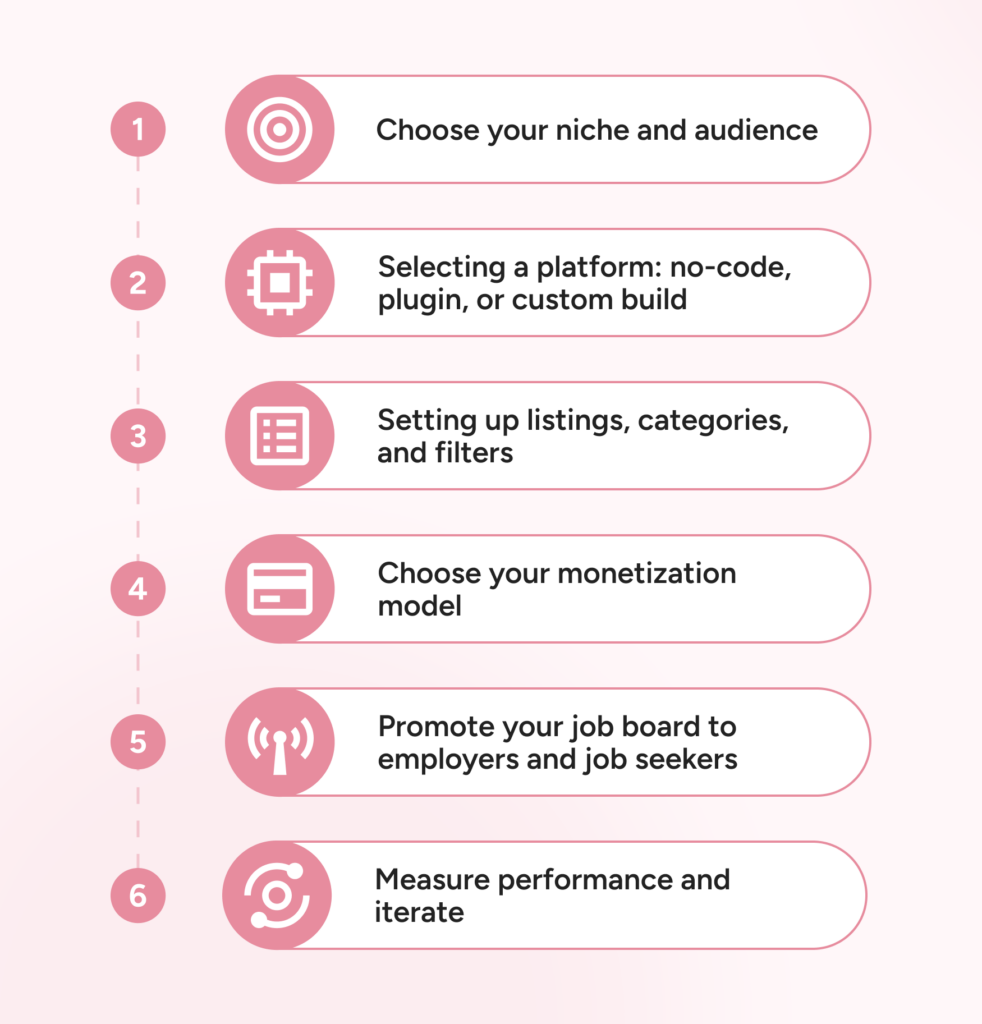
These six steps outline the general process for setting up a niche job board:
Choose your niche and audience
Several well-established general job boards operate worldwide. From LinkedIn to Indeed and other general job boards, the job board space is well established and hard to disrupt. For your job board to stand out, it needs to serve a niche audience.
Every industry has demand for job seekers. When establishing a job board, it’s best to create one that caters to a community you’re already part of.
For example, a gastroenterology professional society can create a niche job board for gastroenterologists and their many related subspecialties. While these positions exist on general job boards, with an assembled audience already, you have a pool of active and passive job seekers looking for a position, plus a value prop you can use to approach healthcare organizations seeking a new hire.
When establishing your job board, define specific metrics aligned with your goals to monitor your progress more accurately.
Selecting a platform: no-code, plugin, or custom build
There are three main paths: no-code SaaS builders (like Jobboardly or Niceboard), WordPress plugins (like WP Job Manager), and custom development. SaaS gets you live fastest with the least technical lift but limits flexibility. WordPress gives you more control at the cost of more setup. Custom development is overkill for most new boards. Consider custom development only if you have requirements that nothing else can meet.
For most first-time builders, SaaS or a WordPress plugin is the solution. Launch, get listings, and let your audience tell you what to build next.
Setting up listings, categories, and filters
Once you’ve chosen a provider, you can set up your job board. Define the fields every posting requires upfront: job title, location, employment type, compensation range, and a description. You want consistent job boards to improve searchability and increase candidate trustworthiness in your board.
When building job categories, base them on how your audience thinks about work. For example, a gastroenterology board filters by subspecialty and practice setting, not just healthcare.
A note on listing quality: if your job board has postings directly from employers, ensure those roles are active. Backfilled jobs from aggregators are often outdated or already filled, alienate job seekers, and dead links dissuade job seekers from returning to your job board.
Choose your monetization model
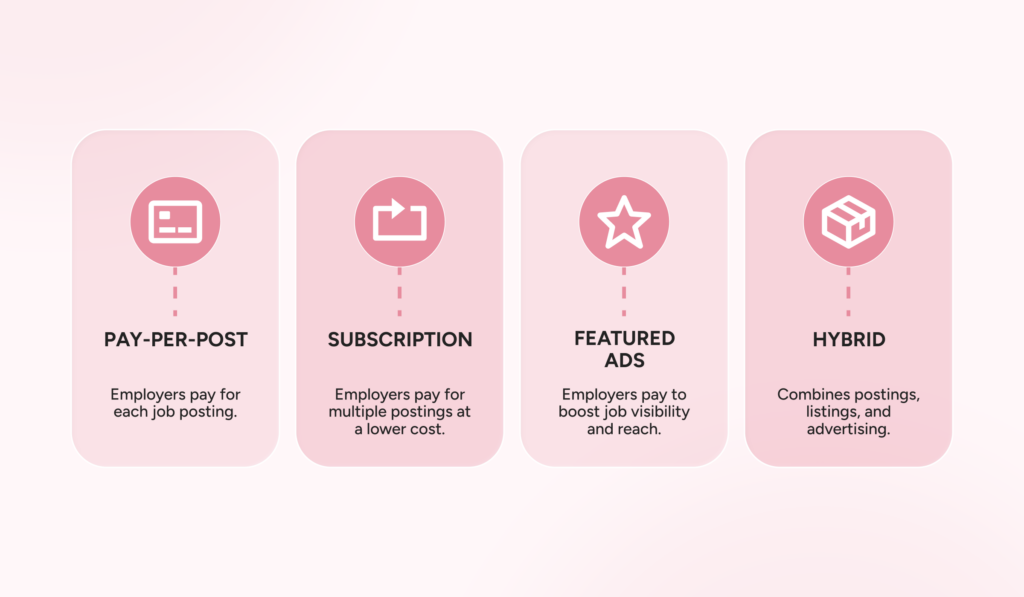
While creating a free job board for users would be ideal, it’s not practical. Job boards must generate revenue to grow into tools that help the most people. There are several different monetization models you should consider:
Pay-per-post
Pay-per-post is the most straightforward model. Employers pay to post on your job site by the number of posts. One post is one payment. It’s effective when just starting up but doesn’t reward repeat posters.
Subscription
A subscription model elevates pay-per-post by grouping multiple postings and offering cost savings. A subscription model rewards repeat posters by offering additional posts at a lower cost.
Featured listings and advertising
This elevates the subscription model further and allows employers to pay to have their job highlighted. Whether that’s a prime position on the job feed or inclusion in a roundup of listings sent to job seekers, employers often pay to ensure their posting has maximum reach.
Hybrid
A hybrid model lets employers save money on postings, featured listings, and advertising. It offers the most cost savings to employers with the highest upfront price tag. Make sure your hybrid packages are competitively priced so employers get the most value.
Promote your job board to employers and job seekers
Employers won’t post if there are no candidates, and candidates won’t visit if there are no jobs.
The solution? Seeding your board before launch. Reach out directly to employers in your network and offer free or discounted postings to get initial listings up. Even a handful of real, active roles gives candidates a reason to visit and gives you proof of concept to approach the next employer.
Once you have listings, keep both sides of the market engaged. Use press releases, email campaigns, blog posts, social media, and targeted advertising to build visibility.
Re-engage past visitors when you add new listings. Posting and promoting placement success stories builds credibility and keeps your audience coming back.
Measure performance and iterate
Once your board is live, track the metrics that tell you whether it’s working: job postings added per month, application clicks, employer return rate, and candidate return visits. These signals will tell you more than traffic alone.
If postings are growing but application clicks are low, your listings or UX needs attention.
If employers aren’t returning, your pricing or candidate pool isn’t delivering enough value.
Let the data drive your next move. A job board is a marketplace, and marketplaces improve through iteration, not just promotion.
Is a Job Board Right for Your Association or Nonprofit?
Job boards are a great way to provide member value, help employers in your industry, and drive non-dues revenue for your association. While a general job board tool covers the basics, for mission-driven organizations the features gap shows up quickly once you’re operational.
A career center platform like Careers Powered by Momentive positions your organization as the trusted career resource for your profession. Members expect their organization’s career center to reflect their industry’s standards, not a generic template.
Another crucial factor is AMS integration. Generic tools don’t know who your members are. A purpose-built career center integrates with your AMS to verify member status, restrict access to active members, and sync career activity back to member engagement records.Those data points are crucial when highlighting efforts that drive retention. Learn how combining your career center and AMS drives better member value.
When it comes to cost, the benefits of a platform are undeniable. Generic platforms charge you a flat fee regardless of performance. Association career center platforms like Careers Powered by Momentive offer a revenue-share model. There’s no upfront cost, and the platform doesn’t make money until you do. Plus, built-in non-dues revenue drivers come standard, leaving your team more time to focus on what matters.
Finally, there’s the network. Careers Powered by Momentive connects employers across nearly 3,000 association-backed career sites. That reach is a value proposition you can bring to employers on day one, before you have built your own audience from scratch. Once your career center is live, see how to promote your association’s job board to keep that momentum going.
If you’re an association or nonprofit building a career center, explore Career Center Software or learn more about Careers Powered by Momentive to see how it’s built for associations across the U.S.
FAQ
What is a job board?
A job board is an online platform that connects employers with job seekers. Employers pay to post open positions; candidates search and apply. Job boards can be general (LinkedIn, Indeed) or niche — focused on a specific industry, profession, or community. Niche boards tend to deliver higher-quality candidates for employers and more relevant opportunities for job seekers, which is why they remain a durable business model even as general boards scale.
How much does it cost to build a job board?
It depends on how you build it. A no-code SaaS platform can run $50–$200/month with no upfront cost. A WordPress plugin setup typically costs less to start but requires hosting ($10–$30/month) and may involve paid add-ons for features like payments and alerts. Custom development starts in the thousands and scales up from there. For most first-time builders, SaaS or a WordPress plugin is the most cost-effective starting point.
Can I build a job board without coding?
Yes. No-code SaaS platforms like Jobboardly and Niceboard are built specifically for this — you configure your board through a dashboard, connect a payment processor, and publish listings without writing a line of code. WordPress plugins like WP Job Manager require slightly more setup but are still manageable without a developer for most configurations.
How do job boards make money?
The most common models are pay-per-post (employers pay per listing), subscriptions (bundled postings at a discounted rate), featured listings (employers pay for premium placement or visibility), and advertising (banner ads, newsletter sponsorships). Most established job boards use a hybrid of these — pay-per-post to attract new employers, subscriptions to retain them, and featured placements to drive additional revenue.
Are job boards a good fit for associations and nonprofits?
Yes, associations already have the two things a new job board needs most: a defined audience and industry credibility. Members are a built-in candidate pool, and the association’s reputation gives employers a reason to post before the board has significant traffic. Add non-dues revenue potential and member engagement benefits, and a career center becomes one of the higher-ROI programs an association can run. Purpose-built platforms like Careers Powered by Momentive are designed specifically for this use case, with AMS integration, revenue-share pricing, and a network of nearly 3,000 association-backed career sites.