AI Agent vs. Chatbot: What’s the Difference?

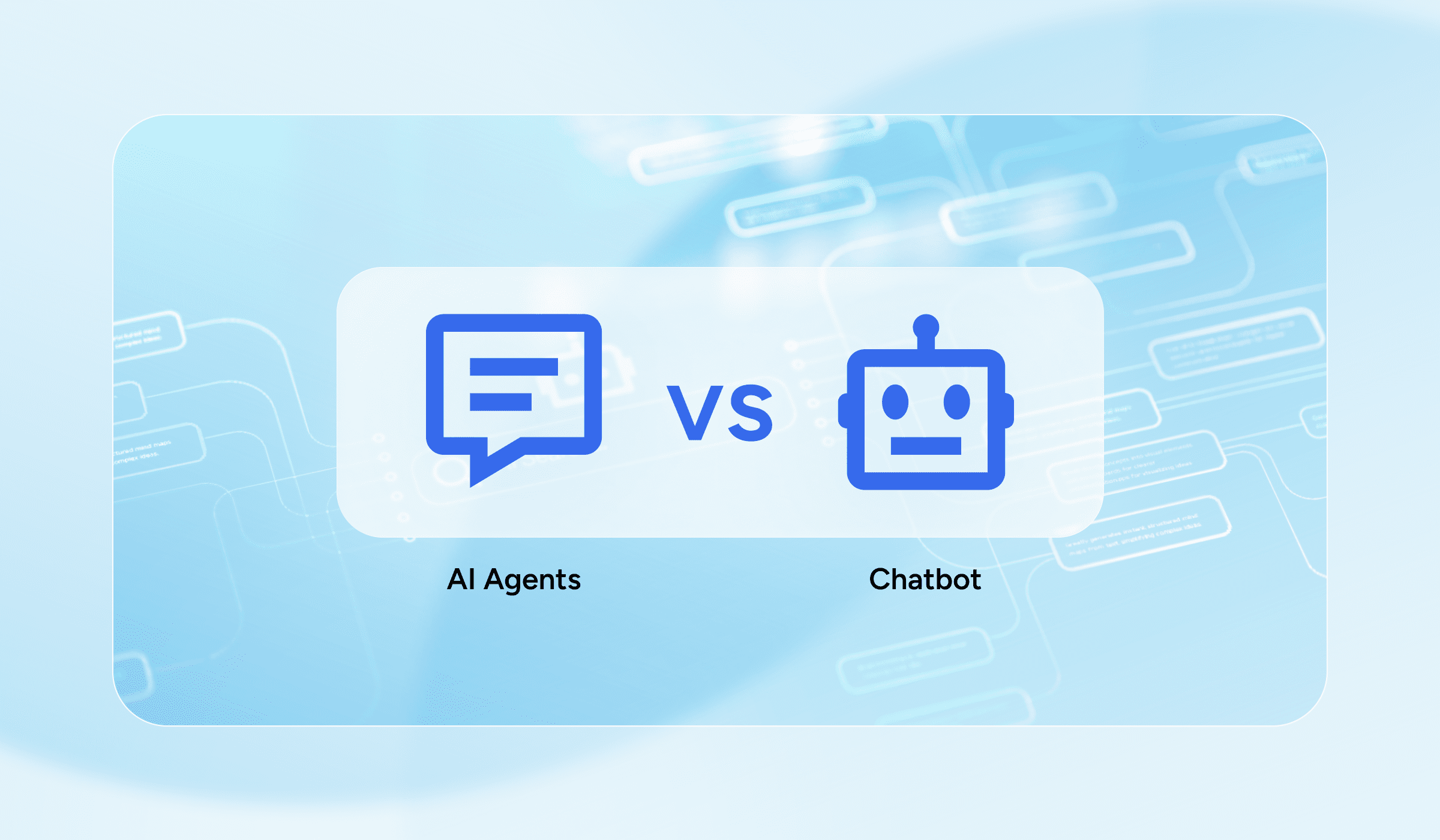
You’ve likely used a chatbot, and you’ve probably heard a lot recently about AI agents. Although both are referred to as “AI” and both involve a computer reacting to your commands, the similarities stop there.
To describe the difference between an AI agent and a chatbot, you could contrast a vending machine and a personal assistant. A vending machine is quick, reliable, and excellent at its job, provided what you want is on the list. A personal assistant, on the other hand, can figure out what you need, make calls, and then deliver the result.
While AI agents and chatbots can provide different services for your association, both are helpful AI tools for your staff and member experience. Our guide on AI agents vs. chatbots helps you determine how both tools can support your association’s members and staff.
What Is a Chatbot?
Recent association research found that 62% of members feel comfortable using AI-powered chatbots to ask questions and seek answers at their member-based organizations. A chatbot is software designed to simulate a conversation; it takes user input, whether a typed question or a voice command, and responds.
Traditional chatbots use decision trees, and a designer writes a series of if/then rules. For example, if the user asks about association hours, the chatbot displays the organization’s hours. Or if the user inquiries about online store returns, the chatbot will show the return policy. Although these bots are quick and reliable, they fail as soon as someone asks a question outside the script.
More modern chatbots are based on large language models (LLMs), the same technology behind tools like ChatGPT and Claude. These conversational AI systems can answer a far wider variety of questions, engage in back-and-forth dialogue, and produce responses that appear genuinely human. They are considerably more flexible than rule-based bots.
Chatbots answer the question in front of them and then wait for the next one. They do not initiate any action, nor do they act on their own. They never send any information back to your systems, meaning the conversation with the user is the result.
What Is an AI Agent?
Did you know that 76% of association members use AI at least a few times a week at work, yet only 39% of association professionals report that their organization uses AI? Members who view their organization as an early technology adopter report 85% satisfaction, compared with 38% among those who see their organization as a technology laggard. Technology adoption is a major factor in long-term member loyalty.
An AI agent is software that can perceive a situation, reason about it, make decisions, and act without requiring a prompt at every stage.
While a chatbot waits for a question, an AI agent can detect a situation. For example, an AI agent can detect if a member’s renewal lapsed 30 days ago and then decide on an action, like sending a re-engagement sequence. Next, it might carry out that action by drafting and queuing the outreach action. Finally, it would record the result back in your system of record. Some of these agents require human approval at every stage, while others, once set up, can work on their own within the established guardrails.
The key characteristics of agentic AI:
- Goal-oriented — AI agents are given an objective, not just a question.
- Multi-step reasoning — AI workers can break down sophisticated tasks and handle them sequentially.
- Tool use — Agentic AI can query databases, trigger workflows, send communications, update records.
- Memory — AI agents can track context across a process, not just a single conversation.
- Autonomy — AI workers can act without being prompted for each step.
AI agents are often called agentic AI workers, a term used to describe their ability to act independently toward specific goals. Agentic AI is fundamentally different from a chatbot’s role as a reactive conversational partner.
How Chatbots Work
Most modern chatbots follow a straightforward loop:
- The user sends a message.
- The chatbot processes the text (using rules, machine learning, or an LLM).
- The chatbot generates a response.
- The user reads the response and replies.
In this model, the human carries out each step, and the robot does nothing between turns; it has no lasting awareness of what’s happening outside the conversation window, and it only responds.
For situations where the chatbot is dealing with customers—such as answering frequently asked questions, handling common service requests, or leading a person through a simple process—this level of performance is more than sufficient. Chatbots can handle fast, high-volume, low-complexity interactions, plus scale in ways humans in staff positions cannot.
However, when a task involves acting within a system, making a judgment, or managing something over time, a chatbot reaches the limits of what it can do.
How AI Agents Work
AI agents operate in a cycle that looks more like this:
- The AI agent perceives a state (reads data from a system, detects a trigger, and receives a goal).
- The agent reasons about what to do, often using an LLM as its decision engine.
- The agent selects and executes an action (queries a database, sends a message, and updates a record).
- The agent observes the result and decides the next step.
- The process continues until it reaches the goal or hits a human checkpoint.
The loop can run with or without a human at each stage. Many implementations include human-in-the-loop checkpoints, meaning the agent carries out the task and then presents a recommended action for staff to approve before any sending or change takes place. This is especially important in organizations where governance, trust, and board accountability matter.
The technology in question usually has an LLM to handle reasoning, as well as connections to external tools that let the agent act, not just talk.
Key Differences Between AI Agents and Chatbots
Here’s how the two AI tools compare across the dimensions that matter most for most member-based organizations and associations:
| Chatbot | AI Agent | |
| Primary function | Responds to questions | Executes tasks and workflows |
| Initiated by | A user message | A trigger, schedule, or condition |
| Acts autonomously | No | Yes, within defined parameters |
| Writes to systems | Rarely | Yes — updates records, sends communications |
| Handles multi-step tasks | Limited | Core capability |
| Memory/context | Within the conversation | Across workflows and over time |
| Best for | Q&A, triage, guided navigation | Operational workflows, lifecycle management |
In a nutshell, a chatbot is reactive while an AI agent operates proactively.
When to Use a Chatbot
Chatbots work best when you need to handle many simple, predictable interactions quickly. Consider using a chatbot when:
- You need to answer the same 20 questions repeatedly at scale (e.g., your association’s hours, location, pricing, or event details)
- You want to deflect routine support tickets before they reach a human.
- You need to guide users through a standard process step by step.
- You want 24/7 availability for basic inquiries without adding staff hours.
- Your interactions are mostly one-and-done. This works best when the user asks, the bot answers, and the conversation ends.
In these situations, a well-designed conversational AI is cost-efficient, quick to deploy, and genuinely useful. It doesn’t have to be an agent, since the extra complexity of agentic AI is unnecessary when all that is required is a responsive conversation.
When to Use an AI Agent
AI agents should be considered a separate category of work since they are designed for workflows that involve judgment, multiple steps, and action—not simply providing a reply.
Consider an AI agent when:
- You need the AI to notice something at your organization and act on it, not wait to be asked.
- The task involves writing back to your systems, modifying records, triggering communications, and queuing tasks for review.
- You’re managing ongoing processes at your association (e.g., membership renewals, outreach cycles, compliance tracking), not one-off questions.
- Staff currently do this work manually while juggling other priorities.
- You need an audit trail and record of what the AI did, including when and why.
Governance is just as important as the automation itself in organizations accountable to members, donors, or a board. A well-designed AI agent keeps staff in control of the following steps and provides full visibility into what it did and why.
What AI Agents and Chatbots Mean for Nonprofits and Associations
For nonprofits and associations with small teams but large operating demands, it’s important to decide which AI tool best fits your organization.
A chatbot can answer members’ questions on your website at midnight, telling them when their dues are due, where to log in, or what events are coming up. That helps because your staff won’t have to take those calls.
However, the operational workload most association and nonprofit teams face isn’t an FAQ issue. It is the kind of thing that demands judgment, continuous tracking, and action over time:
- Members who go quiet before their renewal date
- Donors whose giving patterns imply they’re drifting
- Online communities that need consistent moderation
- Renewal outreach that staff never quite get to because they’re overextended
AI agents handle these higher-level situations best. AI agents will spot at-risk members, create outreach sequences for staff to review and approve, and record all actions in a timestamped audit trail your board can access. Additionally, agentic AI can work within your association management software and donor management platform—not as a separate tool—so all your data syncs in one convenient location.
Can AI Agents and Chatbots Work Together?
Yes, many organizations use both.
A chatbot manages the front door by answering questions, routing requests, and giving users quick, self-service access to standard information. At the same time, an AI agent handles the back office by running operational workflows, monitoring results, and taking on work staff don’t have time to follow through manually.
This hybrid approach associations take with AI isn’t redundant, since it matches the right tool to the task. Chatbots excel at conversations, while agents are better at carrying out work; most organizations have both.
Some AI-powered platforms now combine these capabilities into one layer, so an interactive interface can hand off control to an agent that acts and then display the results through a chat-like interface. The boundary between chatbots and agents is becoming less clear every day. Yet the fundamental difference between reactive and preemptive behavior, and conversation and action, is still the right way to figure out what your association needs today.
Take the Next Step
The decision between a chatbot and an AI agent comes down to the kind of work you’re trying to offload. Conversations belong to chatbots. Business processes belong to agents.
For nonprofits and associations, role-specific AI agents built on sector-specific data are now available—designed to handle the membership, engagement, and community workflows most teams manage manually today. If that sounds like the work your team is carrying, MomentiveIQ Agentic Workers are built for exactly this.
FAQ
A chatbot provides information in response to user input, while an AI agent perceives a situation, makes decisions, and carries out action—usually without being asked. The fundamental difference is that the chatbot is reactive, whereas the agent acts proactively.
The idea of intelligence is misplaced. A contemporary chatbot powered by an LLM can produce sophisticated replies. An AI agent uses the same reasoning ability when carrying out tasks that involve action—such as querying systems, running workflows, and writing results back to a database. Agents aren’t smarter; they do more.
It’s not exactly true. While adding a powerful language model makes a chatbot better at carrying out a conversation, turning it into an agent requires giving it the ability to perceive external data, make multi-step decisions, and act within systems. That involves a change to the architecture, not simply upgrading the model.
One chatbot example is a website bot that answers questions about association event registration. As for an example of an AI agent, it is software that keeps an eye on member engagement data, spots members who are at risk of not renewing membership, creates a renewal outreach sequence, shows this sequence to staff for their review, and records the result—all without any individual having to carry out that process manually.
Chatbots are well suited to handling a large volume of simple service inquiries. At the same time, AI agents are better for proactive contact, situations that involve acting in a backend system, or continuous management of the customer lifecycle. Many customer service operations benefit from using both chatbots and AI agents.
Possibly. If you have both a front-door service problem (lots of simple incoming questions) and a back-office operations problem (manual workflows eating staff time), you’ll likely benefit from both. If one is your primary problem, start with the tool that fits it.