

20 Halloween Fundraising Ideas for Schools and Nonprofits

Your fall calendar is already crowded. The gala is booked, year-end appeals are half drafted, and someone on your board just asked whether you’re doing anything for Halloween.
Say yes. Halloween fundraising ideas work because the season does most of the marketing for you. Nobody needs convincing that October is for costumes, candy, and neighbors gathered in a parking lot at dusk. You don’t have to build interest from scratch. Attach your mission to something people already plan to show up for.
Choose one you can staff. A haunted trail and a candy gram sale raise money in different ways and need different lead times. Choose late, and you’re scrambling in October. Choose well, and you finish the month with new donor records going into year-end giving.
Below are 20 Halloween fundraisers grouped by how they work: in-person events, virtual campaigns, product sales, and ideas built for schools and PTAs. Each one also doubles as a fall fundraising idea you can run through November. A comparison table up front helps you narrow the list in a minute, and a planning timeline at the end supports whichever one you pick.
What makes a good Halloween fundraiser?
A good Halloween fundraiser fits the money you can realistically raise, the volunteer hours you have, and the weeks left on the calendar. Test any idea against four questions.
- Where does the revenue come from? Ticket sales, entry fees, donation-based voting, product margin, or sponsorships. The strongest fundraisers stack two of these rather than leaning on one.
- How many volunteers does it need at peak? A trunk-or-treat needs the most hands in a two-hour window. An online costume contest needs almost none.
- What’s the upfront spend? Haunted houses and galas cost money before any comes in. Candy grams and voting contests don’t.
- Does it give you donor data you can use in November? A cash-only bake sale raises money and nothing else. A registration page hands you contact records right before year-end.
Most teams skip that last question. October gifts are worth more when they feed December giving, so favor fundraisers that capture names and giving history.
Halloween fundraising ideas at a glance
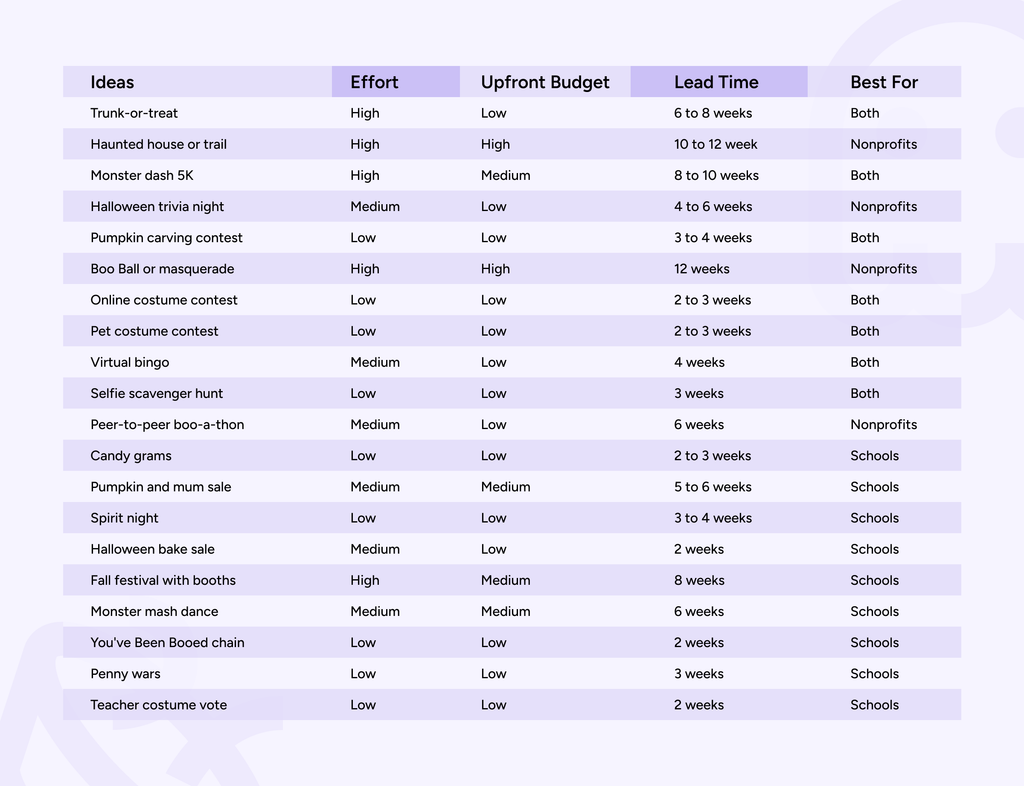
Shortlist two or three before you read further. Effort reflects volunteer hours at peak, budget reflects upfront spend before revenue arrives, and lead time is the minimum recommended runway.
Treat ratings as planning guidance. A 400-student school and a 40-person nonprofit will run the same idea differently.
Event-based Halloween fundraising ideas
These raise the most per attendee and ask the most of your volunteers.
1. Trunk-or-treat. Families park in a lot, decorate their trunks, and hand out candy to kids walking the rows. Revenue comes from three places: a suggested donation per family, a sponsorship fee from businesses hosting a trunk, and concessions. It scales from 15 cars to 150 without changing the format. Put a QR code on every trunk sign so parents can give while they’re standing there.
2. Haunted house or haunted trail. The highest ceiling and the highest risk on this list. You need a venue, liability coverage, a build crew, and enough actors for multiple nights. Sell timed-entry tickets to control flow and add a lower-intensity matinee for younger kids. If you’ve never run one, partner with a theater group instead of building from zero.
3. Monster dash 5K or costume fun run. Registration fees cover the event, and a peer-to-peer fundraising layer turns a $35 entry into several hundred dollars per runner. Route permits and police coordination set the lead time, not fundraising.
4. Halloween trivia or bingo night. A bar, church hall, or school cafeteria works. Teams buy in, buy extra cards or trivia mulligans, and bid on themed baskets between rounds. This is the best low-budget option for a nonprofit with an adult donor base.
5. Pumpkin carving contest. Charge an entry fee per pumpkin, then let the community vote with donations. Display the finished pumpkins at a local business so voting runs a full week instead of one evening. Almost no upfront cost, and the photos carry your social feed for the rest of October.
6. Boo Ball or masquerade gala. Your annual gala, wearing a mask. Ticketed, sponsored, and paired with a silent auction or paddle raise. Only worth it if you already have a gala audience, since a first-time formal event in October competes with your own year-end appeal for the same donors.
If none of these fit your volunteer count, the next group asks for far less.
Virtual and online Halloween fundraisers
Online formats give a small team the best return on its hours. They run for a week or two instead of one night, cost almost nothing to launch, and every entry hands you a contact record.
7. Online costume contest with donation-based voting. Supporters submit a costume photo and donors vote by giving. A dollar equals a vote, votes are unlimited, and competitive entrants come back three and four times. Repeat giving offers real benefit here, because it reframes donating as participating.
8. Pet costume contest. Same mechanic, better engagement. Pet photos outperform people photos in social sharing, and entrants recruit their own friends to vote without any prompting from you. Run categories, so you have more than one winner: best group costume, best punny costume, best senior pet.
9. Virtual bingo. Set up registration that lets players buy extra cards on the order form, then send every player their cards ahead of time. Decide rounds, gameplay pattern, and prizes before you sell a card. Because you know who bought what, you can verify a win the moment someone calls it.
10. Selfie scavenger hunt. Publish a list of fall-themed items, and teams find them, photograph themselves with each one, and post with your hashtag. Registration funds it; the tagged photos do your promotion. Award prizes for finishing first, best group costume, and top fundraising team so more than one kind of participant has a reason to push.
11. Peer-to-peer boo-a-thon. Supporters commit to something for a set stretch of time, a gaming stream or a horror movie marathon, and raise money from their own networks while they do it. You supply the page templates and the deadline. Build in a mid-campaign milestone, so fundraisers have a reason to send a second ask.
Any of these can also run alongside an in-person event rather than instead of one.
Product and sale-based Halloween fundraisers
Margin-driven fundraisers are predictable. You know your cost, your price, and your break-even before you start.
12. Candy grams or boo grams. Sell a small treat plus a note delivered to a classmate, coworker, or teammate. Costs almost nothing and sells on volume. Take orders online so no one has to handle cash envelopes.
13. Pumpkin and mum sale. Buy from a regional grower at wholesale and sell from your parking lot for two weekends. Margins are real, but so is spoilage, so pre-sell online and only stock walk-up inventory you’re confident you’ll move. Bundle a pumpkin, a mum, and candy as a fall porch kit to lift the average sale.
14. Spirit night with a local restaurant. A restaurant gives you a percentage of one evening’s sales, and you bring the crowd: zero upfront cost, about two hours of promotion. Pick a Halloween-week Tuesday, when restaurants are quiet and more willing to give a better split.
15. Halloween bake sale or treat boxes. Instead of a folding table, sell pre-order boxes of decorated treats for pickup on a set date. Pre-orders tell you how much to bake, eliminate leftovers, and collect payment before anyone turns on an oven.
Pick one from this group to run alongside whatever you choose next.
Halloween fundraising ideas for schools and PTAs
School fundraisers have a built-in audience and a hard constraint: everything has to be safe, inclusive, and approved by an administrator. These five clear that bar.
16. Fall festival with game booths. Sell an armband for unlimited games or tickets by the strip. Classrooms or grade levels each sponsor a booth, which spreads the volunteer load across dozens of families instead of concentrating it on the PTA board. Add a cakewalk and a trunk-or-treat row, and it becomes the school’s biggest community night of the fall.
17. Monster mash dance. Tickets at the door, a DJ or a parent with a playlist, glow sticks, and concessions sold inside. Run separate sessions for lower and upper grades so the music and the bedtime both work. Most revenue comes from concessions, not the ticket.
18. You’ve Been Booed neighborhood chain. A family pays a small fee for a treat bag delivered anonymously to another family, who then pays to boo two more. It spreads on its own and needs no venue. Cap it with a deadline, or it runs past Halloween.
19. Penny wars. Each class gets a jar. Pennies count as positive points, silver coins and bills count against the class they’re dropped into, and the competition gets loud fast. Cheap, and teachers tend to be enthusiastic because it doubles as a counting lesson.
20. Teacher costume vote. Students and parents donate to vote for which costume the principal or a group of teachers wears on Halloween. It raises less than a festival but takes one afternoon of setup, and it’s the easiest yes you’ll get from an administrator.
School events also generate parent contact data for your spring campaign, so capture it at registration rather than on a clipboard.
How to plan and promote your Halloween fundraiser
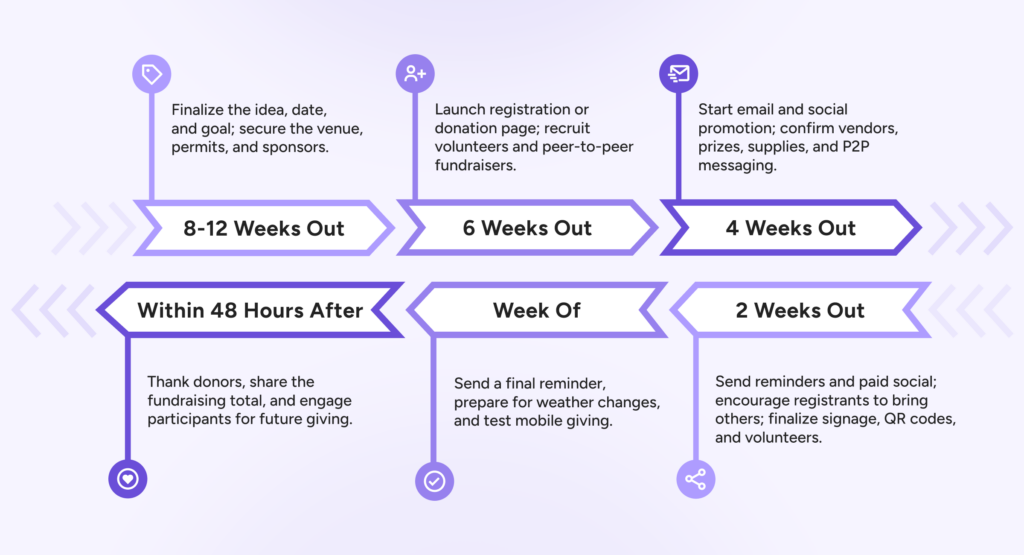
Work backward from October 31. Most fundraisers on this list fail for one of two reasons: not enough runway, or promotion that starts too late to matter.
Eight to 12 weeks out. Lock the idea, date, and goal. Secure the venue and permits. Line up sponsors now, because corporate giving calendars close early in the fall.
Six weeks out. Open registration or the donation page and recruit volunteers and peer-to-peer fundraisers. You want the page live now, not the week of the event, because early registrants help your event gain momentum.
Four weeks out. Start the email sequence and social push. Confirm vendors, prizes, and supply orders. Brief your peer-to-peer fundraisers on what to send and when.
Two weeks out. Send the second email, run paid social if you’re running any, and remind every registrant to bring someone. Print signage and QR codes. Confirm the volunteer schedule hour by hour.
Week of. Send a day-before reminder, share any needed weather contingencies, and do a final check that mobile giving works on your own phone before anyone else tries it.
Within 48 hours after. Thank every donor, post the total, and tag participants. Halloween donors are prime year-end prospects, and the thank-you you send in November determines whether they open your December appeal.
Two promotion notes worth the space. Keep your ask on one link, because a supporter who has to hunt for where to give usually doesn’t. And make giving work without a laptop: most people at a trunk-or-treat have a phone in one hand and a toddler in the other, so QR codes and text-to-donate are what convert. The Boy Scouts Long Beach Area Council funded a dining hall with text-to-give, which shows how far a simple mobile ask can go.
Raising more with the right fundraising platform
Picking the idea is the easy part. The harder work is running registration, collecting donations, tracking who gave what, and getting it all into your donor records before the year-end appeal goes out. That’s where Halloween fundraisers lose money: in the spreadsheet afterward, not on the night.
GiveSmart, Momentive’s fundraising platform, supports events and campaigns. Registration and ticketing, peer-to-peer pages, donation-based voting contests, and online giving with real-time tracking run in one place. A costume contest, a trunk-or-treat, and a pumpkin pre-sale report into the same donor records, and your team spends October running the fundraiser instead of reconciling it.
See GiveSmart in action before your Halloween campaign goes live.
Halloween fundraising FAQs
Quick answers to the questions organizers ask most when they’re choosing a Halloween fundraiser.
What are the best Halloween fundraising ideas?
The best Halloween fundraising ideas are trunk-or-treats, online costume contests with donation-based voting, and fall festivals with game booths, because each pairs high participation with low upfront cost. Trunk-or-treats draw the broadest community crowd, voting contests generate repeat gifts from the same donor, and festivals spread the volunteer load across many families. Pick based on the volunteer hours you have, not the revenue ceiling.
What are easy Halloween fundraisers for schools?
Candy grams, penny wars, teacher costume votes, and spirit nights are the easiest school Halloween fundraisers to run. All four need under three weeks of lead time, almost no upfront spend, and a handful of volunteers. Spirit nights take the least effort, since the restaurant handles fulfillment and your only job is bringing the crowd. For bigger goals, see our guide to school fundraising ideas.
How much money can a Halloween fundraiser raise?
It depends on format, audience size, and ticket price, so treat any single benchmark you find online with caution. What you can control is the revenue structure: fundraisers that stack two or three streams, such as entry fees plus sponsorships plus concessions, consistently outperform single-stream ones at the same attendance. Set your goal from last year’s comparable event and your current supporter count.
When should you start planning a Halloween fundraiser?
Start eight to 12 weeks out for any event with a venue, permits, or sponsors, and two to four weeks out for online and product-based fundraisers. Sponsorship is the real constraint, because most corporate giving calendars for the fall close in August and September. If it’s already mid-October, run an online costume contest or a candy gram sale rather than forcing an event you can’t staff.
What is a trunk-or-treat fundraiser and how does it make money?
A trunk-or-treat is a Halloween event where families decorate their car trunks in a parking lot and hand out candy to kids walking the rows. It makes money in three ways: an entry fee or suggested donation per attending family, sponsorship fees from businesses and families hosting a decorated trunk, and on-site concession sales. Adding a QR code at each trunk lets people donate without cash.
How can small nonprofits run a Halloween fundraiser on a low budget?
Choose a format with no venue cost and no inventory: an online costume or pet contest, a selfie scavenger hunt, or a peer-to-peer boo-a-thon. Each launches for the cost of your fundraising platform and a few hours of setup, and supporters promote it by sharing their own entries. Ask a local business to donate prizes, which turns a cost line into a sponsor relationship. Our roundup of online fundraising ideas covers more no-budget formats.
Can Halloween fundraisers work as virtual or hybrid events?
Yes, and several formats are stronger online. Voting contests, bingo, and scavenger hunts can run for a week or more instead of a single evening, giving supporters more chances to participate and you more chances to ask. For a hybrid version, run the voting contest online for two weeks and announce winners at your in-person event. See more formats in our guide to virtual fundraising events.
Struggling to keep your volunteer program organized? Discover what volunteer management software can do for your organization.