What Is Event Management? Process, Phases & Best Practices

Every conference, gala, member summit, and product launch runs on decisions most attendees never see. Someone chose the venue, set the budget, built the registration flow, briefed the speakers, and made sure the doors opened on time. That work is event management: the coordinated process of planning, organizing, promoting, and running an event from first idea to final report. Whether your team hosts one annual conference or dozens of gatherings a year, strong event management is what keeps costs in line, attendees engaged, and goals met. The right event management software supports every step, but the discipline itself starts with people and process.
What Is Event Management?
Event management is the end-to-end coordination of everything an event needs to succeed. It spans strategy, logistics, budgeting, marketing, on-site operations, and post-event analysis. The goal is to create an experience that meets your objectives while respecting your budget, your timeline, and your attendees’ time.
Event managers work across corporate, nonprofit, association, and community settings. A corporate team runs a user conference. An association might host a certification summit and a virtual webinar series in the same quarter. A community group organizes a 5K. The scale changes considerably. The process doesn’t. You define the goal, plan the details, promote the event, execute cleanly, then measure what happened.
Strong event management turns a one-day gathering into a repeatable process. Your team learns what worked, keeps what did, and starts the next one in better shape.
The Event Management Process: 4 Key Phases
Most events move through four phases. They overlap in practice, but each one answers a different question: What are we building? Who is coming? How does the day run? And what did we learn?
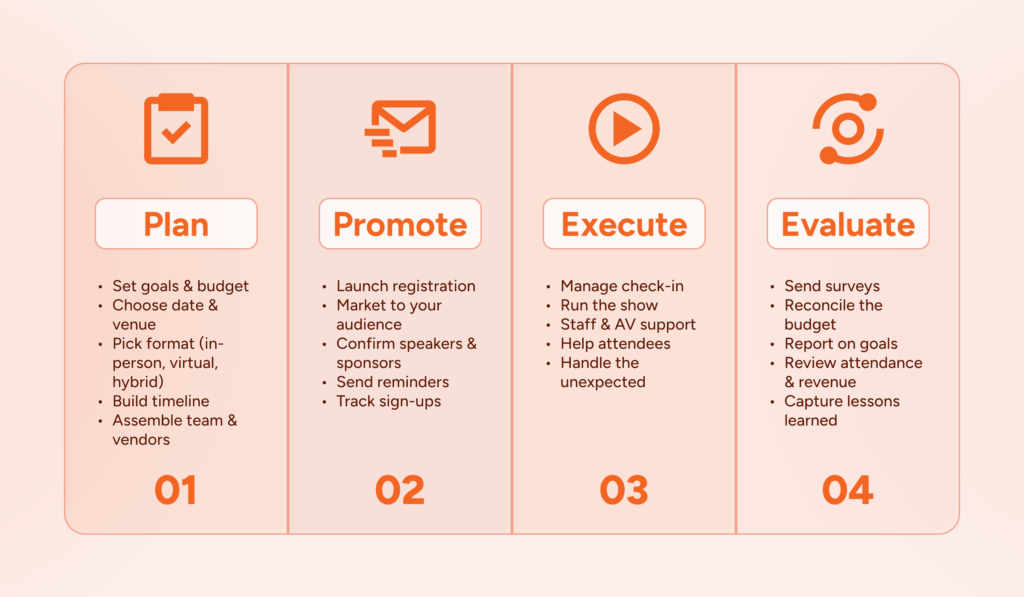
Phase 1: Planning and Design
Start with the objective. Are you driving revenue, growing membership, training staff, or thanking donors? A clear goal shapes every later decision, from venue size to ticket price.
Build the essentials: a budget with a contingency line, a target date, a format, and a venue. Decide early whether the event is in-person, virtual, or hybrid, because that choice affects your technology, staffing, and marketing. Then map a project timeline with owners and deadlines, and lock in your vendors and internal team. Every decision made now is one you won’t be scrambling to make later.
Phase 2: Promotion and Registration
An event no one hears about is an empty room. This phase is where marketing and registration take over. Open registration with clear pricing and an easy sign-up flow. Promote through the channels your audience already uses, whether that is email, social, your website, or a member portal. Confirm speakers and sponsors, and give them assets to share. Keep momentum with reminders as the date approaches. For events that raise money, such as galas or benefit auctions, connect your registration to your fundraising software so ticket sales, donations, and attendee data live in one place instead of three.
Phase 3: Day-of Execution
Execution is the phase attendees actually see, and it is where preparation pays off. Check-in should be fast and friendly. Your run of show keeps sessions on schedule and tells every staff member where to be and when. Assign clear roles for registration, AV, speaker support, and troubleshooting. Something will go wrong at every event: a speaker will run long, a mic will drop, a room location will need to flip. Build in slack and name the person who makes the call when it does.
Phase 4: Post-Event Evaluation
The event is not over when the last guest leaves. Send attendee surveys while the experience is fresh. Reconcile the budget against what you actually spent. Report on the goals you set in Phase 1: attendance, revenue, leads, renewals, or engagement. Then hold a short debrief and write down what you would change. That’s what makes the next event easier to run.
Types of Events
Event management applies across a wide range of formats. The phases stay the same, but the details shift with the goal and the audience. Common types include:
- Conferences and summits that bring a large audience together for education and networking
- Corporate meetings, sales kickoffs, and user conferences
- Trade shows and expos with exhibitors and booths
- Fundraising galas, auctions, and benefit events
- Member events, chapter meetings, and annual gatherings
- Workshops, training sessions, and certification programs
- Virtual and hybrid events that reach attendees anywhere
- Community events, festivals, and charity runs
Each type carries its own priorities. A trade show lives and dies by exhibitor logistics. A gala depends on donor experience and giving. A hybrid conference has to serve two audiences at once. For a closer look at planning specific formats, browse related guides on the Momentive blog.
Event Management vs. Event Planning: What’s the Difference?
The terms get used interchangeably. They’re not the same thing. Event planning is a part of event management, not a replacement for it.
Event planning focuses on the details that bring an event to life: the venue, the schedule, the catering, the speakers, and the logistics. It is largely front-loaded, concentrated in the weeks and months before the event.
Event management is the wider discipline. It includes planning, but it also covers strategy, budgeting, marketing, on-site operations, and post-event analysis. Planning gets the event ready. Management runs the full lifecycle and owns the results. A planner asks whether the room is booked. A manager asks whether the event met its goal.
Key Skills Every Event Manager Needs
The best event managers stay organized under pressure and are good with people — usually at the same time. The strongest ones tend to share the same core strengths:
- Organization and time management, to keep dozens of moving parts on schedule
- Budgeting and financial discipline, to deliver the experience without overspending
- Communication, to keep staff, vendors, speakers, and attendees aligned
- Negotiation, to secure the right terms with venues and suppliers
- Problem-solving, to make fast, sound calls when plans change
- Attention to detail, because the small misses are the ones attendees notice
- Technology fluency, to run registration, payments, and reporting without friction
Most of these skills sharpen with repetition, which is why the debrief habit matters more than most people give it credit for.
How Event Management Software Helps
As events grow, spreadsheets and inboxes stop keeping up. Event management software brings the whole lifecycle into one system, so your team spends less time on manual work and more time on the experience.
A strong platform handles registration and ticketing, collects payments, sends attendee communications, and reports on results in real time. It connects to the rest of your stack, so attendee data flows to your CRM, your finance tools, and your email platform without re-keying. For recurring events, it lets you clone a past setup and start the next one in minutes, not days.
Your team stops reconciling registration lists by hand. Check-in moves faster. Reporting that once took a week is ready the morning after. That is the difference event management software makes for organizations that run more than one event a year.
Frequently Asked Questions
Event management involves coordinating every part of an event, including strategy, budgeting, planning, marketing, registration, on-site execution, and post-event evaluation. It covers the full lifecycle from the first idea to the final report.
The process typically moves through four phases: planning and design, promotion and registration, day-of execution, and post-event evaluation. Each phase builds on the previous one.
Event planning covers the logistics that prepare an event, such as venue, schedule, and catering. Event management is the broader discipline that includes planning plus strategy, marketing, budgeting, execution, and analysis across the entire lifecycle.
Event managers need organization, budgeting, communication, negotiation, problem-solving, attention to detail, and comfort with event technology. These skills help them keep many moving parts aligned and respond quickly when plans change.
Conferences, corporate meetings, trade shows, fundraising galas, member events, workshops, virtual and hybrid events, and community gatherings all benefit from event management. Any event with a goal, a budget, and an audience needs it.
Event management software is a platform that centralizes event registration, ticketing, payments, communications, and reporting. It replaces scattered spreadsheets and manual tasks with one connected system.
Struggling to keep your volunteer program organized? Discover what volunteer management software can do for your organization.