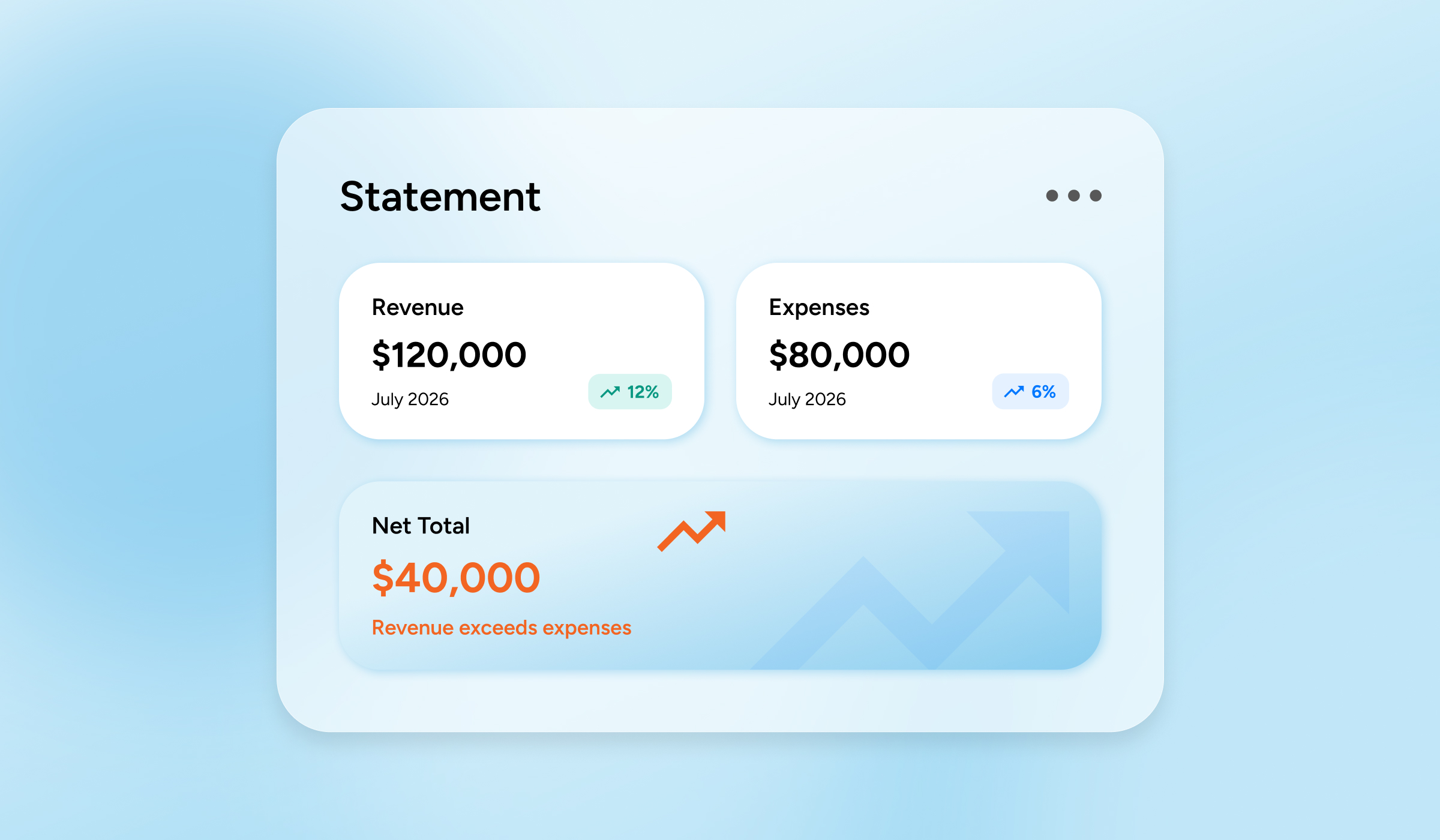

Are we bringing in more than we’re spending? A statement of revenue and expenses answers it directly, showing what came in, what went out, and where the two land on the bottom line.
A statement of revenue and expenses shows what an organization earned and spent over a set period, ending in one bottom-line number. Any business, nonprofit, or association can use one to gauge financial health.
Nonprofits and associations handle it a bit differently, since compliance rules also call for a more formal Statement of Activities.
This guide covers what a statement of revenue and expenses is, how to format one, read the bottom line, and avoid the most common mistakes — anchored by a free downloadable example of a revenue statement you can relabel with your own numbers.
What Is a Statement of Revenue and Expenses?
A statement of revenue and expenses shows total income earned and expenses incurred over a specific period of time for businesses, nonprofits, and associations alike.
In the for-profit world, this statement is also known as the Income Statement, the Statement of Profitability and Loss (P&L), and sometimes the Statement of Operations. The Statement of Revenue and Expense takes the place of these statements, since nonprofits don’t have profit.
In its simplest form, the Statement of Revenue and Expense begins with a revenue section, followed by an expense section. The total revenue minus the total expenses produces the bottom line. If revenue exceeds expenses, you have revenue over expenses. If expenses exceed revenue, you have revenue under expenses, which is sometimes displayed as a red number.
Statement of Revenue and Expenses vs. Statement of Activities
Nonprofits occasionally confuse a statement of revenue and expenses with a statement of activities. Nonprofits are required to file a Statement of Activities (FASB ASU 2016-14, which updates what used to be called Statement 117); the Statement of Revenue and Expenses is often an internal/management version of the same data.
Here’s a simple comparison table of the two forms:
| Statement of Revenue and Expenses | Statement of Activities | |
| What it’s used for | Internal management reporting — day-to-day monitoring, board updates, budget tracking | External financial reporting — the official record of financial performance for a period |
| Who requires it | No formal requirement; format is set by the organization | Required under GAAP (FASB ASC 958), typically part of audited financial statements |
| Level of detail | Simpler — revenue and expenses without mandatory net asset classifications | Must break out changes in net assets by donor restriction |
| Audience | Staff, management, board | Auditors, donors, grantors, regulators |
| Relation to nonprofit financial statements broadly | Internal companion to the Statement of Activities — same data, less formal | One of the core nonprofit financial statements, alongside the Statement of Financial Position and Cash Flows |
Statement of Revenue and Expenses Format
The Statement of Revenue and Expenses has a defined format. It needs several key elements:
Heading
The heading is important because it tells you three things:
- Name of the organization
- Statement type
- Time period elapsed
A Specified Time Period
The statement shows results over a defined period. That means there are start and end dates for the statement.
For example, the statement might report revenue and expenses for a month, a quarter, a year, or since your last birthday. Just be sure the dates are stated in the heading.
Body of Statement
The body contains the revenue section and the expenses associated with earning that revenue.
Revenue is the money coming in. The expenses section is the money going out. Even though this section reflects money going out, the amounts are reported with positive signs.
The Bottom Line
Expenses are deducted from total revenue to produce the bottom line. Some organizations report this in stages — starting with Net Operating Income, then layering in non-operating items like interest and taxes — before arriving at the final total, sometimes called Excess Revenue Over (Under) Expenditures.
[Downloadable] Statement of Revenue and Expenses Example
This example template is a basic statement of revenue and expenses for nonprofit organizations. The template features sample figures, multiple fund/program columns, and the bottom line.
The template can be used and relabeled with your organization’s data and figures.
Download the Nonprofit Statement of Revenue and Expenses and improve your organization’s fiscal transparency today.
Cash Basis vs. Accrual: How Reporting Method Affects Your Statement
Organizations generally report income in one of two ways: using a cash basis or an accrual method.
A cash basis organization reports the revenue when the cash is received. A cash basis method is simpler to maintain and understand because it tracks cash as it moves and provides a real-time picture of cash on hand. Typically, smaller organizations will use a cash basis method.
Most organizations use an accrual method. Under the accrual method, revenue is recognized in accordance with accounting rules.
For example, revenue might be reported when the item is shipped rather than when the cash is received for the order. For a childcare service organization, the accrual method would report revenue upon a participant’s completion of childcare classes, rather than when they pay to register for the class.
No matter which method you use, accounting rules require that the expenses listed be for the period that matches the revenue reported.
How to Read the Bottom Line
Your organization’s Bottom Line is the definitive answer for how your organization performed. Your organization will either have revenue over expenses or revenue under expenses.
Revenue over expenses is the nonprofit equivalent of net income. Nonprofits don’t report profits because any surplus gets reinvested into the organization rather than distributed.
When expenses exceed revenue, the result is negative, and it’s called revenue under expenses. While not alarming as a one-off, it signals trouble if it persists across multiple periods and suggests taking a closer look at your operational processes.
Your bottom line should also account for special considerations, such as non-cash items and the depreciation of those assets.
Depreciation is a non-cash item that reports the wear and tear of assets such as equipment, vehicles, computers, or machinery.
Depreciation spreads the cost of those assets over time, so while depreciation isn’t using up cash at the time of the report, it is a reminder that assets are wearing out and will need to be replaced someday.
Non-cash items are one reason the income (or loss) reported on the bottom line will not match the cash in the bank.
Amortization is another non-cash item. Similar to depreciation, amortization spreads the cost of intangible assets over time.
Most importantly, your bottom line doesn’t tell your organization’s entire story. While it provides a foundation to build on, other fiscal reports such as your balance sheet and cash flow, along with narrative data, paint a full financial picture.
Common Mistakes Nonprofits Make on Revenue and Expense Statements
Mistakes on revenue and expense statements can be traced back to simple human error. Here’s where things typically go wrong, and how to fix them.
- Mixing cash and accrual entries within the same statement. Recording some transactions when cash moves and others when they’re earned or incurred creates a statement that doesn’t reconcile. Fix: pick one method and apply it consistently to every line, revenue, and expense.
- Misclassifying restricted vs. unrestricted funds. Donor-restricted contributions reported as general revenue overstate what’s actually available to spend. Fix: tag every gift and grant by restriction at the point of entry, not at reporting time.
- Leaving out non-cash items like depreciation. Skipping depreciation makes the bottom line look better than it is and hides the fact that equipment and vehicles are wearing out. Fix: include a depreciation line even on internal, simplified statements.
- Inconsistent reporting periods across statements. Comparing a quarterly statement to an annual budget, or shifting fiscal year cutoffs mid-comparison, makes trends impossible to trust. Fix: lock the reporting periods across all statements before you start comparing them.
While mistakes happen, fund accounting technology simplifies the process and eliminates manual spreadsheet entry.
How Fund Accounting Software Simplifies Revenue and Expense Reporting
Fund accounting software is designed for the nuances of nonprofit accounting.
Organizations go from manually tracking fund columns, restricted vs. unrestricted revenue, and functional expense allocation in spreadsheets to effortless fund tracking and reporting.
Fund accounting software eliminates manual entry by auto-splitting revenue/expenses by fund and generating fiscal statements without manual reclassification.
Simplify reporting. Eliminate errors. Increase staff efficiency. Fund accounting software helps nonprofits meet their mission.
MIP Accounting, by Momentive Software, is fund accounting software trusted by more than 4,800+ organizations to track every dollar by fund, grant, program, or project.
MIP is built for how nonprofits actually manage money: close your books faster with accounting designed for nonprofit fund structures, stay audit-ready with compliance tools built for nonprofits and municipalities, and give leadership real-time financial visibility without manual report building.
Frequently Asked Questions
What is a statement of revenue and expenses for a nonprofit?
It’s a financial statement showing a nonprofit’s total revenue and total expenses over a set period, ending in a bottom-line figure called revenue over (or under) expenses. Nonprofits use it internally to monitor financial health, track budget performance, and update leadership and the board — separate from the audited Statement of Activities.
What is the difference between a statement of revenue and expenses and a statement of activities?
A statement of revenue and expenses is an internal management report with no required format, used for day-to-day monitoring. A statement of activities is the GAAP-required external version (FASB ASC 958), typically part of audited financial statements, that breaks out net assets by donor restriction for auditors, donors, and regulators.
What does “revenue over expenses” mean?
Revenue over expenses is the nonprofit equivalent of net income — total revenue minus total expenses for the period. Nonprofits avoid the term “profit” since any surplus is reinvested into the organization rather than distributed. When expenses exceed revenue, the result is negative and called “revenue under expenses.”
Should nonprofits use cash or accrual reporting?
Most nonprofits use accrual reporting, which records revenue when it’s earned and expenses when they’re incurred, regardless of when cash changes hands — giving a more accurate financial picture and meeting GAAP requirements. Smaller organizations sometimes use cash basis for its simplicity, tracking money only as it moves.
What goes in the expenses section of the statement?
The expenses section includes all money spent during the reporting period: program costs, management and general (administrative) expenses, fundraising costs, and non-cash items such as depreciation. Amounts are reported as positive numbers, and expenses should match the same period and reporting method (cash or accrual) as the revenue.
How does depreciation appear on a revenue and expense statement?
Depreciation appears as a non-cash expense line, spreading the cost of assets such as equipment or vehicles over their useful lives. It reduces the bottom line without using any actual cash, which is one reason reported revenue over expenses won’t always match the cash balance in the bank.