Recurring Donations: How to Grow Monthly Giving

One-time donors stay with an organization for an average of 18 months, but when you turn that one-time donor into a recurring donor, they stay involved for seven-to-eight years.
Recurring donors are transformational for nonprofits. They are reliable revenue your organization can count on, and a spirited base to draw from.
This guide covers recurring giving, why it’s compelling, and how to build a sustainable monthly giving program, from converting your first sustainers to keeping them for years.
What Are Recurring Donations, and Why Do They Matter?
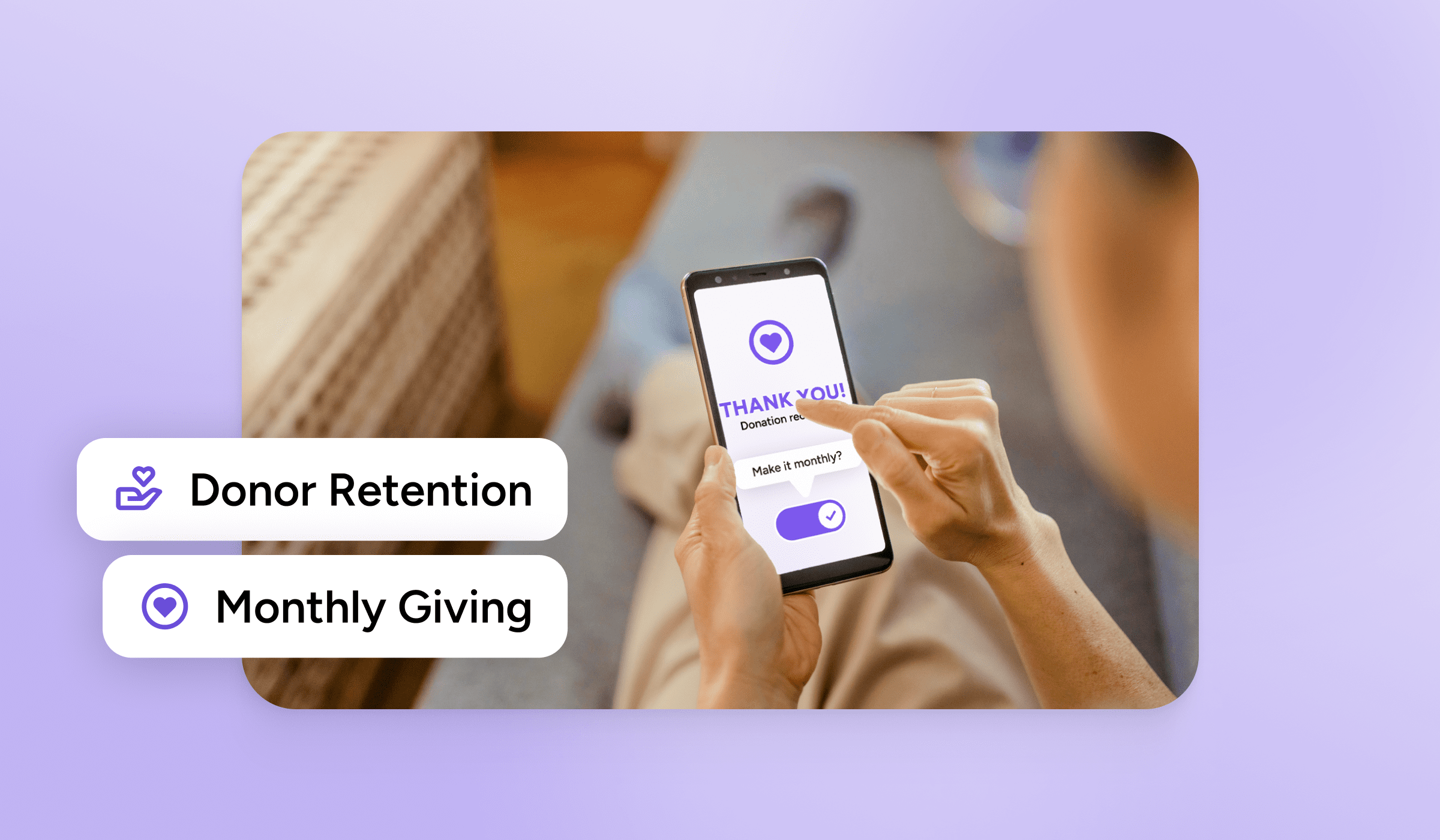
A recurring donation is an automatic, scheduled gift that a donor sets up once, and that continues until they cancel.
Recurring donors are also called sustainers, monthly donors, or members of a sustainer program.
Donor programs are in an interesting spot today. Overall, online donor retention averaged 48% in 2024, and only 24% of first-time donors returned to give in any given year. If your organization relies on one-time gifts, it’s like you’re starting from scratch every year.
But recurring donors behave differently. According to the M+R Benchmarks 2026 report, 71% of sustainers are still active after a full year. And the drop-off early on is manageable: only 10% of sustainers stop giving within the first two months of setting up their gift. After that initial window, sustaining donors tend to stay. In fact, monthly giving now accounts for 27% of all online nonprofit revenue.
The benefits of a recurring donation program are apparent, but how do you turn one-time donors into recurring donors?
How to Turn One-Time Donors into Recurring Donors
Turning a one-time donor into a recurring donor can be difficult, but these strategies make it easier:
Ask within the first 30 days: The window to convert a new donor into a sustainer is narrow. Industry consensus is to ask within 30 days of their first gift, while you’re top of mind and the giving experience is fresh. After 60 days, conversion rates drop significantly.
Make monthly giving easy to find on your donation form: Donors shouldn’t have to look for the recurring option. When creating your donor form, list recurring options first and include the specific impact a recurring gift can have alongside the monthly amount.
Lower the entry point: Offer a lower suggested amount for the monthly option. Initial monthly gifts tend to start smaller than one-time gifts and grow over time as donor relationships deepen.
Use a welcome series to deepen the relationship early: Create a four-email series consisting of these emails:
- Thank you
- Impact story
- Testimonial
- Invitation to give monthly
When used regularly, this sequence turns one-time donors into sustaining donors, and you likely already have some version of all these emails in your repertoire.
Segment by giving channel: Donors who give online via credit card or ACH are significantly more likely to convert to recurring giving than mail donors, because the payment infrastructure already exists. Target your online donors first before transitioning to mail-in donors.
Once you start turning one-time donors to recurring givers, it’s time to scale up your monthly giving program.
Best Practices for Building a Monthly Giving Program
These best practices make building a strong monthly giving program easier:
Name the program: Naming your recurring donor program creates a sense of belonging that an unnamed automatic charge does not. Donors who feel like members of something are more likely to stay members. Your program’s name signals that this group of donors is distinct and valued.
Communicate differently to sustainers: Recurring donors should receive acknowledgments that reflect the ongoing nature of their commitment, like: “you’ve been giving for six months” or “your monthly gift has added up to X impact this year.” Acknowledge your most dedicated fans, rather than sending them generic appeals that don’t distinguish them from the rest of your base.
Make the upgrade ask annual: Once a donor is giving monthly, ask them to increase their gift once a year, around their anniversary. A small percentage increase across your sustainer base compounds over time.
Monitor payment failure rates: Credit card expirations and declines are a leading cause of involuntary lapse among recurring donors. A donor who intends to keep giving but whose card fails without a recovery sequence in place becomes a lapsed donor. Automated card updater tools and proactive payment failure sequences are table stakes for any program above a handful of sustainers.
Track retention separately: Monthly giving programs need their own retention metrics, separate from your overall donor retention rate. If you track all donors together, you can’t clearly see recurring vs. one-time donor rates and don’t know how your efforts stack up.
Common Recurring Giving Challenges and How to Solve Them
Challenge: “Our donors don’t give monthly.”
64% of nonprofits still default to one-time giving on their donation pages, and donors default to what’s easiest or most visible. Auditing your donation form to give monthly giving equal or greater prominence is the fastest lever.
Challenge: “Our sustainer base isn’t growing.”
If you’re only acquiring sustainers during campaigns and aren’t working to convert existing donors in the off-season, you’re leaving donors on the table. Use a year-round conversion sequence and watch the donations come in.
Challenge: “Donors cancel after a few months.”
Early cancellations usually signal a donor communication failure. If a new sustainer receives the same generic communications as everyone else and never hears back with impact reporting specific to their gift, they don’t build the relationship that sustains the commitment. A dedicated onboarding sequence in the first 90 days significantly reduces early cancellations.
Challenge: “We can’t track who’s a recurring donor.”
This is a data and platform problem. If your CRM or giving platform isn’t tagging recurring donors, you can’t communicate with them appropriately, calculate retention, or measure program health. Fixing your data requires taking a different approach or perhaps changing tools entirely.
Working with a Fundraising Platform Built for Recurring Giving
A monthly giving program hits its limit without infrastructure that automates payment processing, card-failure recovery, donor communications, and reporting in one platform.
GiveSmart is built specifically for mission-driven organizations. Recurring giving is a native feature of the platform, so donation forms default to monthly giving prompts, payment failure sequences run automatically, and your sustainer data lives alongside the rest of your donor record rather than in a separate system.
Teams using GiveSmart spend less time chasing failed payments and manually segmenting sustainers, and more time on the relationship side of fundraising that moves retention. If you’re building or scaling a monthly giving program, see how GiveSmart supports recurring giving end to end; request a demo.
Featured resource callout box: Bloom Our Youth: GiveSmart Success Story
Bloom Our Youth used GiveSmart to build a sustainable recurring donor program. Read how they did it.
Frequently Asked Questions
A recurring donation is an automatic, scheduled gift — most commonly monthly — that a donor authorizes once and that continues until they choose to cancel. The payment processes automatically each cycle without requiring the donor to re-give. Recurring donors are sometimes called sustainers or monthly donors.
Most giving platforms allow donors to select a recurring frequency (monthly, quarterly, annually) directly on your donation form. To set up recurring giving effectively, make sure your platform supports automatic payment processing, card updater tools for declined payments, and the ability to tag and segment recurring donors separately in your CRM. The form should make monthly giving the default or most prominent option; 64% of nonprofits haven’t made that change yet, which means there’s real upside for organizations that do.
According to the M+R Benchmarks 2026 report, 71% of sustainers are still active after a full year, and more than half remain active after two full years. If your sustainer retention at 12 months is below 60%, audit your welcome experience, payment-failure recovery process, and how consistently you communicate impact back to sustainers.
The three highest-leverage tactics are: asking within 30 days of their first gift, making monthly giving the default or most visible option on your donation form, and running a welcome series that builds relationships before the conversion ask. Donors who give online via credit card or ACH convert at higher rates than mail donors because the payment infrastructure for recurring giving is already in place.
Monthly giving currently accounts for 27% of all online nonprofit revenue, and more than half of all monthly gifts remain active after two full years. Despite that durability, 64% of nonprofits still default donation pages to one-time giving, which means most organizations have significant headroom to grow their sustainer share.
At minimum: a giving platform that supports recurring payment processing, a card updater tool or automated payment failure sequence, and a CRM that tags recurring donors distinctly so you can communicate with them separately. As programs scale, dedicated reporting on sustainer retention, payment failure rates, and upgrade rates becomes essential. Purpose-built giving platforms like GiveSmart handle these pieces natively, so you don’t need to stitch together separate systems.
Struggling to keep your volunteer program organized? Discover what volunteer management software can do for your organization.