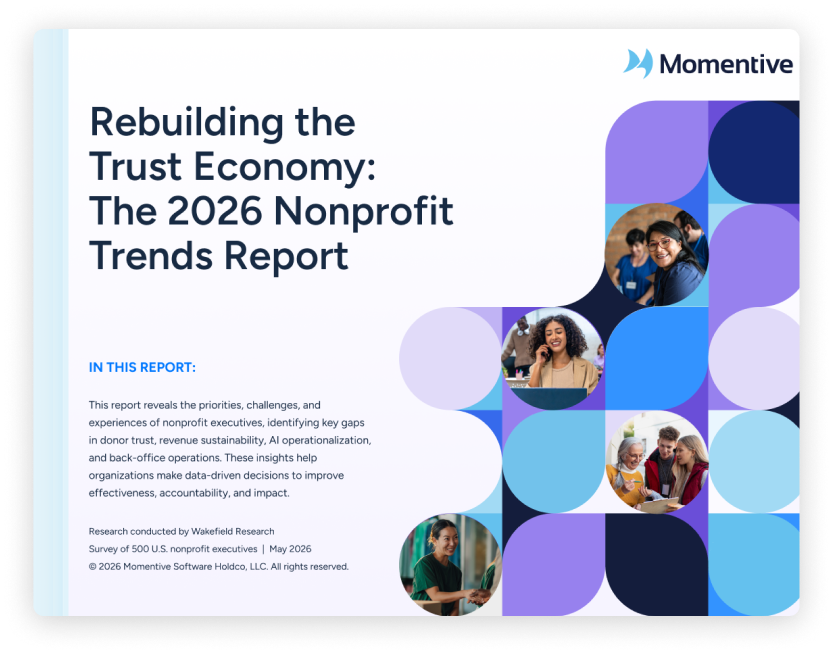
Mission-driven organizations are deeply committed to their communities, but traditional outreach tactics are no longer enough to secure long-term donor loyalty. This report, conducted by Wakefield Research and commissioned by Momentive Software, examines shifting donor expectations, technological bottlenecks, and the functional realities facing nonprofits to identify the critical factors between back-office data and external fundraising. This research shows how nonprofits can repair the trust economy.
Insight 1
Donor trust is eroding, and the tactics organizations rely on aren't closing the gap
Most nonprofit leaders know donor trust is harder to earn than it used to be, but knowing it and solving for it are different things. The tactics organizations use most often to build trust are falling short of what donors actually need. The gap isn't awareness. It's execution. Organizations with systematic, operationally grounded trust-building practices are the ones holding onto donor relationships. Those that rely on situational outreach are quietly losing ground.
of nonprofit leaders say donor trust is harder to earn today than it was three years ago
are very or extremely concerned their organization isn't doing enough to protect stakeholder data
of organizations experienced a data security breach or incident in the past two years
of Arts, Culture and Humanities organizations experienced a data security incident, the highest of any sector
Donor trust isn't a communications problem, it's an operational one. The organizations closing the gap aren't sending better emails. They're building the internal systems that make external accountability possible: data governance policies, connected workflows, and operational practices that don't depend on who's in the office that week.
Insight 2
AI adoption jumped from 21% to 91% in a single year. Operationalization hasn't kept pace.
The sector moved fast on AI adoption, but adoption and operationalization are not the same thing. Most organizations are concentrating AI use on content generation while leaving higher-value applications in donor analytics, workflow automation, and financial planning largely untapped. The organizations that have moved AI from experiment to operation are already reporting meaningfully lower operational friction. The ones that haven't are running out of time.
of executives believe organizations that don't adapt to AI within two years will struggle to compete for donors
of organizations now use AI, up from 21% in 2025
are using AI extensively, the gap between that number and 91% is where the risk lives
of organizations using AI extensively cite repetitive administrative tasks as a top frustration, versus 48% sector-wide
AI operationalization doesn't happen in a vacuum. It happens in organizations where workflows are connected, data is accessible, and administrative systems are strong enough to support it. For every organization still concentrating AI use at the surface level, the limiting factor usually isn't the technology. It's what sits beneath it.