

Your association management software (AMS) processes renewals, registers members for events, issues invoices, and records payments. It handles invoicing and payments, but it doesn’t handle your finances.
It captures the transaction, but it doesn’t provide the context needed to understand your financial health.
That’s where a purpose-built accounting system, like MIP Accounting, comes in. Accounting technology takes those transactions and adds the context needed to understand your organization’s financial health and make informed decisions about your future.
Your AMS is one piece of the puzzle, but an accounting system contextualizes the whole picture. Here is why every membership activity has an accounting implication and what it takes to turn member transactions into financial clarity.
Every Membership Activity Creates a Financial Event
An AMS streamlines your day-to-day operations. Dues, registrations, sponsorships, certifications, donations, and more create an accounting transaction. When money changes hands, it creates an entry.
For example, when a member pays annual dues upfront, that money isn’t fully earned on day one. Most AMSs mark the invoice as paid and move on, which means your revenue figures can look very different from what your auditor expects.
An AMS records the event, but it doesn’t interpret it.
Follow the Dollar: The Membership Dues Lifecycle
So how do you interpret it? That’s where you need an accounting system.
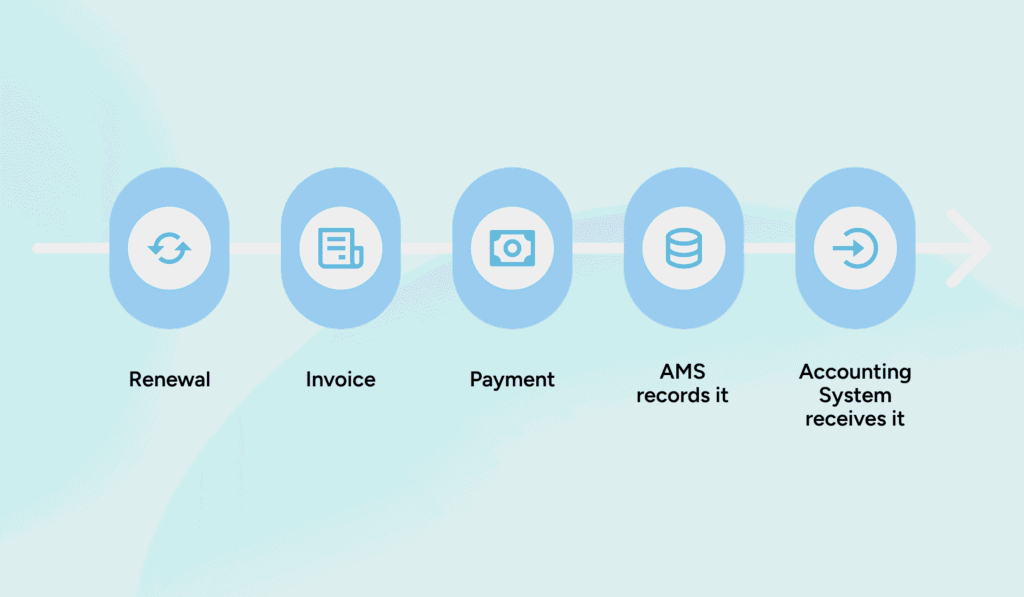
Accounting systems, like MIP, provide the context your finance team needs, while the membership dues lifecycle highlights where an accounting system makes a difference.
Renewal → invoice → payment → AMS records it → Accounting system receives it
For example, when a member pays $600 in January for a twelve-month membership, your AMS marks the invoice paid. But your accounting system recognizes only $50 in January. The remaining $550 sits on your balance sheet as a liability because you have collected money for services you have not yet delivered. Each month, $50 moves from liability to revenue until the membership year is complete.
Multiply that single transaction across hundreds or thousands of members, and without the right systems in place, your organization operates with an incomplete picture. To further understand the importance of an AMS and fund accounting technology, it’s critical to understand the context both systems provide.
Exploring Common Accounting Terms
Think of your accounting system as two layers working together. The general ledger is the master record of every transaction your organization has ever made, organized by account and used to produce your financial statements. Behind it are subledgers: detailed records for one category of transaction that roll up into the general ledger as a summary.
Your AMS functions as the member revenue subledger. It holds every individual invoice, every payment, and every membership type. The accounting system holds the summary, and the two should always reconcile.
Who Owns What
Each system is a piece of the whole puzzle. Your AMS shows your relationship with your members, and your accounting system tells you how value is delivered to your members and other stakeholders.
An AMS owns: member invoices, payment history, membership status, renewals, registrations, and certifications.
Your accounting system owns: revenue, expenses, assets, liabilities, budgets, and financial statements.
Associations Have Unique Financial Complexity
Exploring the association structure highlights why general accounting or your AMS’ built-in finances don’t cut it.
- Revenue streams: Dues are just one revenue stream. As your organization grows in size and your membership base increases, so does the complexity of your finances. A mid-size association might have membership dues, annual conference registrations, webinar fees, certification exam fees, sponsorship revenue, advertising revenue, and charitable donations all in the same fiscal year. If any of those aren’t properly accounted for, it adds unneeded complexity to your financial health.
- Programs: Associations often run education programs, advocacy initiatives, research projects, and certification bodies at the same time. Leadership wants to know whether each is financially viable, which means revenue and expenses need to be tracked at the program level.
- Events: Association events, especially annual conferences, are significant financial undertakings with their own set of finances. Your board will ask whether the conference made money. To properly answer that question, you need event-level revenue and expense tracking that a standard general ledger structure doesn’t provide without segmentation.
- Chapters: If your association operates with semi-independent local chapters, you need financial visibility at the chapter level while also allowing national roll-up reporting. You need a financial system that tracks each chapter’s performance independently while still providing visibility into the national organization.
- Dual entities: It’s common for an association (501(c)(6)) also to operate a foundation (501(c)(3)). You must allocate costs between them for shared resources, but you must maintain separate financial records for IRS compliance. An accounting system makes that separation manageable without requiring two completely separate platforms.
Each of those revenue streams, programs, events, chapters, and entities generates financial data. While a general ledger captures all of it, to answer the questions your board is asking, you need a way to slice that data across multiple dimensions at once.
Moving Beyond a General Ledger
The biggest benefit of purpose-built accounting, like MIP, is in its financial segmentation and multi-dimensional chart of accounts (COA). A flexible multi-dimensional chart of accounts uses customizable data segments like fund, department, grant, and project to tag every transaction, allowing you to slice, dice, and report on your financial data from any angle.
A COA answers board questions like: Did the annual conference make money? Did the foundation cover its own costs?
Each transaction is tagged by entity, program, event, chapter, and revenue source simultaneously.
Accounting technology features in-depth reporting options to take that data and present it in a way that’s easily digestible for external stakeholders. From monthly reports to year-end reports, they can all be made in minutes and present your finances with the complexity needed that an AMS’ built-in tools simply can’t.
When both systems are working from the same data, your reporting is reliable, and your organization stays in control of its finances. When they aren’t, the gaps show up at the worst possible time, in an audit, at a board meeting, or at year-end. That’s the case for integration, and it goes deeper than a technical handoff between systems.
Why Integration Questions Move beyond Tech and into Governance
Each system works best when it owns what it was built for. Your AMS owns the member relationship. Your accounting system owns financial accountability. When these systems integrate, you get a complete picture of your association’s health.
When your AMS and accounting system share data reliably, your team works from a single source of truth. The goal is full financial visibility for your organization, your board, and your auditors.
When a member renews, registers for an event, or donates, that transaction should flow correctly into your financial records without manual intervention or errors.
One Source of Truth, One Platform
Associations that rely on their AMS to do both membership and finances are working with half the picture. Member data may be clean, but financial data will eventually show gaps in a board report, an audit, or a budget conversation where no one can agree on the numbers.
When both systems do their jobs and share data reliably, your membership team and your finance team can look at the same organization and finally work from the same page.
Momentive Software connects all the pieces of the puzzle. With association management and accounting technology built to work together, your member data and your financial data stay in sync without manual reconciliation in between. It’s the single source of truth in your association’s organizational health.
Frequently Asked Questions
What is the difference between an AMS and an accounting system?
An AMS manages your member relationships — invoices, payments, renewals, registrations, and certifications. An accounting system manages your financial health — revenue, expenses, assets, liabilities, budgets, and financial statements. The AMS captures the transaction. The accounting system tells you what it means for your organization.
Why can’t my AMS handle my association’s finances?
Most AMSs mark invoices as paid and move on. They don’t recognize revenue over time, maintain a general ledger, or produce audit-ready financial statements. When a member pays $600 in dues upfront, your AMS shows a paid invoice. Your accounting system recognizes $50 a month and holds the rest as a liability. Both systems are doing their jobs — but only one is doing the accounting.
What is deferred revenue, and why does it matter for associations?
Deferred revenue is money you have collected for services you have not yet delivered. When a member pays annual dues in January, you haven’t earned all of it on day one. A purpose-built accounting system recognizes that revenue over the membership year, which keeps your financial statements accurate and your auditor satisfied.
Why do associations need more than a basic general ledger?
Associations manage multiple revenue streams, programs, events, chapters, and sometimes a foundation alongside the main organization. A general ledger captures all of those transactions, but it can’t easily tell you whether your annual conference turned a profit or whether the foundation covered its own costs. A multi-dimensional chart of accounts tags each transaction by entity, program, event, and revenue source so your board can get answers without a manual deep dive.
What does AMS and accounting integration actually solve?
Without integration, someone on your team is manually reconciling two systems — usually at month-end, usually in a spreadsheet. Integration ensures that when a member renews, registers for an event, or donates, that transaction flows into your financial records automatically and accurately. The result is one version of the truth for your membership team and your finance team.
Does my association need both an AMS and an accounting system?
Yes. They serve different purposes and are built for different jobs. An AMS that tries to handle accounting will leave gaps in your financial reporting. An accounting system without an AMS loses the member-level detail that drives your revenue. Together, they give you complete visibility into both your membership and your organization’s financial health.