
Your best supporters already talk about your cause. They tell friends why they volunteer, why they give, and why the work matters. Peer-to-peer fundraising takes that word of mouth and turns it into revenue, letting the people who love your mission raise money on your behalf and reach donors you’d never find on your own. It’s become one of the most dependable creative fundraising ideas for organizations that need to grow past a plateaued donor list.
What Is Peer-to-Peer Fundraising?
Peer-to-peer fundraising is a strategy where individual supporters raise money for a nonprofit by creating their own fundraising pages and asking their personal networks to give. Instead of your organization soliciting every gift directly, your volunteers, donors, and staff become the fundraisers, each collecting donations toward a shared goal.
It’s sometimes called social fundraising, team fundraising, or simply P2P. The mechanics are the same: one campaign, many fundraisers, each with a page and a story. A supporter shares that page with friends, family, and coworkers, and the gifts they collect roll up to your organization’s total.
Here’s what that looks like in practice. A shelter running a “feed the animals” campaign asks families who have adopted a pet to set up a page. Each family posts a photo, explains what adoption meant to them, and invites their circle to chip in. Twenty families reaching twenty networks puts your cause in front of hundreds of people who’d never seen your name before, and every one of those gifts came with a personal endorsement attached.
How Does Peer-to-Peer Fundraising Work?
A peer-to-peer campaign runs on a simple loop: you recruit fundraisers, they raise money, and you keep them motivated to the finish. Here’s how it comes together, step by step:
- Set the campaign goal and timeline. Decide what you’re raising money for and how long the campaign runs. Many organizations open a campaign 30, 60, or even 90 days before an event so supporters have time to build momentum.
- Recruit your fundraisers. Invite the people closest to your mission: recurring donors, board members, staff, volunteers, and corporate partners. These are your campaign’s engine.
- Give each fundraiser a personal page. Using a peer-to-peer fundraising platform, each supporter creates a page with their own photo, story, and goal that ties back to your total.
- Fundraisers share with their networks. Supporters send their pages out by text, email, and social media. Because the ask comes from a trusted friend, it converts better than a message from a brand.
- Donors give and see their impact. Gifts process on the page, progress updates in real time, and donors watch the goal fill.
- You recognize and re-engage. Thank donors, celebrate top fundraisers, and fold new supporters into your donor program so a one-time gift becomes a lasting relationship.
Key Features of a Peer-to-Peer Fundraising Platform
The software you choose shapes how easily supporters can fundraise and how much of the work lands back on your team. Look for these capabilities:
- Personal and team pages: Let supporters build branded pages in minutes and group them into teams that compete toward a common goal.
- Mobile-first giving: Make donating and managing a page effortless on a phone, where most sharing and giving now happens.
- Social sharing tools: Give fundraisers one-tap sharing to text, email, and social channels so their stories travel further.
- Live leaderboards and a fundraising thermometer: Show individual and team progress in real time to fuel friendly competition.
- Donor recognition: Automate thank-you messages and milestone badges so no gift goes unacknowledged.
- CRM and email integration: Sync every donor and gift into your systems automatically, with no manual exports.
- Reporting dashboards: Track revenue, participation, and top performers as the campaign runs, not weeks after it ends.
Types of Peer-to-Peer Fundraising
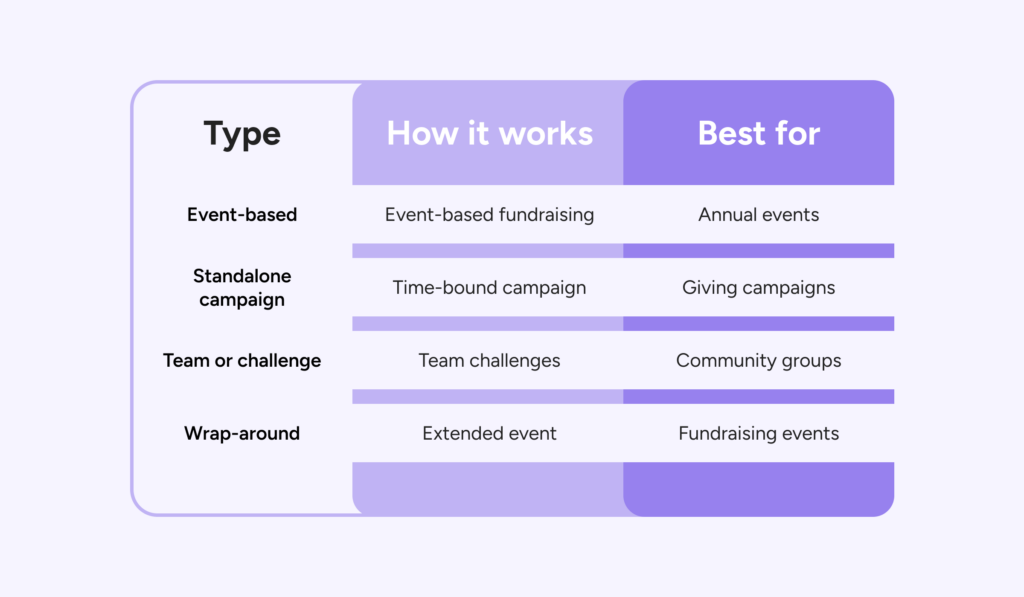
Peer-to-peer isn’t a single format. Most campaigns fall into one of these types, and many organizations run more than one:
| Type | How it works | Best for |
| Event-based | Fundraisers raise money tied to a walk, run, ride, or gala, often before the event date | Organizations with a signature annual event |
| Standalone campaign | A time-boxed campaign with no event attached, built entirely around supporter pages | Giving days, awareness months, and year-end pushes |
| Team or challenge | Supporters form teams or take on a challenge, like miles run or a creative contest, and collect pledges | Corporate partners, schools, and community groups |
| Wrap-around | A peer-to-peer layer added before, during, and after a main event to extend its timeline | Galas, golf tournaments, and auctions |
An event-based format is the most familiar, but a wrap-around campaign is where many teams find new revenue: it turns a single-day event into a multi-week fundraising window.
Benefits of Peer-to-Peer Fundraising
The real payoff isn’t just the dollars raised in one campaign. It’s the reach and the relationships that carry into next year:
- New donors you couldn’t reach alone. Every fundraiser opens their personal network to your cause, putting your mission in front of people who’ve never heard of you.
- Lower cost per dollar raised. Your supporters do the outreach, so a peer-to-peer campaign can extend your revenue without a matching jump in spend.
- Stronger donor relationships. Gifts arrive with a personal endorsement, and the fundraisers themselves become advocates you can re-engage year after year, which supports long-term donor retention.
- A longer fundraising timeline. A campaign that opens weeks before an event keeps giving going well beyond event day.
- Proven scale. The U.S. Top 30 peer-to-peer programs raised $1.17 billion in 2025, up 3.4% over the prior year, with participation climbing 3.6% to 2.63 million people (Peer-to-Peer Professional Forum, 20th annual Top 30 survey).
Scale isn’t limited to national brands. Working with nonprofits on GiveSmart, we’ve seen this play out at the local level: Jackson State University raised $110,000 through a crowdfunding and peer-to-peer competition, driven largely by supporters rallying their own networks.
Peer-to-Peer Fundraising vs. Crowdfunding
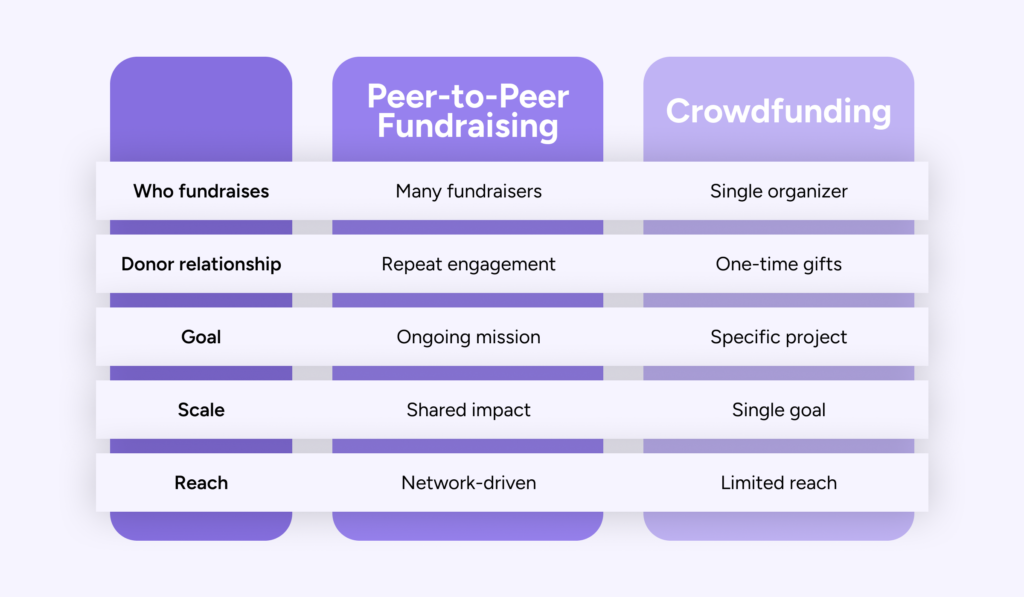
The two terms get used interchangeably, but they work differently, and the difference matters when you’re choosing an approach.
| Peer-to-peer fundraising | Crowdfunding | |
| Who fundraises | Many supporters, each with their own page | One person or organization runs a single page |
| Donor relationship | Builds community and repeat engagement | Tends toward one-time gifts |
| Goal | Advances an ongoing nonprofit mission | Funds a specific project or one-off need |
| Scale | Many small efforts roll up to a shared total | A single campaign with a single goal |
| Reach | Expands through each fundraiser’s network | Limited to the organizer’s own audience |
Both can raise meaningful money. But peer-to-peer builds something crowdfunding usually doesn’t: a network of advocates who show up again next year. If you want a deeper comparison of formats, our guide to online fundraising ideas covers where each one fits.
Who Needs Peer-to-Peer Fundraising?
Peer-to-peer works for any organization with supporters willing to speak up for the cause, which is most of them. It’s a strong fit if you’re a nonprofit, school, faith-based organization, or foundation that:
- Runs a signature event and wants to raise money beyond ticket sales
- Needs to reach new donors without buying more ad space
- Has an engaged base of volunteers, alumni, or recurring donors with their own networks
- Wants to turn a giving day or awareness month into a coordinated push
If your supporter list has plateaued and you’re relying on the same donors each year, peer-to-peer is how you grow past them. Momentive’s peer-to-peer fundraising software is built for these organizations, whether you’re launching your first campaign or scaling an annual one.
How to Choose a Peer-to-Peer Fundraising Platform
The platform you pick shapes how many supporters actually finish a campaign. Weigh these factors before you commit:
- Ease of setup for fundraisers. If a supporter can’t build a page in a few minutes, they won’t. Look for templates and guided setup.
- Mobile experience. Sharing and giving happen on phones, so both the fundraiser and donor flows need to work cleanly on a small screen.
- Integration with your existing systems. The platform should sync donors and gifts into your CRM and accounting tools without manual work.
- Motivation built in. Leaderboards, badges, and progress tracking keep fundraisers engaged past the first week.
- Reporting you can act on. You want real-time visibility into revenue, participation, and top fundraisers while there’s still time to coach.
- Support and resources. Sample messaging, setup checklists, and a peer-to-peer fundraising toolkit help volunteers launch faster and stay engaged.
Match the platform to how your supporters actually behave, not to the longest feature list. The right fit is the one your fundraisers will use without a manual.
FAQ
What’s the difference between peer-to-peer fundraising and crowdfunding?
Crowdfunding runs through a single page managed by one person or organization to fund a specific project. Peer-to-peer fundraising spreads across many supporter pages that roll up to a shared goal, expanding your reach and building longer-term donor relationships in the process.
How much does peer-to-peer fundraising raise on average?
It varies widely by campaign and cause. Industry data from 2025 through early 2026 puts the average individual fundraiser at roughly $244 and the average fundraising page near $568, though a strong story and an active network can push a single page well beyond that.
Is peer-to-peer fundraising effective for small nonprofits?
Yes. Peer-to-peer is one of the most budget-friendly ways for a small team to grow, because your supporters do the outreach. You don’t need a national profile, just a group of engaged advocates willing to share your cause with people who already trust them.
How do you recruit peer-to-peer fundraisers?
Start with the people closest to your mission: recurring donors, board members, staff, and volunteers with a personal story to tell. Promote the campaign across email, social media, and your website, and make joining easy with ready-made templates and messaging.
What should I look for in a peer-to-peer fundraising platform?
Prioritize easy page setup, a clean mobile experience, CRM and email integration, and built-in motivation like leaderboards and badges. Real-time reporting matters too, so you can coach fundraisers and recognize top performers while the campaign is still live.