
Every organization runs on people outside its own walls. The caterer for your annual gala, the AV crew running your conference, the platform hosting your member database, the printer producing your renewal mailers. Each one is a vendor. Each relationship has to be chosen well, kept on track, and measured against what you’re paying for. When that happens by email threads and memory, costs creep, contracts auto-renew past their usefulness, and one supplier missing a deadline can stall an entire event.
Vendor management is how you keep that from happening. Done well, it turns a scattered list of suppliers into a set of relationships you can see, compare, and improve. Here’s what it covers, how the process works stage by stage, and what to look for when the manual approach stops scaling.
What Is Vendor Management?
Vendor management is the process of selecting, onboarding, monitoring, and offboarding the external suppliers, partners, and service providers an organization depends on. It spans the full lifecycle of each relationship, from the first selection decision through contract management and performance tracking to the eventual end of the engagement, so every vendor delivers on cost, quality, and risk.
The term gets used most often in corporate procurement, but the work isn’t finance-specific. A professional association running its annual conference deals with dozens of vendors: a venue, an AV company, a registration platform, a badge printer, a hotel block. A nonprofit has its own roster of grant portals, payment processors, and event suppliers. In each case the questions are the same. Are you getting what you agreed to? Is the price still fair? What happens if this vendor disappears next quarter?
Vendor management gives your team one consistent way to answer those questions across every supplier, instead of reinventing the process for each one.
Why Vendor Management Matters
Most organizations don’t set out to manage vendors loosely. It happens by accretion: a contract here, a renewal there, a new tool one department signed up for without telling anyone. Before long, no one can say how many vendors you have, what you’re paying in total, or which agreements are about to renew.
The cost of leaving it informal is quiet, but real. Duplicate tools you’re paying for twice. Renewal windows missed by a day. A scramble every time a key supplier drops the ball. A defined process replaces that with visibility and control, so your team spends less time chasing vendors and more time on the work only they can do.
The Vendor Management Process: Key Stages
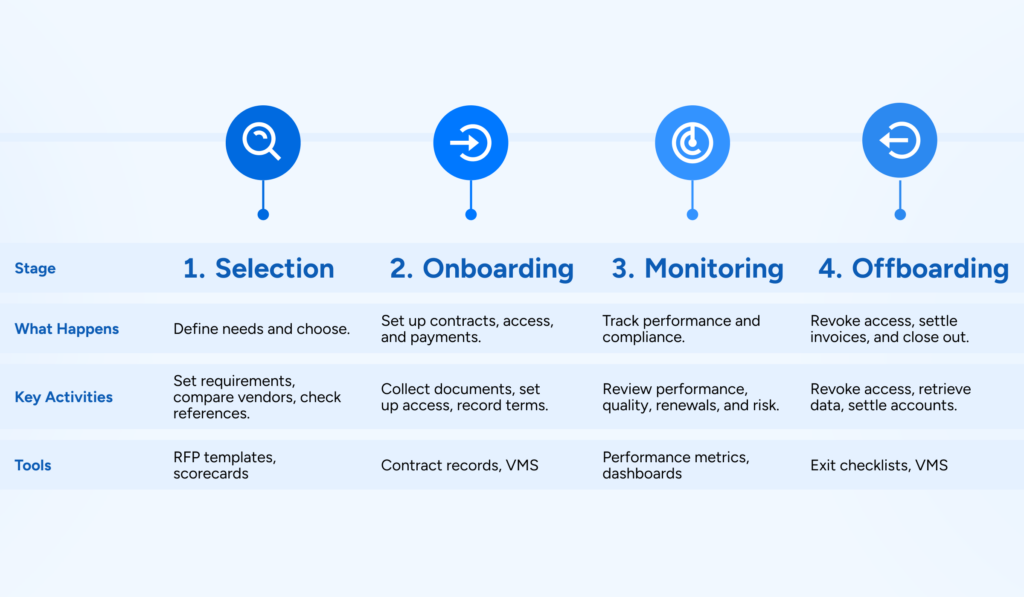
Vendor management runs in four stages, each with its own activities and tools. The cycle repeats: offboarding one vendor often feeds the selection of the next.
Stage 1: Vendor Selection
Selection is where you define what you need and decide who can deliver it. Skip the rigor here and you’ll pay for it later. Start with clear requirements, then compare vendors against the same set of vendor selection criteria: price, capability, references, financial stability, security posture, and fit. For larger commitments, a formal request for proposal (RFP) keeps the comparison honest and creates a paper trail. If your organization handles public or grant funding, a written procurement policy sets the rules for how those decisions get made.
Stage 2: Onboarding
Onboarding turns a signed contract into a working relationship. Collect the vendor’s documentation, set up payment and system access, define points of contact, and agree on how you’ll communicate. This is also where you capture the details that matter later: contract end date, renewal terms, service-level agreements, and who owns the relationship on your side. Log it once, in one place, and you won’t be hunting for it a year from now.
Stage 3: Performance Monitoring
Monitoring is the stage most organizations skip, and it’s where value leaks. Track each vendor against agreed vendor performance metrics: on-time delivery, quality, responsiveness, and cost against budget. Schedule regular reviews rather than waiting for something to break. For vendors tied to a specific event or a high-stakes deliverable, build a plan for what happens if they fail before you need it.
Stage 4: Offboarding
Every vendor relationship ends eventually. Offboarding done right protects you: revoke system access, retrieve or delete your data, settle final invoices, and document why the relationship ended. A clean exit also makes the next selection easier, because you know exactly what worked and what didn’t.
Key Roles in Vendor Management
Vendor management is rarely one person’s job. In a small nonprofit, one operations lead may wear every hat. In a larger association, the work is shared:
- Relationship owner: the person accountable for a given vendor’s day-to-day performance.
- Finance: manages budgets, approves spend, and tracks contracts and renewals.
- Legal or compliance: reviews agreements, data terms, and regulatory requirements.
- Leadership: sets policy and signs off on the highest-value or highest-risk relationships.
Benefits of Vendor Management
A defined vendor management process pays off in four clear ways:
- Cost control. When every contract, renewal date, and rate lives in one place, you stop paying for tools no one uses and negotiate from a position of knowledge.
- Lower risk. A vendor with access to your member data or payment flow is a risk you inherit. Managing the relationship means vetting security, tracking compliance, and having a fallback if the vendor fails.
- Consistent quality. Clear expectations and regular reviews keep service from drifting after the contract is signed.
- Time back for your team. One source of truth means less time chasing details across inboxes and spreadsheets, and fewer last-minute fire drills.
Common Challenges in Vendor Management
- Too many vendors, no single owner. Relationships pile up faster than anyone claims responsibility for them.
- Manual tracking. Contracts and terms scattered across spreadsheets and email are easy to lose and impossible to report on.
- Silent renewals. Agreements that auto-renew without review lock you into terms you’d have renegotiated.
- Weak risk visibility. Without a record of who holds what access and data, compliance gaps go unnoticed until an audit.
- No agreed metrics. You can’t measure performance you never defined, so underperformance goes unchallenged.
Vendor Management Best Practices
- Centralize everything. Keep vendor records, contracts, renewal dates, and performance data in one system, not one person’s memory.
- Standardize selection. Use the same criteria and scorecard for every vendor so comparisons are fair and defensible.
- Assign clear owners. Every vendor gets one accountable person on your side.
- Review on a schedule. Set renewal and performance reviews as recurring dates, not reactions to problems.
- Plan the exit before you sign. Know how you’d leave, get your data back, and transition, before you’re committed.
What Is a Vendor Management System (VMS)?
A vendor management system (VMS) is software that centralizes the whole lifecycle: vendor records, contracts, renewal dates, performance data, and communication history in one place. Instead of chasing details across spreadsheets and email, your team works from a single source of truth.
For many organizations, vendor management lives inside tools they already use. If most of your vendors support events, event management software with built-in vendor tracking may cover it. If your vendors are tied to membership operations, your member management system may be the natural home. The goal is the same either way: one place where every vendor relationship is visible and current.
Vendor Management vs. Procurement
The two terms often get used interchangeably, but they cover different work. Procurement is about acquiring what you need; vendor management is about the relationship that follows.
| Vendor Management | Procurement |
| Focus: the ongoing relationship after a vendor is chosen. | Focus: sourcing and purchasing goods or services. |
| Timeframe: the full lifecycle, from onboarding to offboarding. | Timeframe: the buying cycle, from need to purchase order. |
| Goal: get lasting value, quality, and low risk from each vendor. | Goal: get the right goods or services at the right price. |
| Scope: performance, compliance, renewals, exits. | Scope: sourcing, negotiation, contracting, payment. |
In practice they overlap. Procurement chooses and buys; vendor management keeps the relationship delivering after the ink dries.
Frequently Asked Questions
What is the purpose of vendor management?
The purpose of vendor management is to get consistent value, quality, and low risk from every external supplier. It gives your organization one process for choosing vendors, holding them to agreed terms, tracking performance, and ending relationships cleanly, so no supplier becomes a blind spot.
What are the stages of the vendor management process?
Vendor management has four stages: selection (define needs and choose a vendor), onboarding (set up the relationship and record terms), performance monitoring (track delivery, quality, and renewals), and offboarding (end the relationship, retrieve data, and document lessons learned). The cycle repeats with each new vendor.
What is a vendor management system (VMS)?
A vendor management system is software that centralizes vendor records, contracts, renewal dates, performance data, and communication history in one place. It replaces scattered spreadsheets and email threads with a single source of truth, so your team can see and manage every vendor relationship at once.
What is the difference between vendor management and procurement?
Procurement is the act of sourcing and buying goods or services. Vendor management is the ongoing work of managing the relationship afterward: onboarding, monitoring performance, handling renewals, and offboarding. Procurement ends at the purchase; vendor management runs for the life of the relationship.
What are the biggest challenges in vendor management?
The most common challenges are having too many vendors with no clear owner, tracking everything manually across spreadsheets and email, contracts that renew silently, weak visibility into risk and compliance, and measuring performance without agreed metrics. Each one is fixable with a defined process and a central system.
How do you measure vendor performance?
Measure vendors against metrics you set at onboarding: on-time delivery, quality of work, responsiveness, and cost against budget. Track them consistently and review on a schedule rather than only when a problem surfaces. Agreed metrics turn a subjective impression into an accountable, comparable score.