Raffle Rules and Regulations: A Nonprofit Compliance Guide

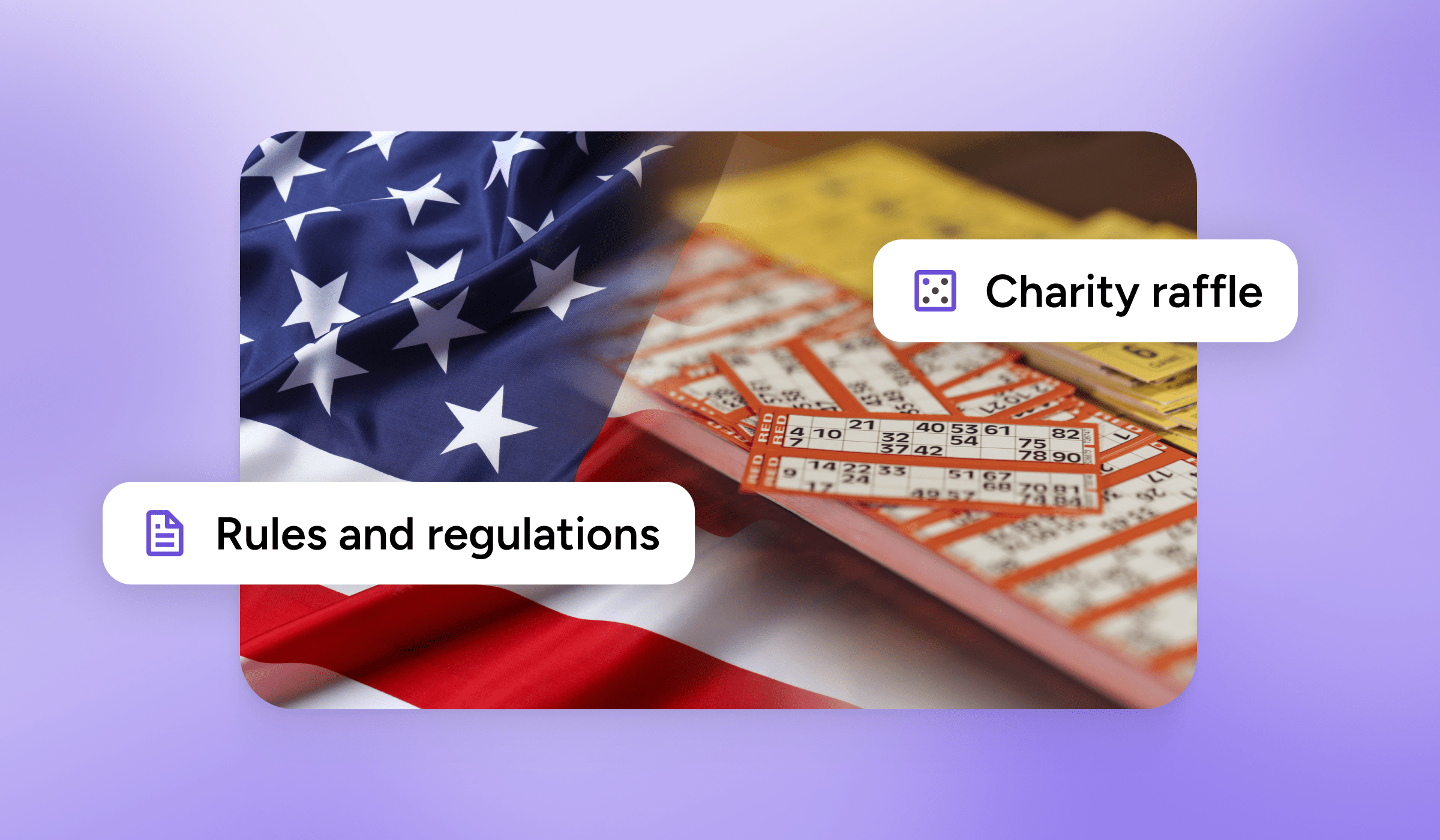
Running a raffle sounds simple. But because raffles meet the same legal definition as a lottery, most states regulate them as gambling. Which means compliance starts before you sell the first ticket.
Raffle rules and regulations are the legal requirements governing how nonprofits conduct games of chance with paid ticket entry and prizes, including state licensing, IRS reporting, and participant eligibility rules.
Understanding the framework before your first ticket goes on sale is not optional; whether you’re planning your first raffle fundraiser or revisiting compliance for an annual event. Organizations that skip this step risk fines, permit revocations, and event cancellations that undermine the fundraising goals they set out to achieve. This guide covers the legal framework behind raffle compliance, federal and state requirements, online raffle rules, a state-by-state breakdown, and a step-by-step checklist your organization can use to run a legally sound raffle fundraiser.
What Are Raffle Rules and Regulations?
A raffle is a game of chance in which participants purchase tickets for the opportunity to win a prize, with the winner selected through a random drawing. In legal terms, a raffle contains three elements:
- A prize
- A random method of selecting the winner (chance)
- A payment to enter (consideration)
Those three elements are the reason raffle rules and regulations exist at all. Because raffles satisfy the same legal definition as a lottery, most states classify them as a regulated form of gambling. To allow nonprofits to use them as fundraising tools, most states have passed laws creating specific exemptions for qualifying organizations. That exemption is the legal foundation your fundraising raffle rests on. Without it, a paid-entry raffle is treated the same as an illegal lottery under state law.
Compliance matters beyond just following the rules. Organizations that conduct raffles without proper permits can face civil fines, loss of their charitable registration, and, in some states, criminal penalties under gaming laws. Getting it right upfront protects your organization’s reputation, your event, and the donors who support you.
What Is the Difference Between a Raffle, a Lottery, and a Sweepstakes?
The distinction between a raffle, lottery, and sweepstakes matters because it determines which legal framework applies to your fundraiser. The three formats look alike on the surface but carry different legal implications.
Lottery
A lottery has three elements: a prize, a random selection method, and paid entry. Operating a lottery in the United States is reserved for state governments. A private organization running a lottery is committing a crime, regardless of how the proceeds are used.
Raffle
A raffle also has all three elements: a prize, a random drawing, and paid tickets. The difference is that most states have created specific exceptions allowing qualified nonprofit organizations to run raffles legally. Without that state exemption, a raffle is an illegal lottery.
Sweepstakes
A sweepstakes removes the consideration element. No purchase or payment is required to enter. Because there is no paid entry, sweepstakes do not meet the legal definition of a lottery and face far fewer restrictions. “No purchase necessary” is not just marketing language. It is a legal requirement that keeps the activity out of lottery territory.
Nonprofits operating in states that prohibit or heavily restrict paid raffles often use a sweepstakes format as a compliant alternative. Remember that sweepstakes carry their own state-specific registration, disclosure, and bonding requirements and are not a regulation-free alternative.
| Format | Prize? | Chance? | Paid Entry? | Who Can Operate? |
|---|---|---|---|---|
| Lottery | Yes | Yes | Yes | Government only |
| Raffle | Yes | Yes | Yes | Qualified nonprofits (state-specific) |
| Sweepstakes | Yes | Yes | No (free entry required) | Anyone (state rules vary) |
Who Can Legally Run a Raffle?
Most states limit raffle eligibility to established nonprofit organizations. The requirements vary by state, and you should verify those rules from your state’s current official sources, but these are the most common criteria:
Nonprofit or 501(c)(3) Status
Many states require organizations to hold 501(c)(3) federal tax-exempt status, or to be recognized as a charitable organization under state law, to qualify for a raffle permit. Some states extend eligibility to additional categories such as religious organizations, veterans’ groups, PTAs, and civic associations.
Organizational Age Requirements
Many states require your organization to have been operating for a minimum period before applying for a permit. Requirements range from six months in some states to five or ten years in others. Verify from the official source before assuming a standard threshold applies.
Membership and Residency Requirements
Some states require a minimum membership number or that the organization be based in the state. These rules exist to prevent organizations from forming specifically to conduct raffles.
Participant Age Restrictions
Most states set the minimum age to purchase a raffle ticket at 18. However, this varies by state. Verify your state’s specific age requirements before your event.
Who Is Not Eligible
For-profit businesses, government agencies, and individuals generally cannot legally run a raffle, even when all proceeds go to charity. Some states allow for-profit entities to co-sponsor a raffle or donate prizes, but the nonprofit must be the legal organizer.
What Are the Federal Tax Requirements for Nonprofit Raffles?
Holding a valid state permit does not end your compliance obligations. Nonprofit organizations running raffles also have federal requirements to meet. Here are four federal requirements for nonprofit organizations running raffles.
1. File Form W-2G and Provide a Winner’s Copy
Nonprofits are required to file Form W-2G with the IRS and provide a copy to the winner when raffle prizes meet specific thresholds. Important 2026 update: For raffles conducted after December 31, 2025, the reporting threshold changed to $2,000 or more (net of the wager) AND at least 300 times the cost of the ticket, pursuant to changes enacted by the One Big Beautiful Act (OBBBA), Pub. L. 119-21, as reflected in IRS Bulletin 2026-19. The previous $600 threshold no longer applies. Always verify the current threshold directly at IRS.gov before your event, as thresholds are now inflation-indexed.
2. Withhold Federal Income Tax on Large Prizes
Regular federal income tax withholding applies when raffle proceeds exceed $5,000. The current withholding rate is 24%. Your organization is responsible for withholding and remitting these amounts to the IRS using Form 945. Noncash prizes are subject to the same rules based on their fair market value.
3. Recordkeeping and Filing Deadlines
Collect winner identification and taxpayer identification numbers from prize recipients using Form W-9 for any prizes that meet or may meet reporting thresholds. Issue Form W-2G to applicable winners by January 31 of the year following the raffle, and file with the IRS by the last day of February (or March 31 if filing electronically). Thorough records protect your organization in the event of an IRS inquiry.
4. Understand Unrelated Business Income Tax (UBIT)
The IRS generally classifies gaming activities, including raffles, as unrelated business activities for tax-exempt organizations, meaning raffle proceeds can be subject to UBIT. The most common path to exemption is the volunteer exception under IRC Section 513(a)(1): if substantially all of the work in conducting the raffle is performed by unpaid volunteers, the activity is generally excluded from UBIT.
Organizations that rely on paid staff to run their raffles, or that conduct large, frequent, or highly commercialized events, should consult a CPA or tax attorney to assess their UBIT exposure. Note that IRC Section 513(f)’s specific exclusion applies to qualified bingo games, not to raffles generally. Per IRS.gov, raffles are treated as gaming activities subject to UBIT unless a recognized exception applies.
What Are the Key State Raffle Regulations?
Raffles are legal for qualifying nonprofits in most U.S. states, but the rules vary considerably. Three states effectively prohibit paid-entry nonprofit raffles: Alabama, Hawaii, and Utah. Florida is a special case: it allows charitable drawings but prohibits requiring any payment to enter, which means the standard paid-ticket raffle format isn’t available there.
Raffle laws by state vary along these common criteria:
License and permit requirements
Most states require nonprofits to obtain a permit or license from a state agency before selling raffle tickets. These are typically issued by the state Attorney General’s office, a charitable gaming board, or a gaming commission. Start the application process well before your event, as processing times can run several weeks or longer.
Use-of-proceeds requirements
Many states require that raffle proceeds be used for the organization’s charitable or exempt purpose. California, for example, requires at least 90% of gross receipts to go to charitable purposes in-state.
Prize restrictions
Some states cap total prize value, restrict cash prizes in favor of merchandise, or require specific disclosures about prize fair market value.
Organizational age requirements
These range from six months to ten years, depending on the state.
To find your state’s current requirements, go directly to your state Attorney General’s charitable gaming page or your state’s gaming commission. Third-party summaries, including older versions of this blog, can become outdated and should not substitute for primary source research.
Raffle Laws by State: A 50-State Reference Guide
The entries below reflect research conducted in June 2026 from official state sources and recently published legal references. This guide is for general informational purposes only. Raffle laws change frequently. Always verify current rules directly with your state’s charitable gaming authority or a qualified attorney before selling a single ticket.
States Where Paid Raffles Are Prohibited
Three states do not provide a workable charitable exemption for standard paid-ticket raffles. In each, a no-purchase-necessary sweepstakes may be a compliant alternative, though sweepstakes carry their own registration and disclosure requirements in some states.
Alabama: Raffles are treated as lotteries under Alabama law, and there is no general statewide charitable-raffle exemption. Some activity may occur under local constitutional amendments in specific counties. Verify with the Alabama Attorney General before proceeding. Source: Alabama Code Title 13A, Chapter 12.
Hawaii: The state’s gambling prohibition under Hawaii Revised Statutes Chapter 712 covers raffles with no nonprofit exception. Source: Hawaii Revised Statutes Chapter 712.
Utah: Utah Code Section 76-9-1401 defines a lottery to include a raffle, and the state prohibits gambling without a charitable exception. Paid-ticket raffles are not authorized. Source: Utah Code Section 76-9-1401.
Florida: A Special Case
Florida authorizes charitable “drawings by chance” but expressly prohibits requiring any payment to enter. Under Florida Statutes Section 849.0935, organizations eligible under 501(c)(3), (4), (7), (8), (10), or (19) may conduct drawings as long as no contribution, donation, or ticket purchase is required to enter or win. This is fundamentally different from a paid-ticket raffle. Every ticket and advertisement must disclose the organization’s name and address, the source of all prizes, the drawing date, time, and place, and that no purchase or contribution is necessary.
Source: Florida Statutes Section 849.0935
Raffle Rules for all 50 States
Alabama
Paid raffles are prohibited statewide. No general charitable exemption exists. Some counties may allow limited activity under local constitutional amendments. Verify with local authorities before proceeding. Source: Alabama Attorney General
Alaska
Charitable gaming, including raffles, is permitted for qualified nonprofits with at least three years of existence and at least 25 Alaskan resident members. Licenses are issued by the Alaska Department of Revenue. Online ticket sales are permitted. Source: Alaska Department of Revenue, Charitable Gaming
Arizona
Legal for nonprofits with at least one year of continuous existence in Arizona. No separate raffle license is required; organizations must obtain certification from the Arizona Attorney General’s office. Source: Arizona Attorney General
Arkansas
Legal for registered nonprofits that have operated in the state for at least five years with at least 25 members. A raffle license is required from the Arkansas Department of Finance and Administration. Online, electronic, and third-party-conducted raffles are prohibited. Only volunteer members and officers of the organization may conduct the raffle; compensation is not permitted. Proceeds must go to charitable purposes. Source: Arkansas Department of Finance and Administration
California
Legal for qualifying nonprofits as a narrow exception to the state’s anti-lottery rule. Requirements are among the strictest in the country. Organizations must have been registered in California for at least one year and must register annually with the California Attorney General’s Registry of Charities and Fundraisers (Form CT-NRP-1) at least 60 days before the raffle. Written confirmation from the Registry must be received before any tickets are sold. At least 90% of gross ticket receipts must go to charitable purposes in California. Online ticket sales are expressly prohibited. Tickets may not be sold, traded, or redeemed over the internet, though online advertising is permitted. The annual raffle report (Form CT-NRP-2) is due February 1. Source: California Attorney General, Nonprofit Raffles; Cal. Penal Code Section 320.5
Colorado
Legal for nonprofits that have existed in Colorado for at least five years. A raffle license is required from the Colorado Secretary of State. Processing can take up to six weeks, so apply early. Online ticket sales are not permitted. Net proceeds must benefit the organization’s charitable mission. Source: Colorado Secretary of State, Bingo-Raffle
Connecticut
Regulated at the municipal level. Each municipality issues permits for raffles within its jurisdiction, typically through the local police department. Organizations must have been active for at least six months, with at least three active member-signatories on the application. Submit the permit application at least 15 days before the event. Cash and alcohol prizes are generally prohibited. After the event, the organization has 30 days to file gross receipts, net profit, expenses, and prize details with the municipality. Prizes exceeding $7,500 may trigger a review of the organization’s qualifications. Online ticket sales may be permitted if explicitly authorized by the municipality. Source: Connecticut Department of Consumer Protection, Charitable Gaming
Delaware
A raffle permit is required when a ticket price exceeds $5 for a single drawing, when a ticket price exceeds $15 for a series of drawings, or when the total prize value is $5,000 or more. The organization must have existed for at least two years and hold IRS recognition as a charitable organization. In 2024, Delaware enacted a new annual raffle license framework (House Bill 389) allowing up to 20 events per year for a $300 annual fee, with a seven-day advance notice and 60-day post-event reporting. Source: Delaware Division of Professional Regulation, Gaming
Florida
See the special callout above. Florida charitable drawings must be free to enter. Paid-ticket raffles are not permitted under any circumstances. Source: Florida Statutes Section 849.0935
Georgia
Only nonprofit, tax-exempt organizations licensed by the county sheriff’s office may conduct raffles. The organization must have existed for at least two years. Online ticket sales are not permitted. Source: O.C.G.A. Section 16-12-22.1; contact your county sheriff’s office
Hawaii
Paid raffles are prohibited. No charitable exemption exists for paid-ticket raffles. Charitable drawings requiring no payment may be permitted. Verify with the Hawaii Attorney General. Source: Hawaii Revised Statutes Chapter 712
Idaho
Legal with a license, but organizations are limited to 12 drawings per year. Cash prizes for a single drawing cannot exceed $1,000. At least 80% of raffle proceeds must go to charitable purposes. The organization must have existed for at least one year in the county where the raffle will be held and hold IRS tax-exempt status. Online ticket sales are permitted. An annual statement must be filed with the state lottery. Source: Idaho Code Section 67-7710
Illinois
Legal under the Raffles and Poker Runs Act, but most licensing and oversight is delegated to local governments. Counties and municipalities issue licenses and set limits, including prize caps, ticket price maximums, and the number of raffle events permitted per year. Many local ordinances require five years of continuous organizational existence. Confirm online ticket sale authorization with your local licensing authority. Source: State Board of Elections, Raffles Rules and Regulations
Indiana
Nonprofit organizations may apply for an annual activity license or a one-time activity license to conduct charitable gaming events, including raffles. Applications are submitted to the Indiana Gaming Commission. Source: Indiana Gaming Commission, Charity Gaming
Iowa
A license is required from the Iowa Division of Inspections, Appeals and Licensing for the type of gambling activity being conducted. Online raffles are permitted as long as the platform’s manufacturer or distributor is licensed and certified in Iowa. Source: Iowa DIAL, Social and Charitable Gambling
Kansas
Qualified 501(c) tax-exempt nonprofits may apply for a raffle license from the Kansas Department of Revenue. Applications must be submitted at least 30 days before the event, and fees are assessed based on annual gross raffle receipts. Online ticket sales are generally permitted. Verify current eligibility and license requirements directly with the Kansas Department of Revenue before proceeding, as some sources note Kansas restrictions that may apply to specific raffle formats. Source: Kansas Department of Revenue, Bingo and Charitable Gaming
Kentucky
Nonprofits conducting charitable gaming must be licensed by the Department of Charitable Gaming. License applications must be submitted at least 60 days before the expected raffle date. Online ticket sales are not permitted. Source: Kentucky Department of Charitable Gaming
Louisiana
Nonprofits must obtain licensure from the Louisiana Office of Charitable Gaming (with certain exceptions) and fully disclose all raffle information. Records must be maintained for three years. Online ticket sales are generally permitted. Source: Louisiana Office of Charitable Gaming
Maine
Eligible organizations must register to conduct raffles in Maine. No registration is required if the total prize value is under $10,000. Online raffles are permitted, but the online operator must be licensed in Maine. Source: Maine Gambling Control Unit
Maryland
Nonprofit organizations may conduct two raffles per year with a permit from the county where the raffle will be held. The organization must also provide the Maryland Charitable Organizations Division with disclosure of raffle information before advertising or conducting the event. Source: Maryland Secretary of State, Raffles
Massachusetts
Only organizations operating for nonprofit purposes that have been active for at least two years in Massachusetts may conduct raffles. A permit must be obtained from the Town or City clerk where the raffle will be held. Source: Massachusetts Attorney General, Guidance on Raffles
Michigan
Qualified nonprofits must file a qualification form and supporting documentation with the Michigan Charitable Gaming Division before applying for a license. Source: Michigan Charitable Gaming Division
Minnesota
Registered nonprofits are permitted to conduct raffles under the oversight of the Minnesota Gambling Control Board. Online ticket sales are prohibited. Electronic raffle selection systems are permitted if they meet state requirements. Source: Minnesota Gambling Control Board, Raffles
Mississippi
Nonprofits are eligible for a charitable gaming license if the organization has at least a three-year documented history of charitable activity. Fees are due at the time of application. Source: Mississippi Gaming Commission, Charitable Gaming
Missouri
Recognized nonprofit organizations may conduct raffles after applying for and receiving a license from Missouri’s charitable gaming authority. Source: Missouri Attorney General
Montana
No state license is required for nonprofit organizations to conduct raffles in-state. Organizations must register with the Montana Gambling Control Division to sell raffle tickets online. Montana permits nonprofits to sell tickets outside the state online only if the purchase is not prohibited where the buyer resides, and any internet advertisement must disclose that restriction along with the organization’s name and raffle terms. Credit card payments are prohibited for online ticket sales. Source: Montana Department of Justice, Gambling Control Division; Montana Code 23-5-413
Nebraska
To apply for a Nebraska raffle license, a nonprofit must have at least 10 members and hold IRS recognition as a tax-exempt nonprofit. Some jurisdictions within the state require local raffle permits in addition to the state license and may charge a raffle tax. Source: Nebraska Department of Revenue, Charitable Gaming
Nevada
Qualified organizations may conduct raffles by registering with the Chair of the Nevada Gaming Control Board. Source: Nevada Revised Statutes Chapter 462
New Hampshire
Nonprofit organizations may conduct a raffle with a permit from the town in which the raffle will be held. The raffle should promote the organization’s stated charitable purpose. Source: New Hampshire RSA Chapter 287-A
New Jersey
Raffles are legal, but organizations must register with the New Jersey Division of Consumer Affairs to receive an identification number, then apply for a raffle license through the municipality where the event will be held. Source: New Jersey Division of Consumer Affairs, Legalized Games of Chance
New Mexico
Gambling and gaming are generally illegal in New Mexico, but nonprofits may qualify for raffle licenses through the New Mexico Gaming Control Board. Proceeds must go to a charitable purpose. Online ticket sales are not expressly authorized; confirm with the Gaming Control Board before proceeding. Source: New Mexico Gaming Control Board
New York
New York is one of the few large states that expressly permits online raffle ticket sales. Raffles are regulated as “games of chance” by the New York State Gaming Commission with a municipal licensing layer. No state registration is required if expected net proceeds are under $5,000 per raffle and under $30,000 per year; above those thresholds, a Games of Chance Identification Number plus municipal authorization is required. Single prizes are capped at $300,000, series prizes at $500,000, and total prizes per license period at $3,000,000. Online and mobile ticket sales are expressly permitted by credit or debit card within New York’s games-of-chance framework, subject to age verification, geographic limits, and a rule that sales may not begin more than 180 days before the raffle. Participants must be 18 or older. Source: New York State Gaming Commission; NY Gen. Mun. Law Sections 189 and 190-a
North Carolina
Any nonprofit organization may conduct a raffle in North Carolina without a license, but is limited to a maximum of four raffles per calendar year. Online ticket sales are not clearly authorized under current statutes; confirm with the North Carolina Attorney General before proceeding. Source: North Carolina General Statutes Chapter 14, Article 37
North Dakota
Organizations must obtain either a State Gaming License through the Attorney General’s Office or a local permit from the city or county where the event will be held. Source: North Dakota Attorney General, Charitable Gaming
Ohio
Ohio lets many nonprofit categories run raffles without requiring a separate bingo license. Qualifying organizations include 501(c)(3) charities and certain (c)(4), (c)(6), (c)(7), (c)(8), (c)(10), and (c)(19) organizations, with a requirement of two years of continuous Ohio existence. 501(c)(3) groups may keep 100% of net proceeds; other eligible categories must direct at least 50% of net profit to a charitable purpose. Online ticket sales are not currently authorized. Note: Ohio House Bill 476, which would explicitly authorize fully online charitable raffles, passed the Ohio House in November 2025 and was pending in the Senate as of June 2026. Source: Ohio Attorney General, Charitable Gaming; Ohio Rev. Code Section 2915.092
Oklahoma
Nonprofits must qualify to conduct raffles in Oklahoma. Organizations are prohibited from using a third party to sell tickets or solicit contributions. Source: Oklahoma Statutes
Oregon
Nonprofit organizations exempt from federal income taxes that have held that status for at least one year may apply for a charitable gaming license from the Oregon Department of Justice. Source: Oregon Department of Justice, Charitable Gaming
Pennsylvania
Pennsylvania regulates raffles under the Small Games of Chance Act. Licensing is handled at the county or municipal level, and small games of chance are only legal in municipalities that approved them by voter referendum. Eligible organizations include charitable, religious, fraternal, veterans, and civic nonprofits generally in existence for at least one year. Special raffle permits are available for prizes that may exceed standard local limits, up to $150,000. Online ticket sales are not clearly authorized; confirm with the local licensing authority. Source: Pennsylvania Department of Revenue, Small Games of Chance
Rhode Island
Nonprofit organizations must submit raffle applications to the police chief in the town where the raffle will be held. Online ticket sales are prohibited; the internet may only be used to advertise the event. Source: Rhode Island State Police, Charitable Gaming Unit
South Carolina
Only certain nonprofit organizations that meet legal requirements may conduct raffles. Eligible nonprofits are prohibited from contracting with third parties to conduct raffles. Source: South Carolina Secretary of State, Raffles
South Dakota
Raffles for charitable purposes are permitted. Organizations must provide the Secretary of State with written notice of the raffle and register with the city in which the event will be held. Source: South Dakota Secretary of State, Raffle Requests
Tennessee
Nonprofit organizations that have existed for at least five years within Tennessee may apply for permission to conduct a raffle. Organizations are limited to one “game of chance” event per year. Source: Tennessee Secretary of State, Charitable Gaming Guide
Texas
No state raffle license is required, but eligibility conditions are strict. Under the Charitable Raffle Enabling Act (CREA), only qualified 501(c) nonprofits in existence in Texas for at least three years (or qualifying religious societies in existence for at least 10 years), volunteer fire departments, and volunteer emergency medical services organizations may hold raffles. Each qualified organization is limited to four raffles per calendar year. Online ticket sales and paid mass-media advertising are not authorized under CREA. All promotional materials must list the organization’s name, ticket price, prizes, and drawing date. An unauthorized raffle is considered gambling under the Texas Penal Code and carries criminal penalties. Source: Texas Attorney General, Charitable Raffles; Tex. Occ. Code Chapter 2002
Utah
Paid raffles are prohibited. Utah Code Section 76-9-1401 defines a lottery to include raffles, and there is no charitable exemption. Verify current law with the Utah Attorney General. Source: Utah Code Section 76-9-1401
Vermont
Only nonprofit organizations may conduct raffles in Vermont. No license is required for operating raffle games. Events may be held up to twice per week. Source: Vermont Attorney General
Virginia
Nonprofit organizations eligible for a Virginia raffle permit must have existed in the state as a nonprofit for at least three years. Source: Virginia Code Section 18.2-340.24
Washington
Only qualifying nonprofits that have been in operation for at least one year may conduct raffles. Washington’s enhanced raffle framework permits sales by mail, fax, phone, and in person. Organizations may post order forms online, but a downloaded form is not itself a completed online sale. Source: Washington State Gambling Commission, Raffles; Washington RCW Chapter 9.46
Washington, D.C.
To qualify for a raffle license in Washington, D.C., organizations must be nonprofit, incorporated in the District of Columbia and either Maryland or Virginia, and must have existed for at least one year prior to applying. Source: DC Lottery, Charitable Gaming
West Virginia
Only tax-exempt nonprofit organizations may obtain licensure to conduct raffles. Applications must be submitted to the Tax Commissioner at least 60 days before the event. Raffle games must be purchased from a distributor holding a West Virginia license. Source: West Virginia Tax Commissioner, Business Registration, Bingo and Raffle
Wisconsin
Nonprofit organizations may qualify to conduct raffles if they meet state requirements. Licensure may be required depending on circumstances and event size. Online ticket sale authorization may be limited; confirm with your state licensing authority. Source: Wisconsin Statutes Section 563.907
Wyoming
No state license is required for charitable raffles in Wyoming. However, individual counties may require nonprofits to obtain a county-level raffle license. Verify with the county where your event will be held before proceeding. Source: Wyoming Attorney General
Can You Run a Raffle Online? What You Need to Know
Online raffle compliance is one of the fastest-changing areas in charitable gaming law. Most states that permit raffles allow online ticket sales under specific conditions, but the rules vary enough to earn your organization’s careful attention before launching digital ticket sales.
The broad rules as of 2026 are typically:
Expressly permitted with restrictions
States like New York expressly allow online and mobile raffle ticket purchases, subject to age verification, geographic limits, and timing restrictions. Montana permits online sales under constraints tied to buyer location.
Expressly prohibited
California prohibits operating a raffle over the internet. Tickets cannot be sold, traded, or redeemed online, though online advertising is permitted.
Not available due to underlying prohibition
Florida does not permit paid ticket sales at all, so online paid ticket sales are not merely an unaddressed gap; they are not available under any interpretation of the current statute.
Order forms only
Washington permits posting order forms online, but a downloaded form is not itself a completed sale.
Silent statutes
States including Texas, Ohio, North Carolina, and Pennsylvania have statutes that predate online fundraising and do not address electronic sales. The conservative reading in silent-statute states is that fully online ticket sales are not permitted without specific authorization from the regulator.
Legislation in progress
Ohio House Bill 476, which would explicitly authorize fully online charitable raffles, including digital ticket sales and remote winner selection, passed the Ohio House in November 2025 and was pending in the Senate as of June 2026. This is precisely the kind of rule that can change between annual reviews of this guide.
Best Practices for Online Raffle Compliance
Consult your state’s charitable gaming office before setting up digital ticket sales. Restrict ticket sales to buyers within your state. Provide clear digital ticket records to all purchasers and document your drawing procedures in advance.
For organizations in states where paid-ticket raffles are restricted, a virtual fundraising event or online auction may be a compliant alternative worth exploring.
How to Run a Legal Raffle: Step-by-Step Compliance Guide
Despite the legal requirements, running a compliant raffle is manageable when you prepare. The following steps apply to most qualifying nonprofits, though your state’s specific requirements may vary.
Step 1: Verify Your Organization’s Eligibility
Confirm your organization meets your state’s eligibility requirements: legal structure, years of operation, membership requirements, and any residency criteria. If you are not sure, contact your state’s charitable gaming office directly.
Step 2: Research and Obtain the Required Permit
Identify the state or local agency that issues raffle permits in your state. Submit your application with ample lead time, as processing can take several weeks or longer in many states.
Step 3: Set Up Compliant Ticket Pricing, Prize Documentation, and Use-of-Proceeds Tracking
Document all prizes and their fair market values before the event. Set ticket prices that align with state restrictions. Create a system to capture ticket purchaser information, including names and contact details. This data is required by many states and will be essential for IRS reporting if prize thresholds are met.
Step 4: Conduct the Drawing According to State Rules
Most states specify how drawings must be conducted, including whether they must be held in person, whether independent witnesses are required, and how results must be documented and retained.
Step 5: Handle IRS Reporting for Large Prizes
Collect Form W-9 information from winners before distributing prizes that meet or may approach W-2G reporting thresholds. Issue Form W-2G to applicable winners by January 31 of the following year. File with the IRS by the last day of February (or March 31 if filing electronically). Remit any required federal tax withholding to the IRS using Form 945.
Step 6: File Post-Event Reports With Your State
Many states require nonprofits to file a post-event report documenting ticket sales, prize distributions, and use of proceeds. Review your permit requirements and file on time to remain in good standing for future permits.
Raffle Compliance Checklist
| Stage | Task | Done? |
|---|---|---|
| Pre-event | Confirm organizational eligibility | ☐ |
| Pre-event | Apply for state raffle permit | ☐ |
| Pre-event | Document all prizes and fair market values | ☐ |
| Pre-event | Set up ticket and attendee tracking system | ☐ |
| Event day | Conduct drawing per state rules | ☐ |
| Event day | Collect winner W-9 information (if applicable) | ☐ |
| Post-event | Issue Form W-2G to qualifying winners by Jan 31 | ☐ |
| Post-event | File W-2G with IRS by Feb 28 (or Mar 31, e-file) | ☐ |
| Post-event | Remit required federal withholding using Form 945 | ☐ |
| Post-event | File state post-event report (if required) | ☐ |
Raffle compliance is easier when your ticket data, attendee records, and reporting live in one place.
GiveSmart by Momentive is built for nonprofit fundraising events, including raffle campaigns, event ticketing, donor tracking, and reporting.
FAQ: Raffle Rules and Regulations
In most states, yes. Most states require qualifying nonprofits to obtain a permit or license from a charitable gaming agency or the state Attorney General’s office before selling raffle tickets. Some states do not require a permit for smaller raffles or certain categories of organizations. Alabama, Hawaii, and Utah prohibit paid-ticket nonprofit raffles entirely. Always verify your state’s current permit requirements before selling a single ticket.
As of June 2026, Alabama, Hawaii, and Utah prohibit paid-entry nonprofit raffles outright. Florida is a distinct case: it permits charitable drawings but requires free entry for all participants, making the standard paid-ticket raffle format unavailable. Organizations in these states should consult an attorney about compliant alternatives, such as properly structured sweepstakes.
A raffle and a lottery share the same three legal elements: a prize, a random drawing, and paid entry. The key difference is who can legally operate each. State governments can run lotteries; private organizations generally cannot. Most states have created specific exemptions that allow qualifying nonprofits to run raffles legally. Without that state exemption, a raffle is treated as an illegal lottery under state law, regardless of whether the proceeds benefit a charitable cause.
For raffles conducted after December 31, 2025, nonprofits must file Form W-2G when a raffle prize is $2,000 or more (net of the wager) and is at least 300 times the ticket price, pursuant to changes enacted by the One Big Beautiful Act (OBBBA). Federal income tax withholding at 24% applies when proceeds exceed $5,000. W-2G must be issued to winners by January 31 following the raffle year. Always verify current thresholds at IRS.gov before your event. Collect taxpayer identification numbers from prize winners using Form W-9 before distributing prizes.
It depends on your state. New York expressly permits online and mobile ticket sales with specific conditions. California expressly prohibits them. Florida does not permit paid ticket sales at all. Many states, including Texas, Ohio, and North Carolina, have statutes that do not address electronic sales, which generally means you should confirm with your regulator before proceeding. Check your state’s charitable gaming office for current rules before setting up any digital ticket sales process.
Most states set the minimum age at 18. However, age requirements vary by state, and some states may set different thresholds for different categories of charitable gaming. Always verify your state’s specific age requirements before your event and communicate them clearly on your tickets and marketing materials.