AMS Implementation: Steps, Timeline & Integration Guide

If you’ve already selected an AMS, or you’re deep in the evaluation process, you don’t need another overview of association management software. What you need is a credible, honest account of what implementation actually involves: the phases, the realistic timeline, where projects stall, and what separates a smooth rollout from a costly one.
This guide consolidates everything you need to plan and execute AMS implementation with confidence. No vendor spin. Just process clarity from people who’ve seen what works.
What Is AMS Implementation?
AMS implementation is the end-to-end process of deploying an association management system — from initial discovery and configuration through data migration, integration, staff training, and go-live stabilization. It is not simply installing software.
A successful AMS implementation requires deliberate decisions about data architecture, workflow design, and technology integration. It demands real internal ownership, adequate staff bandwidth, and a structured project plan. When those elements are in place, implementation is a manageable, well-scoped project. When they’re missing, it becomes one of the more expensive and disruptive operational undertakings an association can face.
Understanding what you’re walking into, before you start, is the single most valuable thing you can do.
AMS Implementation Phases: How the Process Works
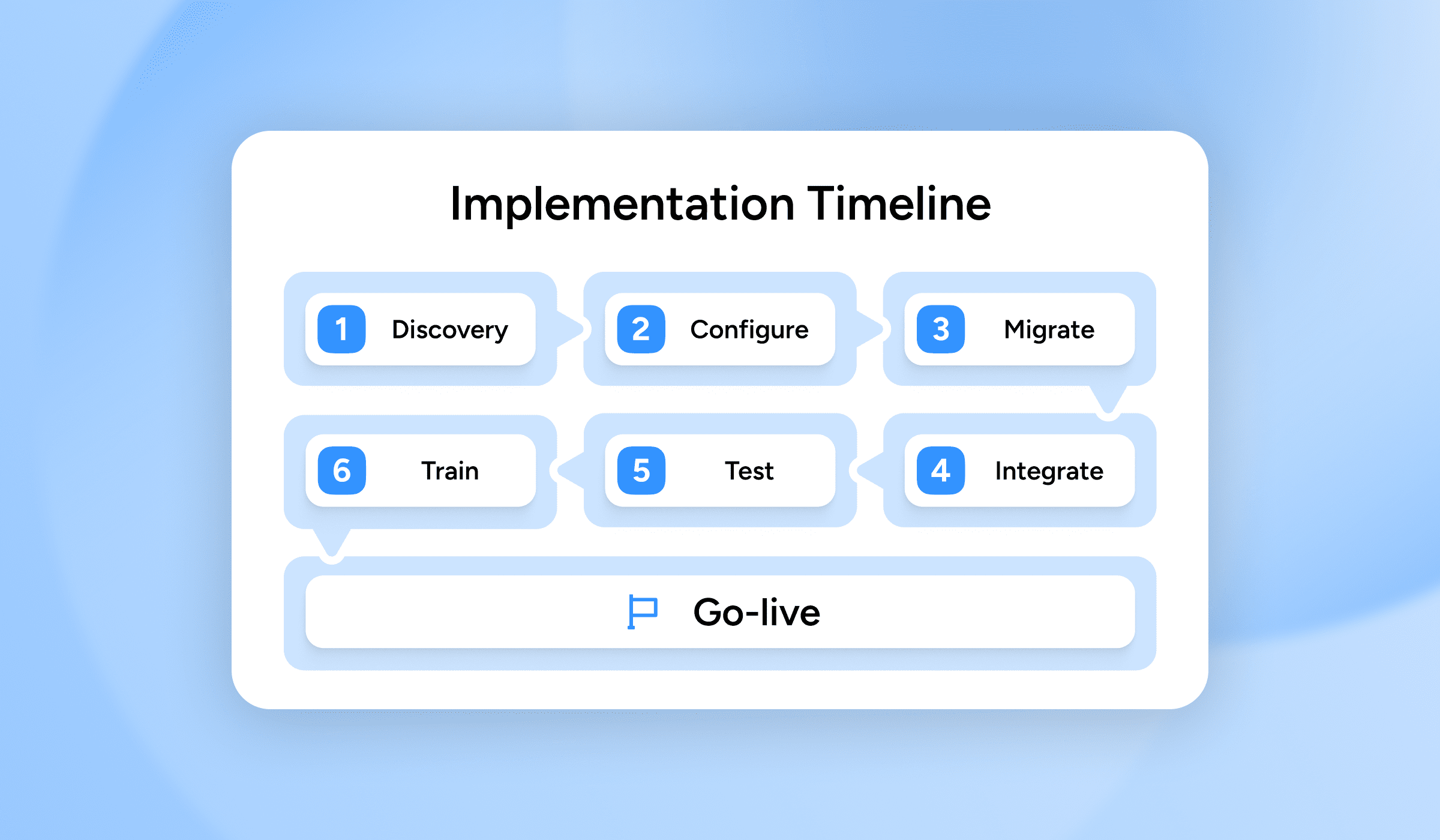
Most AMS implementations follow a consistent sequence of phases, even if vendors label them differently. Here’s how the process actually unfolds.
Phase 1: Discovery and Planning
Discovery is where scope gets defined before anyone touches configuration. This means auditing your current data structure, documenting existing workflows, inventorying your integrations, and aligning your internal team on priorities and decision-making authority. Organizations that treat discovery as a formality, or skip it entirely, are the ones that end up with blown timelines and rework in later phases.
Key outputs: data audit, integration inventory, go-live criteria, project team assignments.
Phase 2: System Configuration
Configuration is where your AMS gets built out to reflect your association’s actual structure — membership types, dues schedules, committee hierarchies, event setup, chapter relationships, custom fields, automations, and permission levels.
This phase requires careful, deliberate decision-making. Configuration choices made here create the foundation everything else runs on, and they’re far harder to undo than they are to get right the first time.
Phase 3: Data Migration
Data migration is consistently the most underestimated phase of AMS implementation — and the one most likely to extend timelines when it hasn’t been properly scoped. Moving member records, transaction history, event data, and engagement history from a legacy system into a new AMS requires field mapping, data cleansing, and multiple rounds of testing before a production migration should ever be attempted.
Plan for at least two full test migration cycles. You will find issues — field mismatches, duplicate records, formatting inconsistencies — that simply aren’t visible until data is actually inside the new system.
Phase 4: AMS Integration with Existing Systems
Integration planning warrants its own section below, but this is the phase where your AMS connects to the rest of your technology stack: website, email platform, accounting system, event tools, LMS, and any other system that touches member data. Integration complexity varies widely, and it’s one of the most common drivers of timeline extension when it’s treated as an afterthought.
Phase 5: Testing and Quality Assurance
User acceptance testing (UAT) is where your staff validates real workflows against real — or representative — data. This isn’t exploratory clicking. It means running through the full lifecycle: membership renewals, event registrations, dues processing, reporting, and the day-to-day workflows your team depends on.
Build iteration time into this phase. Issues will surface. That’s precisely what UAT is for.
Phase 6: Training and Change Management
A well-configured system underperforms when staff aren’t equipped to use it. Training needs to be role-specific — what your membership team needs to know is categorically different from what your finance team needs to know. And it needs to be treated as a first-class project phase, not a checkbox in the final two weeks before launch.
Document your processes as part of this phase. Staff turnover is a reality in every organization, and institutional knowledge that lives only in people’s heads doesn’t survive it.
Phase 7: Go-Live and Stabilization
Go-live is not the finish line — it’s the beginning of a stabilization period. Plan for four to six weeks post-launch where your implementation partner remains accessible, your team is operating in the new system with active support, and you’re monitoring for anything that needs adjustment. Most post-launch issues surface in the first billing cycle or first major event registration after cutover. That’s expected. What matters is having the coverage in place to address them quickly.
AMS Implementation Timeline: What to Realistically Expect
The honest answer: most AMS implementations take six to twelve months from kickoff to go-live. Smaller associations with clean data and limited integrations can move faster — three to four months is achievable in the right conditions. Large or complex organizations with legacy data, extensive integrations, or multi-chapter structures should plan conservatively.
What actually drives timeline variance:
- Data quality — The cleaner your existing data, the faster migration moves
- Integration count and complexity — Each integration adds configuration and testing time
- Internal bandwidth — Your team has a day job; implementation requires real, sustained hours from real people
- Decision-making velocity — Delayed approvals and deferred decisions compound quickly across phases
- Vendor implementation capacity — Not all implementation teams operate at the same pace or with the same responsiveness
A realistic phase-by-phase breakdown:
| Phase | Typical Duration |
| Discovery & Planning | 2- 4 Weeks |
| Configuration | 4-8 Weeks |
| Data Migration | 4-6 Weeks (with test cycles) |
| Integration Setup | 3-6 Weeks (varies by complexity) |
| Testing & UAT | 2-4 Weeks |
| Training | 2-3 Weeks |
| Stabilization Post-Launch | 4-6 Weeks |
These phases overlap in practice. But budget for the full range, build meaningful buffer into your timeline, and avoid scheduling go-live immediately before a major renewal cycle or conference. The stabilization period needs room to breathe.
AMS Implementation Checklist
Use this as a working reference throughout your project — not a one-time exercise.
Before You Start
- Assign an internal project owner with real decision-making authority and protected bandwidth
- Document current workflows, pain points, and the processes you want to improve — not just replicate
- Audit existing data: identify gaps, duplicates, and fields to retire
- Build a complete integration inventory: every system that touches member data
- Define go-live success criteria in writing and get alignment before work begins
During Configuration
- Validate membership type structure before automations are built
- Confirm dues schedules, grace periods, and renewal logic in writing
- Set up and review permission levels for each staff role
- Approve all custom fields before data mapping begins — changes later create rework
Data Migration
- Complete at least two full test migration cycles before production
- Validate record counts, field mappings, and transaction history at each cycle
- Confirm in writing how historical data will be handled: migrated, archived, or cut off at a defined date
Integration Planning
- Document data flow for each integration: what moves, how often, in which direction
- Test all integrations in a sandbox environment before production
- Confirm error handling and fallback behavior for each connection
Training and Go-Live
- Deliver role-specific training, not generalized sessions
- Document key workflows for future staff reference before go-live
- Confirm support SLAs and escalation paths for the stabilization period
- Communicate the go-live timeline to members wherever member-facing changes are involved
AMS Integration Planning: Connecting Your Tech Stack
AMS integration is where many implementations encounter unexpected friction — and where the gap between “technically connected” and “reliably working” becomes obvious.
Your AMS is designed to be the hub of your member data. That means it needs to connect to the rest of your technology ecosystem in ways that are accurate, timely, and maintainable. Common AMS integrations include:
- Website and member portal — Single sign-on, member directory, gated content access
- Email marketing platform — List segmentation, subscription preferences, engagement data sync
- Accounting and finance systems — Dues payments, event revenue, general ledger sync
- Event management tools — Registration data, attendance records, session tracking
- Learning management system (LMS) — Continuing education credits, course completions
- Community platform — Forum participation, engagement scoring, activity feeds
For each integration, four questions need clear answers before your AMS integration developer begins any build work:
- What data needs to move, and in which direction?
- How frequently does it need to sync?
- What is the source of truth when records conflict?
- What happens when the sync fails?
The organizations that handle AMS integration with existing systems most successfully treat integration planning as a Phase 1 activity — something defined during discovery, not retrofitted at the end of configuration. If an integration requires custom API development, that scope needs to be reflected in your timeline and budget from the start, not discovered six weeks before go-live.
Common AMS Implementation Challenges — and How to Avoid Them
These failure patterns recur often enough that they deserve to be named directly.
Underestimating data migration complexity
Data doesn’t clean itself in transit. Organizations consistently underestimate how much time and effort data cleansing requires before migration begins. The closer your source data is to clean and well-structured going in, the smoother your migration will be. This is not a technical problem — it’s a data governance problem, and it requires human attention.
Scope creep during configuration
“While we’re in here, can we also add…” is how configuration phases expand and timelines slip. The solution is straightforward: document your MVP configuration scope, get written approval, and move enhancements to a defined post-launch phase. Scope discipline is a leadership function, not just a project management one.
Insufficient internal bandwidth
Implementation requires your staff to show up — consistently, with focused time — for requirements review, UAT, training, and decisions. If your project lead is simultaneously managing a major conference or running a membership renewal cycle, your timeline will absorb that conflict. Be honest about capacity before committing to a go-live date.
Training as an afterthought
Waiting until two weeks before launch to begin staff training is a predictable way to undermine an otherwise solid implementation. Build training into your project plan as a primary phase. Role-specific preparation takes more time than most teams initially budget for, and it’s the difference between a confident staff and an anxious one on day one.
No defined stabilization plan
Going live without explicit post-launch support coverage is one of the most avoidable implementation risks. Define your stabilization period, confirm your implementation partner’s availability, and make sure your internal team knows who to escalate to when issues surface — because they will.
AMS Implementation Best Practices
These principles hold consistently across implementations of varying size and complexity.
Start with clean data
The effort invested in data cleansing before migration pays returns for years. Migrating bad data into a new system doesn’t solve the problem — it moves it and makes it harder to address later.
Keep your core team small and decision-ready
A tight project team with clear ownership and decision-making authority consistently outperforms large steering committees. Identify who can make calls, give them the mandate, and keep the process moving.
Configure for how you want to work, not just how you’ve worked
Implementation is the right moment to challenge assumptions about your processes. If a workflow has always been cumbersome, don’t replicate it — fix it.
Communicate proactively with members
If your member portal, renewal process, or login experience is changing, your members need advance notice. Surprises during renewals generate support volume and erode trust in ways that are difficult to recover from.
Design with growth in mind
Think about the integrations, reports, and automations you’ll want twelve months post-launch. Make sure your configuration and data architecture won’t constrain you from building them.
Working with an AMS Implementation Partner
Most associations work with either their AMS vendor’s in-house implementation team or an independent AMS implementation consultant. Both approaches have legitimate tradeoffs.
Vendor-led implementation offers deep product knowledge and a clear accountability structure. The team knows the system inside and out, which tends to reduce certain categories of configuration error. Costs can be higher, and availability may be constrained depending on the vendor’s implementation queue at any given time.
Third-party AMS implementation services can offer broader flexibility, cross-platform expertise, and in many cases deeper association sector experience accumulated across multiple vendors and system types. For organizations managing complex integrations or migrating from multiple legacy systems, a specialized implementation partner is often worth the investment.
Regardless of which model you choose, one principle is non-negotiable: you need a named, empowered internal project owner on your side. No implementation partner, however experienced, can substitute for an engaged internal lead who has the authority to make decisions, the trust of their colleagues, and the bandwidth to stay close to the project. That role is yours to fill.
FAQ
For most associations, six to twelve months is a realistic planning horizon from kickoff to go-live. Smaller organizations with clean data and limited integrations may complete implementation in three to four months. Complex implementations — involving legacy data migration, multiple integrations, or multi-chapter structures — should plan for the longer end of the range. The most significant timeline variables are internal bandwidth, data quality, and integration complexity.
It means establishing reliable, maintained connections between your AMS and every other platform that touches member data — your website, email system, accounting software, event platform, LMS, and others. Each integration requires defining data flow direction, sync frequency, conflict resolution logic, and error handling.
Custom API integrations require additional planning time and should be scoped with an AMS integration developer during the discovery phase, not after configuration is underway.
Not in every case — but for organizations without a dedicated internal technical resource, or those managing significant data complexity or multiple integrations, outside expertise is a sound investment.
A qualified consultant brings process knowledge, knows where implementations typically break down, and can compress timelines that an internal-only team would extend. The question isn’t whether you can do it without one — it’s whether your capacity and risk tolerance justify going without.
The patterns repeat: underestimating data migration complexity, inadequate internal project ownership, scope creep during configuration, insufficient training lead time, and no defined post-launch stabilization plan. Most implementation failures are not technology failures. They are process, planning, and governance failures — which means they are preventable.
At minimum: a complete data audit, an integration inventory, written go-live success criteria, approved configuration scope, at least two test migration cycles, a role-specific training plan, and a post-launch stabilization period with defined support coverage and escalation paths. Also consider including a budget for implementation or a total cost of ownership.
Start with a full audit of your current data — what exists, what’s accurate, what’s obsolete. Work with your implementation partner to map fields between the legacy system and the new AMS.
Run at least two test migrations before your production cutover and validate record counts, field accuracy, and transaction history at each stage. Decide early, and document the decision, how historical data will be handled: full migration, partial migration, or archival with a defined cutoff date.
Struggling to keep your volunteer program organized? Discover what volunteer management software can do for your organization.