
Associations, nonprofits, and professional organizations all run on some kind of membership model. Membership is the structure behind what members get, what they pay, and why they keep renewing. Get membership wrong, and engagement drops, retention suffers, and members quietly drift toward Amazon, LinkedIn, and every other place that’s already better at delivering personalized value. A nonprofit membership model built around donors and volunteers faces the same pressure as a membership organization, just with different stakes.
Get it right, and your membership model becomes a growth engine, offering predictable revenue, stronger retention, and a clear answer to what members gain by joining.
No matter the shape or size of your organization, this guide breaks down the most common membership models, where each one works best, and how to choose the right fit for your organization—whether you’re running a two-person shop or managing membership programs across hundreds of chapters worldwide.
What Is a Membership Model?
A membership model is the structure an organization uses to define what members receive, what they pay, and how they access benefits. It covers pricing (a flat fee, tiered pricing, or a free-to-paid path), access (open to everyone or gated by tier), and the mix of benefits tied to each option, from content and community to certifications and career resources.
Some examples of organizations leveraging membership models, include the following:
- Athletic clubs
- Nonprofits
- Businesses
- Associations
Your membership model is a statement of your organization’s values and how it expects members to engage. Two membership organizations offering nearly identical benefits can see very different renewal rates simply because one built its dues structure around what members actually want, and the other built it around administrative convenience.
Why Your Membership Model Matters
Your membership model directly affects retention, revenue, and your member value proposition. Your member value proposition is the reason members give when they explain why they belong to your organization.
However, when your model doesn’t match how members want to engage, the consequences show up in the numbers, including falling renewal rates, low use of paid benefits, and members who can’t explain why they belong to an organization. When it does match, dues become an easy renewal decision instead of an annual reconsideration.
The models that worked a decade ago were built around a different member, including someone with a single employer, a predictable career path, and few alternatives for the professional community. Unfortunately, today, that member is now an exception. The sections below cover the trends driving this shift, the model options available to you, and how to decide which one fits your association and nonprofit.
Five Trends Reshaping Member Expectations
1. Technology is the baseline
Members expect a mobile-friendly site or an online learning library. What stands out now is personalization, including content and recommendations that adapt to each member, not a static portal that everyone sees the same way. Review your tech stack at least once a year and ask whether it lets members engage on their own terms or quietly limits them.
2. Personalization is key
Members share more data when they get something relevant in return including career resources tied to their job function, learning recommendations matched to their goals, renewal offers based on their actual history. Organizations that use member data to personalize the journey, from event invitations to content delivery, see deeper engagement than those sending the same message to everyone.
3. Career journeys are no longer linear
Members are switching industries, taking breaks, and building side businesses instead of climbing one ladder for 30 years. They need credentials that carry weight, learning they can complete on their own schedule, and a community that supports career moves, not just tenure. Stackable credentials and micro-certifications meet members where their careers actually are.
4. Workforce demographics are shifting fast
Someone in the U.S. turns 65 every 8 seconds, and long-standing members are retiring by the thousands. Millennials are now the largest share of the workforce, and Gen Z is fast becoming your newest member segment. Momentive Software research shows organization members rely most on email and online communities to engage, but Millennials and Gen Z use nearly every channel more than older generations, except email, where Gen X leads. Persona research on your member segments should inform how you message and deliver benefits across all of them.
5. Belonging means more than access
In a world saturated with free information, members join for connection, validation, and a clear path forward. Position your membership around transformation, what members become by belonging, not just the transaction of paying dues for access.
Types of Association Membership Models
Once you understand what’s driving member expectations, the next step is to align your structure with to them. These four membership models, with examples from both associations and nonprofits, cover most of what mission-driven organizations use today, and are suited to different organizations, budgets, and member bases.
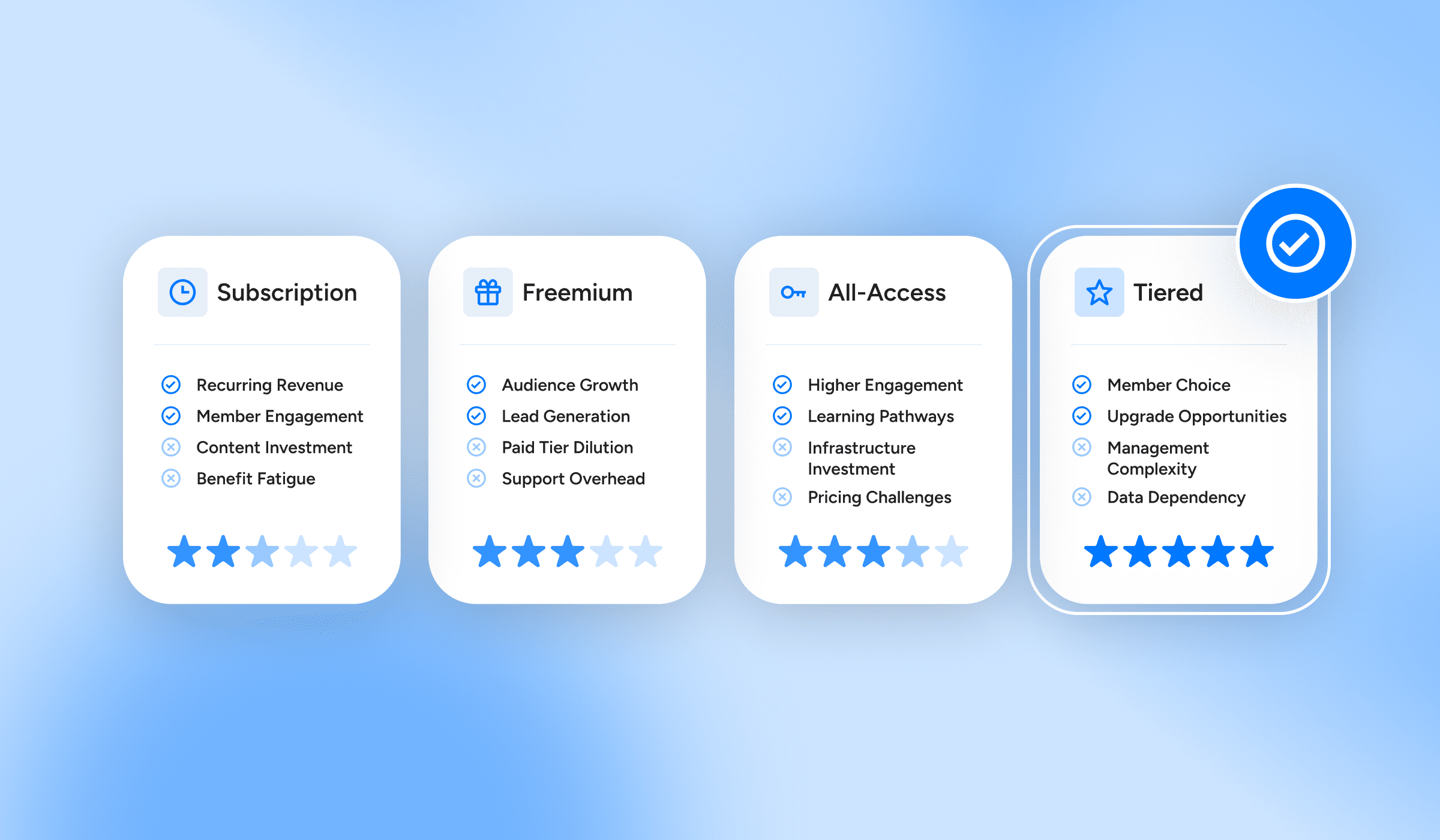
1. Subscription Membership Model
Members pay a recurring fee, monthly or annual, for ongoing access to content, community, or continuing education. It’s the subscription membership model that consumer brands like Spotify and Adobe built their businesses on, and it translates well to membership organizations with strong content libraries.
Pros: predictable recurring revenue, consistent engagement touchpoints, and room for tiered pricing and upsells.
Cons: requires ongoing content investment to justify the fee, and members can feel fatigued if benefits remain static.
Best fit: associations with active digital content or continuing education programs.
2. Freemium Membership Model
A free tier gives members limited access; a paid tier unlocks everything else. This freemium membership approach is a low-barrier way to prove value before asking for dues.
Pros: widens your audience, supports lead generation, and appeals to budget-conscious or early-career members.
Cons: risks undervaluing the paid tier, and a large free-tier population adds support overhead without matching revenue.
Best fit: associations focused on growing membership and reaching early-career professionals.
3. All-Access Membership Model
One flat rate unlocks every resource: courses, certifications, events, and research, with no add-on fees. This all-access membership model removes friction between members and your offerings.
Pros: increases engagement across your full offering and supports members as they move through certification or learning pathways.
Cons: demands real investment in content and infrastructure, and pricing must account for members who use everything at once.
Best fit: associations with a deep content or professional development ecosystem.
4. Tiered Membership Model
Members choose from multiple tiers, basic access, premium content, and leadership opportunities, based on what they value most. The tiered membership model is often the default for larger, more diverse member bases.
Pros: gives members choice, aligns benefits with willingness to pay, and creates a natural upgrade path.
Cons: more complex to manage and communicate, and requires solid member data to personalize offers effectively.
Best fit: larger associations with diverse member segments and a wide range of budgets.
How to Choose the Right Membership Model for Your Association or Nonprofit
There’s no universally “best” membership model, only the one that matches your organization’s size, content depth, member mix, and growth goals. Use these five questions to narrow your options:
- How diverse is your member base? If your members span career stages, industries, or budgets, a tiered model lets each segment self-select the right fit. If your members are more alike, a single subscription or all-access model keeps things simple.
- How much content and programming can you sustain? Subscription and all-access models only work if you can keep producing value for members. If your content pipeline is thin, a freemium or tiered structure lets you scale benefits as your capacity grows.
- Are you optimizing for growth or revenue per member? Freemium models are built to widen your funnel. Tiered and all-access models are built to deepen revenue from members already committed.
- How much complexity can your team manage? Tiered models require more communication, more segmentation, and more data to run well. If your staff is small, a simpler subscription or all-access structure may be easier to execute without added overhead.
- What does your member data actually show? Look at renewal rates, benefit utilization, and where members drop off before committing to a new model. The right membership pricing strategy should be based on evidence from your own membership, not just what’s trending in the sector.
Most organizations don’t pick one model in isolation. They combine elements, like a tiered structure with an all-access top tier, once the fundamentals above point them in a direction.
The Benefits of Adapting Your Membership Model
Adapting your membership model is about aligning your dues structure and membership benefits with how your specific members want to engage today.
Associations and nonprofits that make this shift see it show up in four places:
- Retention: members who feel the model reflects their needs, renew without a second thought.
- Revenue: better segmentation and a clearer membership pricing strategy uncover revenue you weren’t capturing before.
- Efficiency: modern models paired with the right technology reduce manual work for your staff.
- Relationships: a membership model built around real value creates trust that outlasts any single renewal cycle.
How Association Management Software Supports Your Membership Model
Whatever model you choose, your association management software must keep up with it. Manually tracking tiers, renewal dates, and benefit eligibility in spreadsheets doesn’t scale beyond a handful of members, or across five pricing tiers or through a freemium funnel.
The right AMS handles the mechanics your membership model depends on. This includes the following, like automated renewals and billing tied to each tier, self-service portals where members see exactly what they’re entitled to, and reporting that shows which segments are engaging, upgrading, or at risk of lapsing. That last piece matters most. The data your AMS captures should inform the next round of decisions about your model, not guesswork.
Momentive’s association management software adapts to associations of every size and membership structure, from small-staff organizations running a single subscription tier to large associations managing complex, multi-tier programs. Explore how it supports membership management, dues, and reporting on the association management software page, or see it applied to your organization directly with a demo.
If retention is where your current model is falling short, our guide to member retention strategies breaks down tactics that pair with any of the models above.
FAQ
What is a membership model?
A membership model is the structure an organization uses to define member pricing, access levels, and benefits, whether that’s a flat annual fee, a tiered structure, or a freemium approach with free and paid tiers.
What are the most common types of association membership models?
The four most common association membership models are subscription, freemium, all-access, and tiered. Each ties pricing and access to a different mix of member value and organizational capacity.
What is the difference between a tiered and a freemium membership model?
A freemium model offers one free tier and one paid tier, mainly to lower the barrier to entry. A tiered membership model offers multiple paid levels, each with a different set of benefits, so members can choose based on what they value and can afford.
How do you choose the right membership model for your association?
Start with your member data: renewal rates, benefit utilization, and where members drop off. Match that against your organization’s size, content capacity, and growth goals. A tiered model suits diverse member bases, while a simpler subscription or all-access model suits smaller, more uniform ones.
How often should an association review or update its membership model?
Most associations should revisit their membership model every two to three years, or sooner if renewal rates decline, member demographics shift, or member feedback indicates that the current benefits no longer meet expectations.
How can association management software support different membership models?
Association management software automates renewals, billing, and benefit eligibility for each tier, gives members self-service access to what they’ve paid for, and reports on engagement and retention. Associations need to keep refining their model over time.