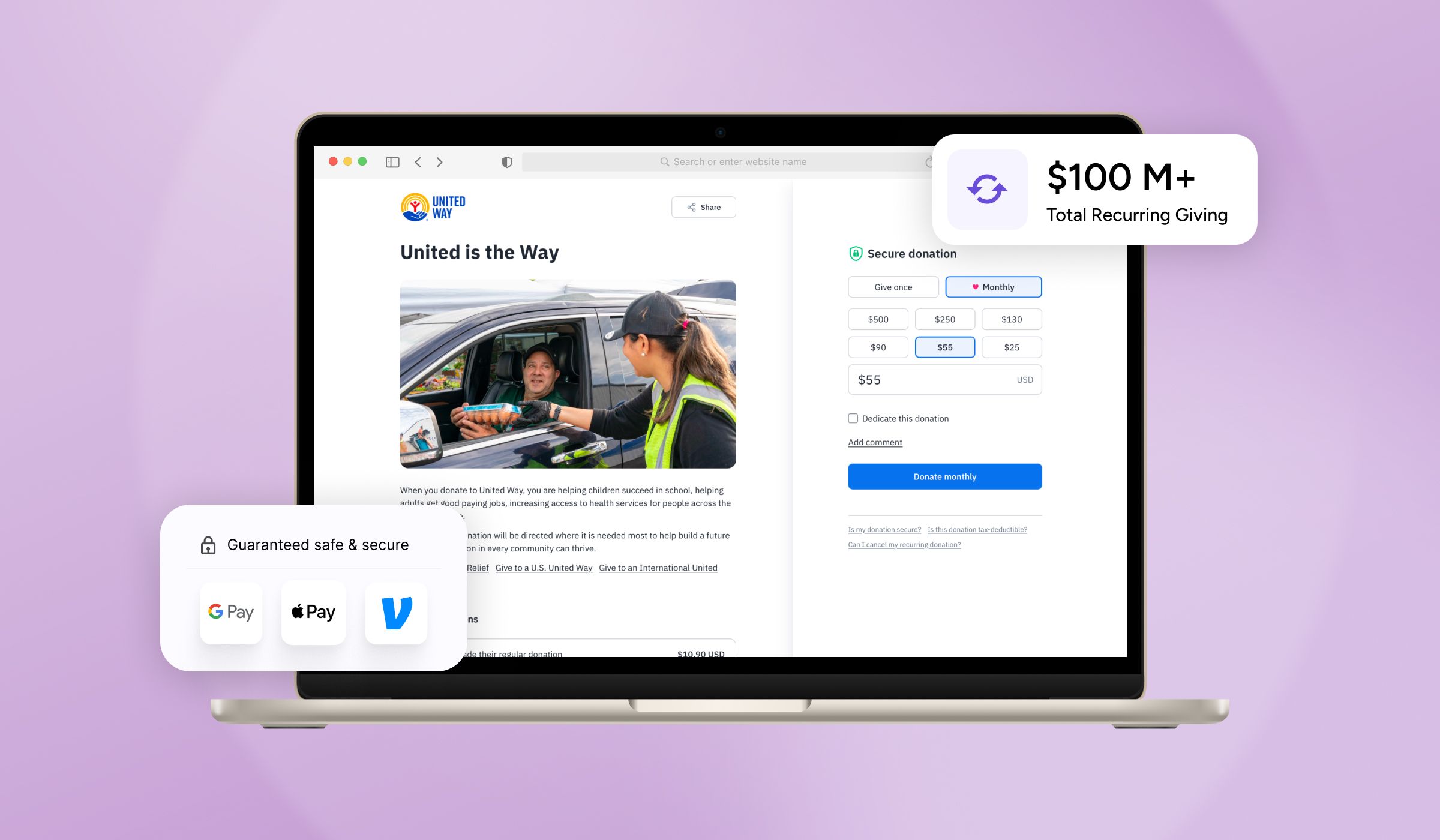

A donation page is one of the most important assets for a nonprofit. It’s where motivated supporters become donors and where a confusing form, weak trust signals, or generic copy quietly reduces gift giving.
You don’t need to invent donation page best practices. Many organizations already run pages that convert visitors into donors. The value comes from studying what they do intentionally. By learning from their approaches, you can create or refine your own donation pages.e.
In this post, we explore:
- How a donation page can make or break your fundraising efforts
- How to build a nonprofit donation page and why most underperform
- Nonprofit donation page examples from successful organizations
- Three tactics to promote your donation page
- How to run a quick donation page audit and set yourself up for success
Whether you’re building a new donation page, optimizing an existing one, or simply looking for inspiration, you’ll find practical guidance to improve completion rates, increase average gift size, and strengthen donor confidence.
How Donation Pages Can Make Or Break Your Fundraising
A donation page doesn’t simply process donations. It determines average gift size, recurring participation, and donor confidence.
Because every campaign ultimately drives traffic to the donation page, its structure and ability to turn visitors into donors directly impact fundraising performance.
From a business perspective, by the time someone lands on a donation page, acquisition costs have already been incurred. For example, staff have spent time writing emails, ads have been distributed and paid for, and campaign landing pages have been designed and launched.
If the donation page introduces friction, that investment fails to generate donations and revenue.
Friction appears in predictable ways: too many required fields, unclear messaging, redirects to unfamiliar domains, or mobile forms that are difficult to complete. When these issues exist, donors abandon the process, and the opportunity for a gift is lost. To see how effective donation pages overcome these challenges, let’s look at some standout examples.
Donation Page Examples:
These three donation landing page examples demonstrate how structure, copy, and trust signals work together to improve performance. Each example highlights a different strength — from recurring positioning to impact labeling to institutional transparency.
Rogers Behavioral Health Foundation
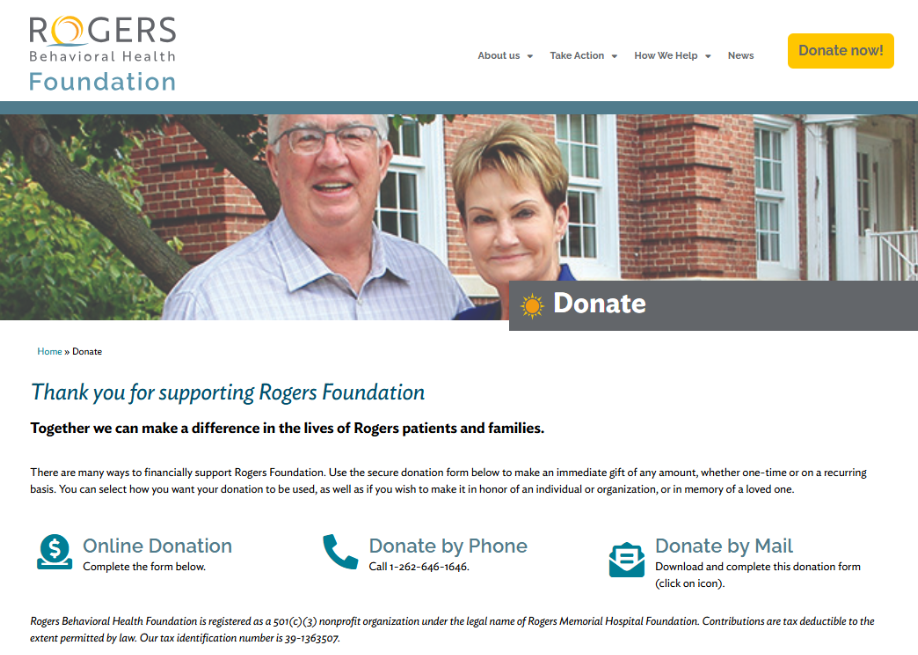
Rogers Behavioral Health Foundation clearly structures giving options and offers online, phone, and mail donations to accommodate different donor preferences. The online form supports both one-time and recurring gifts, with recurring front and center.
The opening line — “Thank you for supporting Rogers Foundation” — expresses gratitude before the transaction. This framing acknowledges donor intent at the outset and establishes a collaborative tone: “Together we can make a difference in the lives of Rogers patients and families.” The language is measured and institutional, avoiding urgency-driven appeals.
The page follows donation form best practices, and although it’s longer than many nonprofit donation pages, each field serves a purpose. Gift designation allows donors to select the area they wish to support, and the optional comment field strengthens personalization by giving supporters space to contextualize their gift.
The “LimeLight” recognition program allows donors to make gifts in honor of specific caregivers. This shifts the act of giving from general institutional support to personal acknowledgment.
Trust signals such as 501(c)(3) registration details, tax ID information, and deductibility language appear clearly in the footer, and the page maintains full visual continuity with the broader Rogers brand.
Meals On Wheels New Mexico
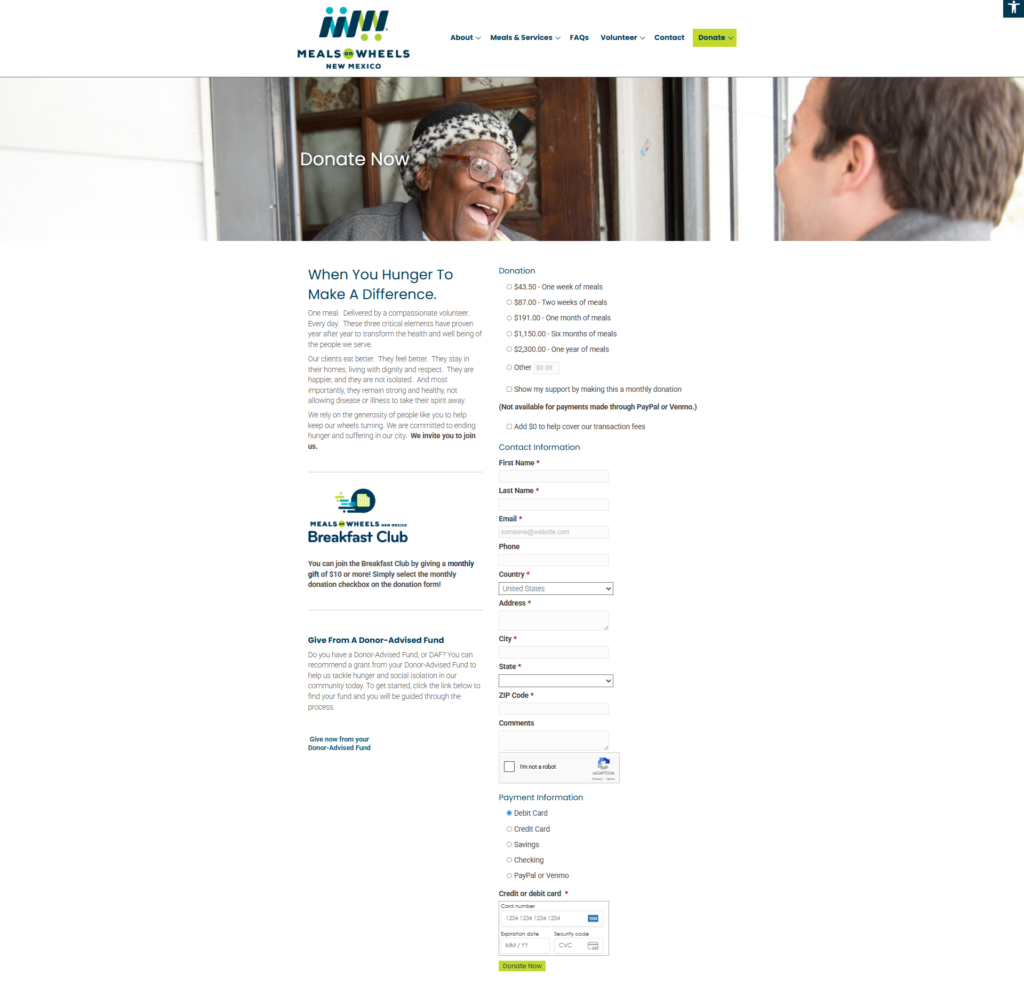
Meals on Wheels New Mexico is one of the best donation page examples.
The headline, “When you hunger to make a difference,” uses wordplay intentionally without becoming sentimental, and positions the donor as the actor before the organization is mentioned.
The line “One meal. Delivered by a compassionate volunteer. Every day.” uses short, declarative sentences to create rhythm and emphasis. Rather than describing programs abstractly, the copy breaks the service into three tangible components: meal, volunteer, and frequency.
The benefits are framed in human terms: clients eat better, feel better, remain in their homes, and avoid isolation. The language is direct and accessible, without relying on statistics or operational jargon.
Suggested donation amounts are tied to measurable outcomes, showing how each gift increases the number of meals delivered. This reinforces clarity and purpose.
The form is straightforward and includes five payment options, accommodating a range of donor preferences.
The footer reinforces credibility through third-party validation, including a four-star Charity Navigator rating and Candid’s Platinum Transparency seal. While these badges are placed in the footer rather than near the payment fields, they still signal legitimacy.
Special Olympics New York
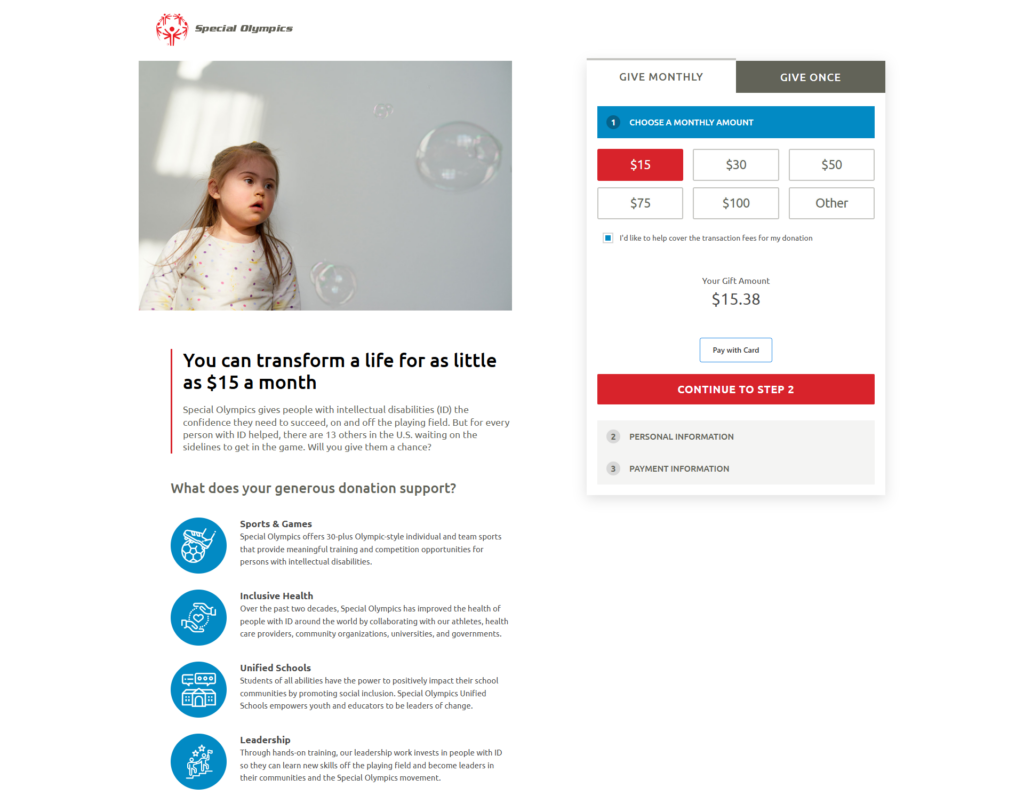
Special Olympics New York opens with a strong recurring frame: “You can transform a life for as little as $15 a month.” The copy that follows introduces urgency without escalation: for every person with intellectual disabilities helped, 13 others are still waiting. The statistic creates a clear participation gap while maintaining a restrained tone.
The page reinforces this framing structurally. The form is clean and organized into a simple three-step process. Navigation is limited, and there are no competing calls to action.
The copy remains outcome-focused, reinforcing what a donor’s gift makes possible for athletes without overwhelming the reader with institutional detail.
The page links to financial disclosures, donor FAQs, and donation policies. Tax-exemption language specifies EIN information and compliance standards, reinforcing transparency.
As a regional chapter operating under a globally recognized name, the page balances global brand equity with local identity. Athlete imagery and New York–specific framing make the gift feel locally relevant while maintaining credibility.
The only limitation is the relatively narrow range of payment options compared to some other pages.
How to Create a Donation Page for Your Nonprofit
It helps to understand what you need to build a donation page that functions reliably within your broader fundraising system.
A donation page isn’t an isolated asset. It sits between your outreach efforts and your donor records. The decisions made during setup affect completion rates, data accuracy, and long-term stewardship.
Choose The Right Fundraising Platform
When building a donation website, most nonprofits use a dedicated fundraising platform. This approach reduces development overhead, shortens implementation time, and ensures consistent handling of payment processing, compliance, and security standards.
The platform you choose determines more than how the page looks. It impacts how donor data flows, payment processing, and how easily your team can maintain the system over time.
Look for a platform that provides reliable infrastructure: mobile-responsive templates to support completion rates, direct CRM integration to keep donor records accurate without manual updates, and multiple payment options to reduce checkout abandonment.
If your organization runs events, the platform decision becomes more significant. A platform like GiveSmart by Momentive Software allows organizations to combine direct giving, auctions, raffles, peer-to-peer fundraising, and ticketing within a single environment.
When fundraising activity and donor data remain connected, post-event reconciliation is reduced, and follow-up becomes more consistent.
Maintain Brand Continuity
A donation page should be consistent with the rest of your organization’s digital presence, as brand alignment reduces hesitation.
If the donation form appears on an unfamiliar domain or uses inconsistent design elements, donors pause. Even minor visual inconsistencies introduce doubt at the point of payment.
Use your organization’s colors, typography, imagery, and tone to reinforce legitimacy and continuity. The goal is not aesthetic polish for its own sake — it’s risk reduction. When the page looks and feels consistent with prior touchpoints, donors are more likely to complete the transaction.
Structure Giving Options Intentionally
The structure of your giving options influences both completion rates and gift size.
At a minimum, include suggested gift amounts. These amounts anchor the donor’s decision and establish what constitutes a meaningful contribution. When possible, tie each amount to a specific outcome to reduce ambiguity.
A visible toggle between one-time and recurring is also essential. If recurring giving is secondary or hidden, participation remains low. When presented clearly within the primary flow, adoption increases.
Finally, offer multiple payment methods. M+R Benchmarks reports that 76% of nonprofits now offer PayPal on their donation pages, while 47% offer Apple Pay and 40% offer Google Pay. When a donor’s preferred payment method is unavailable, abandonment is likely to increase.
Reduce Friction in Design and Copy
Donation page design affects both mobile and desktop completion rates. For example, according to M+R, 53% of nonprofit website traffic now comes from mobile devices. However, desktop users account for 70% of online revenue, with an average gift of $145 compared to $76 on mobile.
Both experiences must be designed intentionally: mobile for accessibility and completion, desktop for clarity and gift optimization. Make sure that:
- The page loads in under three seconds
- The layout is responsive across devices
- The form is visible without excessive scrolling
- Navigation is minimal to prevent distraction
Copy needs to be crisp and clear. For example, the opening language should emphasize the donor’s role in the outcome rather than organizational accomplishments. Near the form, include a concise statement explaining why your organization’s approach is distinct.
Calls to action should describe the outcome of giving rather than rely on generic instructions. For example, “Donate Now” is less inspiring than “Feed a Child For A Week”.
Reinforce Trust at the Point of Payment
Trust is resolved at checkout. Include visible security indicators, recognizable payment logos, and relevant third-party credibility signals. For example, SSL security badges, PCI compliance notices, BBB accreditation, or clearly displayed audit statements.
Additionally, financial transparency statements, when precise, reinforce accountability.
Placement matters. Trust indicators should appear adjacent to the payment fields, so the donor can decide whether to proceed with the transaction.
Connect The Donation Page To Your CRM
A donation page doesn’t end at payment confirmation. It initiates stewardship.
Every gift should automatically update the donor record, capturing the donor’s name, contact information, amount, date, and source. Without direct integration, teams rely on exports, manual uploads, or spreadsheet reconciliation. Over time, this creates inconsistencies and delays follow-up.
Accurate, real-time data flow enables timely acknowledgements, segmentation, and reporting. It also ensures that event participation, recurring gifts, and campaign responses are reflected in a single donor history.
Manual data entry introduces risk. Automation protects data integrity and staff capacity.
Test Everything Before Launching Your Donation Page
Before publishing a donation page, complete a full test transaction on both desktop and mobile devices. Testing identifies breakdowns before traffic scales. It also prevents avoidable donor confusion, such as missing receipts or duplicate charges.
Confirm that:
- The form loads quickly
- Required fields function correctly
- The confirmation page displays as expected
- The receipt email is sent immediately
- The donor record updates accurately in your CRM
This process takes minimal time. Correcting issues after launch consumes significantly more.
Why Donation Pages Underperform
Most underperforming donation pages do not fail because of design. They fail due to structural copy and placement decisions that create hesitation.
Vague Impact Labels
When donors don’t clearly understand the impact of their donation, they default to smaller amounts or hesitate altogether. Specificity reduces ambiguity and increases confidence.
For example, the statement “$50 supports our work” lacks context. It forces the donor to interpret the value independently.
Effective impact labels follow a simple structure: dollar amount, concrete action, specific beneficiary. For example, “$50 provides school supplies for one child for a full year.” The number is clear, the action is defined, and the beneficiary is identifiable.
Copy That Centers The Organization
Donation page copy often emphasizes organizational history or accomplishments. While credibility matters, the donor is the actor in the transaction.
Donation copy should reflect the donor’s role in creating change, not simply the organization’s record.
If the opening language is dominated by “we” and “our,” the message shifts away from the donor agency. For example, “We have served 2,000 families since 2010” vs. “Your gift this year will reach families who have nowhere else to turn.”
Both communicate impact, but only one positions the donor as the driver of that impact.
Commands Instead Of Commitments
Generic calls to action, such as “Donate Now,” encourage donors to complete a task, whereas framing copy as “Feed a child today” signals participation in an outcome. The difference is subtle but measurable. Commitment-based language reinforces identity and increases follow-through.
Misplaced Trust Signals
Security badges and third-party ratings reduce perceived risk, but only when placed near the point of payment. A badge in the footer does little to reassure a donor as they enter credit card information. Trust indicators must be positioned adjacent to the form to function effectively.
Tactics to Promote Your Donation Page
A well-built donation page only works if donors can find it. Here are the most effective ways to drive traffic to your page.
Email Campaigns
Email remains the highest-converting digital channel for most nonprofits because it reaches supporters who already have a relationship with the organization.
Fundraising emails should link directly to the donation page, not to the homepage. Each additional click introduces friction and reduces completion rates.
Segmentation also matters. Supporters who have given before should receive different messaging than first-time prospects. Referencing past giving behavior or aligning the ask with known interests increases relevance and improves response rates.
Social Media
Social media traffic behaves differently from email traffic. Supporters are often passively scrolling rather than actively seeking to give.
Posts that highlight a specific story, time-bound goal, or defined impact tend to get better results than general appeals because context reduces hesitation. Additionally, social promotion is most effective when it combines narrative clarity with a direct link to the donation page.
If you’re running a peer-to-peer fundraising campaign, distribution expands beyond your organization’s account. Individual fundraisers share the page with their networks, often reaching audiences the organization would not otherwise have access to. Personal endorsements frequently outperform institutional posts because the relationship is closer.
Paid Search Advertising
Paid search advertising means paying to have your donation page appear near the top of Google results when someone searches for your organization or related keywords.
For eligible nonprofits, the Google Ad Grant program provides a $10,000 monthly advertising credit to support this purpose.
The practical advantage is visibility. If someone searches for your organization and sees a direct link to your donation page, they can click and give immediately. If they land on your homepage instead, they must navigate to find the form. Each additional step increases the likelihood that they will leave before completing a gift.
Running paid search ads to a dedicated donation page keeps the process direct: search, click, give.
How To Run a 5-Minute Donation Page Audit
You don’t need a full redesign to improve results. Start with a fast diagnostic. Open your donation page in a new tab and ask:
- Can a first-time visitor understand your impact in 10 seconds?
- Is the donation form visible without scrolling?
- Are trust badges and security signals positioned near the payment fields?
- Are there fewer than 8 required fields?
- Can someone complete the form in under 60 seconds?
- Is the recurring giving option clearly visible—unhidden?
- Does the page load in under 3 seconds?
If you answered “no” to even one of these, you’ve found your next optimization opportunity.
High-performing donation pages rarely succeed because of one dramatic change. They convert because friction is removed at every step.
Start Building Donation Pages That Convert
A donation page isn’t just a form — it can make or break your fundraising efforts.
Small structural decisions, such as how impact is labeled, how recurring giving is positioned, and where trust signals appear, compound over time. The difference between a donation page that converts at 8% and one that converts at 18% is rarely aesthetic. It’s an intentional design.
But performance doesn’t live on the page alone. When donation forms, event campaigns, auctions, peer-to-peer fundraising, and donor records operate in separate systems, teams spend more time reconciling data than optimizing results.